"Roll or sheet?" sounds like a packaging preference. It is actually a decision about two different production processes, two different price points, and two different jobs. Getting it right is mostly about understanding what each format is genuinely built for, rather than defaulting to whichever one you ordered last time.
Here is how we run each, what that means for cost and turnaround, and how to pick the right one for your product.
Two products, two processes
The key thing most label guides skip: roll labels and sheet labels are not the same product printed two ways. At our end, they come off different equipment and different processes entirely.
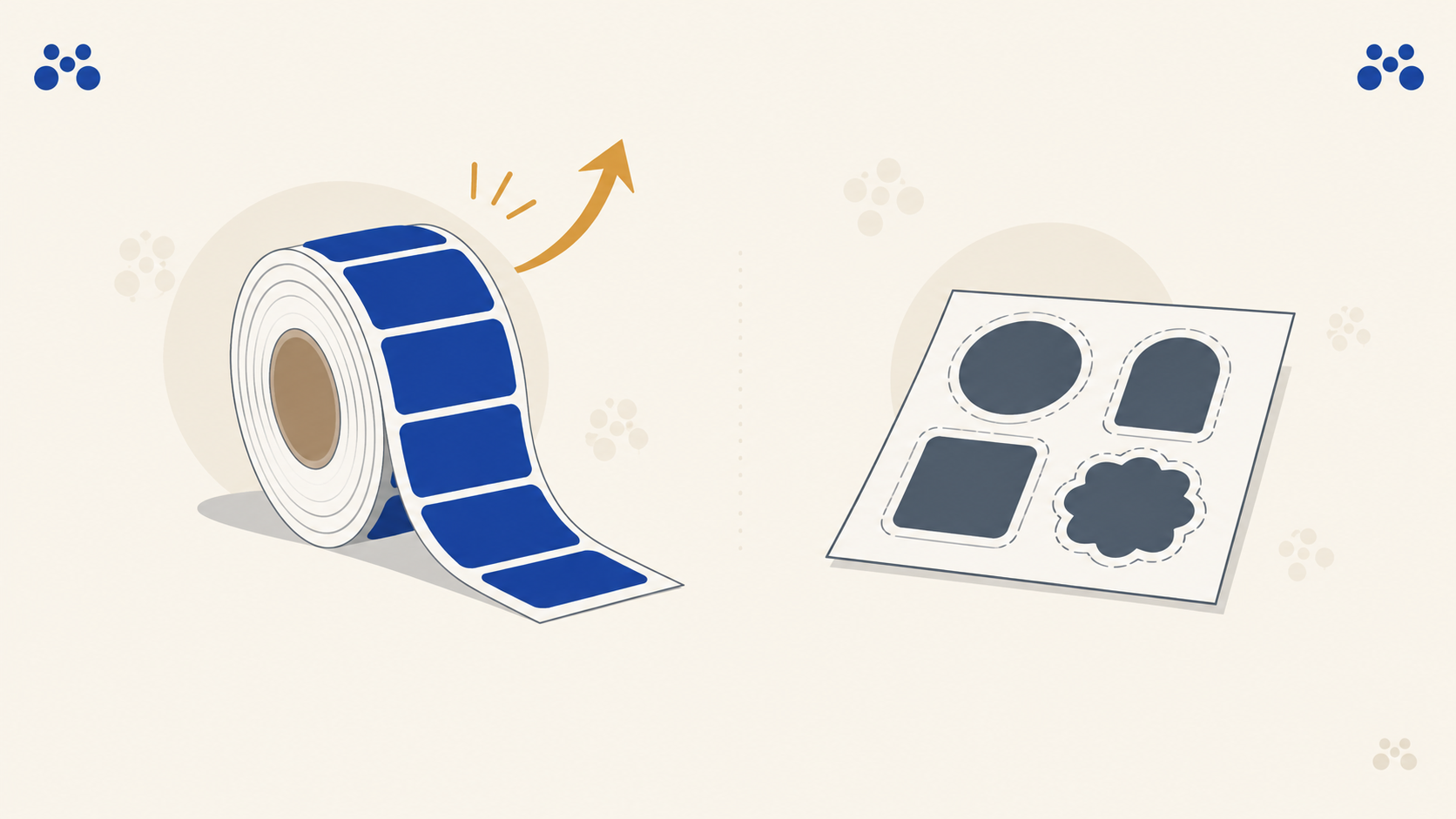
- Roll labels are printed on a dedicated digital label press. It is a fast, efficient, purpose-built process for producing product labels at volume, and it is substantially cheaper per label as a result.
- Sheet labels, in our case, are a kiss-cut sticker sheet product produced on the large-format PVC process. That is a slower and more expensive way to make labels, and it is built around a different use case.
This is why the price gap between the two is real and consistent, not a markup. It reflects genuinely different production methods.
Roll labels: the right choice for products
For the large majority of product labelling, roll labels are the better option. They are:
- Substantially lower cost per label, because the digital label press is a fast, efficient process.
- Purpose-built for products: bottles, jars, tubs, packaging, anything that needs a clean, durable product label.
- Quick to turn around, starting from two business days.
- Available across our full stock range: white, clear and silver BOPP, plus matt paper, on acrylic permanent adhesive.
If you are labelling a product, rolls are almost always the answer. The cost, the speed, and the stock options all line up for that job. Our roll label material guide covers how to choose the right stock within that range.
The sheet product: what it is and when it fits
Our sheet offering is a kiss-cut sticker sheet, and it comes with one important constraint: it allows a maximum of five kiss cuts per sheet. That shapes what it is good for.
A kiss cut means the sticker is cut through the face material but not the backing, so individual stickers peel off a shared sheet. That is handy for:
- Sticker packs and promotional sheets
- Products where a small number of stickers are supplied together on one backing
- Applications where the sheet format itself is part of the deliverable
Because it runs on the large-format PVC process, it is slower and more expensive than roll production, so it earns its place when the sheet format is genuinely what is needed, not as a default way to buy product labels.
Application: how the label gets onto the product
How you apply the label matters as much as how it is printed.
For smaller runs, most application is by hand, and rolls suit that perfectly well. You peel and apply, one at a time, at whatever pace the job needs. There is a common assumption that rolls only make sense with an automatic applicator, but plenty of our roll label orders are hand-applied on smaller runs without any issue.
If you are running higher volumes through a label applicator or dispenser, rolls are the format those machines are built to take, with the labels feeding off the roll in sequence. Sheets do not suit machine application in the same way.
So for both hand application on smaller runs and machine application at volume, rolls are the practical format. The sheet product is not really an application-efficiency choice; it is a format choice for when a sheet is what you actually want to supply.
The "cut a large label into a sheet" question
Some customers order a large label, up to 312mm, and cut it down into their own sheets afterwards. It is a workaround people use, and it is worth being honest that it exists.
That said, for straightforward product labelling it is usually not the most efficient path. If the end goal is product labels, ordering roll labels directly is cheaper, faster, and cleaner than buying large labels to cut down. The workaround makes more sense in specific cases where a customer has a particular reason to handle the cutting themselves. For most jobs, we would point you at rolls.
Quick decision guide
- Labelling a product (bottle, jar, tub, packaging) → roll labels. Cheaper, faster, purpose-built.
- Hand-applying a smaller run → rolls are fine; no applicator needed.
- Running an applicator or dispenser at volume → rolls, which feed the machine.
- Supplying a small pack of stickers on one backing (up to five per sheet) → the kiss-cut sheet product.
- Anything where per-label cost matters → rolls, every time.
Frequently Asked Questions
Are roll labels cheaper than sheet labels? Yes, substantially. Roll labels are printed on a dedicated digital label press, which is a fast and efficient process. Our sheet product is a kiss-cut sticker sheet run on the large-format PVC process, which is slower and more expensive. The price difference reflects genuinely different production methods.
Do I need a machine to apply roll labels? No. Plenty of roll label orders are hand-applied, especially on smaller runs. You simply peel and apply one at a time. Rolls also suit automatic applicators and dispensers at higher volumes, so the format works for both hand and machine application.
When should I choose the sheet product over rolls? When the sheet format itself is what you need, such as a small pack of stickers supplied together on one backing. Our sheet product allows up to five kiss cuts per sheet. For labelling actual products, rolls are cheaper, faster and the better fit.
Can I order a large label and cut it into a sheet myself? Some customers do order a large label, up to 312mm, and cut it down. It is a workaround that exists, but for standard product labelling it is usually not the most efficient route. Ordering roll labels directly is generally cheaper and cleaner if product labels are the goal.
What is a kiss cut? A kiss cut cuts through the face material of the sticker but not the backing, so individual stickers can be peeled off a shared sheet. It is what makes a sticker sheet work as a sheet, with several stickers held together on one backing until they are peeled.
Key takeaways
- Roll and sheet are two different products from two different processes, not the same label printed two ways.
- Roll labels are substantially cheaper, faster, and purpose-built for products.
- Our sheet product is a kiss-cut sticker sheet on the PVC large-format process, capped at five kiss cuts per sheet.
- Rolls suit both hand application on smaller runs and machine application at volume.
- For product labelling, rolls are almost always the right answer.
- Cutting a large label down into a sheet is a workaround, not usually the most efficient path for product labels.
Order the right format
For product labels, rolls give you the best combination of cost, speed, and stock options. Mediapoint runs trade-only, blind-shipped roll labels across white, clear and silver BOPP and matt paper, laser cut with a clean edge and turned around from two business days. Have a look at roll labels or send your artwork through for a quote, and we will help you land on the right format and stock before it prints.