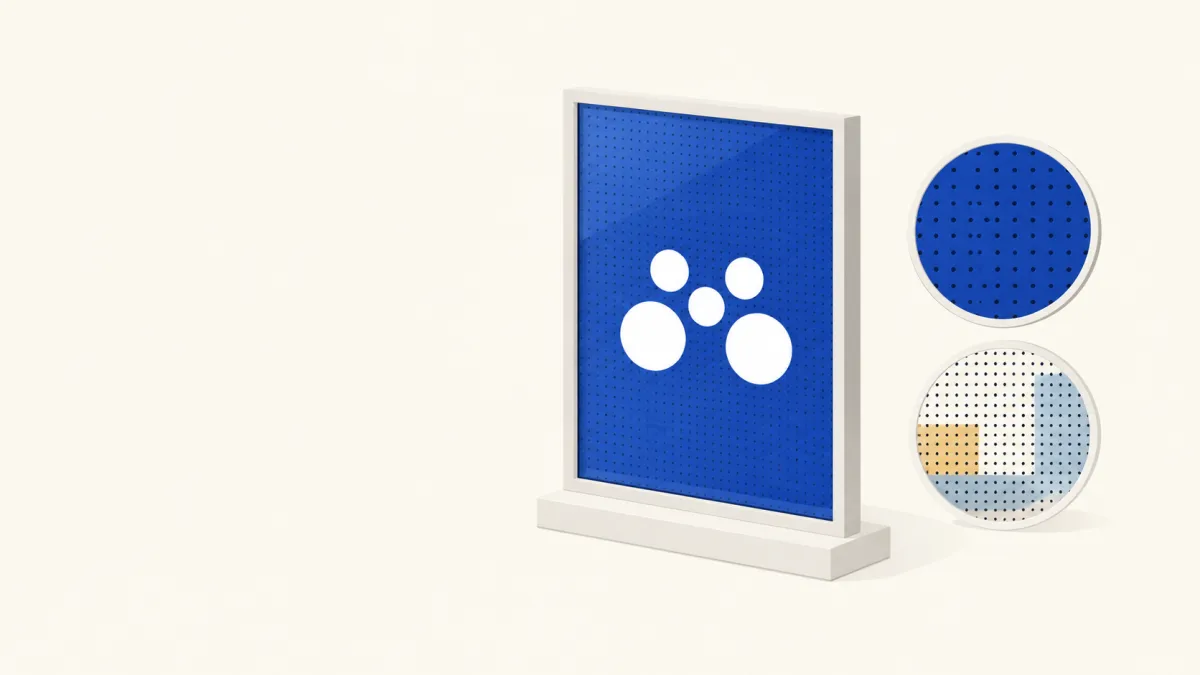
Quick answer: One way vision is a perforated window film with a white printable face and a black back. From outside you see the printed graphic; from inside you look straight through the holes. It works best when it's brighter outside than inside, so it's a daytime effect, not night-time privacy. Mediapoint prints it on 140-micron perforated film with 60% print area and 40% open area, up to 1300mm wide.
Mediapoint is a trade-only printer in Derrimut, Melbourne. We print one way vision window film for print resellers, sign shops, designers and agencies, and blind-ship every job under your brand.
How one way vision works
One way vision (also called one way window film, perforated window film or window perf) is a self-adhesive vinyl punched with small holes across its whole surface. Our film has 1.6mm perforations that take up 40% of the area, leaving 60% to carry the print.
The trick is in how the eye handles light and contrast:
- From outside, the bright printed face is what the eye locks on to, so passers-by read the graphic, not the holes.
- From inside, the back of the film is black. Black sits back visually, so the eye focuses through the holes to the street.
That only holds while the printed side is the brighter side. On a sunny day a shopfront reads as a solid graphic from the footpath. At night, with the lights on inside, the balance flips and people outside can see in. If your client needs privacy after dark, they still need blinds.
Where one way vision works best
- Shopfront windows: turn glass into a campaign without blocking staff's view of the street.
- Glass doors and office windows: branding plus some screening from passers-by during the day.
- Short-term promotions: sales, launches and seasonal campaigns where the graphic comes down after the event.
- Display and retail graphics: anywhere a window would otherwise be dead space.
- Commercial vehicle windows: rear and side windows on larger commercial or goods-carrying vehicles, where the rules allow. Vehicle windows are subject to visible light transmission limits and local road rules, so confirm the window and state are legal with your client and installer before you quote.
It's not the right product for a permanent privacy screen, for night-time privacy, or for anything that isn't smooth glass. For solid graphics on walls, floors or opaque surfaces, quote large format stickers instead.
The film we print on
| Spec | Detail |
|---|---|
| Material | EasyVision ET6-9085, 140-micron monomeric calendered PVC, white on black |
| Perforations | 1.6mm holes; 60% printable area, 40% open area |
| Adhesive | Clear removable acrylic |
| Application | Outside of the glass, printed side facing out |
| Outdoor life | Rated up to 1 year outdoors (unprinted film) |
| UV inks, thru-cut to size on our Zünd cutting tables | |
| Size | Any size up to 1300mm wide and 10m long; larger windows supplied in panels |
| Laminate | None |
Why one way vision isn't laminated
A standard laminate covers the perforations. That cuts the see-through effect, can trap air and moisture, and can bubble. We supply one way vision unlaminated. After rain or cleaning, a little water may sit in the holes for a while; it clears as the glass dries.
Designing artwork for one way vision
With 40% of the surface punched out, artwork behaves differently from a solid sticker. A few rules help your client's design read well from the street:
- Go bold. Strong colours, big images and high contrast read best. Pale, low-contrast designs look washed out over the holes.
- Keep text large. Fine text and thin lines break up across 1.6mm holes. Headlines and logos work; paragraphs and small print don't.
- Think about the view in. The graphic is seen from outside only. From inside, staff see the black back and the street.
- Allow for panel joins on big windows. Keep faces and key text away from where panels meet.
- Size to the glass, not the frame. The film should finish at least 3mm short of the glass edges and clear of rubber window seals.
For general file setup, see our common print file mistakes guide.
Installing and removing one way vision
- Apply it to the outside of clean, smooth, flat glass, printed side out.
- On multi-panel windows, trim adjoining panels to a butt seam. Don't overlap them.
- Keep the film at least 3mm back from the glass edges and away from rubber mouldings.
- Test first on any unusual or coated glass, because adhesion varies by surface.
- The adhesive is removable, but clean removal depends on how long the film stays up, sun exposure and the glass. Plan to take it down within the campaign period.
Glare and heat
The film manufacturer reports 60% glare reduction and 33% solar energy transmission on 3mm glass for the unprinted film. Treat those as reference values only. Real results depend on the glass, how much of the film is printed, which way the window faces and how it's installed, so don't sell one way vision to a client as a heat-control product.
Checklist before you quote one way vision
- Window sizes, measured on the glass, and how many panels each needs
- Glass only, smooth and flat, with outside access for install
- Daytime effect understood; blinds still needed for night privacy
- For vehicles: legal check on the window and local road rules
- Campaign length within the film's rated life, with removal planned
- Bold artwork with large text, and joins kept clear of key content
Turnaround and delivery
Orders up to $1,000 + GST dispatch in 2 business days. Every job is blind-shipped with no Mediapoint branding, so it arrives at your client as your work.
Frequently asked questions
Can people see through one way vision at night?
Yes, often. When the inside is lit and the outside is dark, the effect reverses and people outside can see in. Use blinds where night-time privacy matters.
Which side of the glass does one way vision go on?
The outside, with the printed white face out and the black side facing in.
What's the difference between one way vision and perforated window film?
They're the same product. One way vision, one way window film, perforated window film and window perf all describe printed, perforated vinyl with a black back.
How long does one way vision last?
The film is rated up to 1 year outdoors, so it suits short-term and campaign work.
Can one way vision be laminated?
No. Laminate covers the perforations and reduces the see-through effect, so we supply it unlaminated.
Can I use one way vision on car windows?
Vehicle windows are covered by visible light transmission limits and road rules. It's used on larger commercial and goods-carrying vehicles, but check the rules for the window and state before ordering.
Ready to order? Register for a trade account to see live pricing on one way vision window film for your clients.