PVC banners look simple from the outside: vinyl, ink, maybe some eyelets. Then the questions start. What weight? Hemmed or unfinished? Eyelets, rope or keder? How far apart should the eyelets be? How long will it hold its colour on a fence line in full sun? The answers decide whether a banner hangs flat and lasts, or sags, tears at the corners and fades a season early. This guide covers the stock we run for PVC vinyl banners, every finishing option and when to use it, eyelet placement, outdoor durability and size limits, all from our own production floor.
Mediapoint is a trade-only printer in Derrimut, Melbourne, printing PVC banners for sign shops and print resellers Australia-wide since 2006 — blind-shipped under your brand, so your client only ever sees you.
The stock: premium 500gsm frontlit PVC
- Woven polyester base, high tenacity and low shrinkage, with heavy 1,000 denier yarn in a dense 18 × 18 thread count. That weave gives the banner its tear resistance and its ability to handle wind load.
- PVC coated front and back, with an ultra-smooth surface that holds fine print detail.
- UV stabilised for long and short term use, indoors and out.
It's a heavier, stronger stock than a lot of budget banners are printed on. It hangs flatter, fights the wind better and survives handling, transport and reuse.
Finishing: five options
Finishing is how a banner meets its install. Two banners on the same stock with the same artwork can have completely different lives depending on how they're finished.
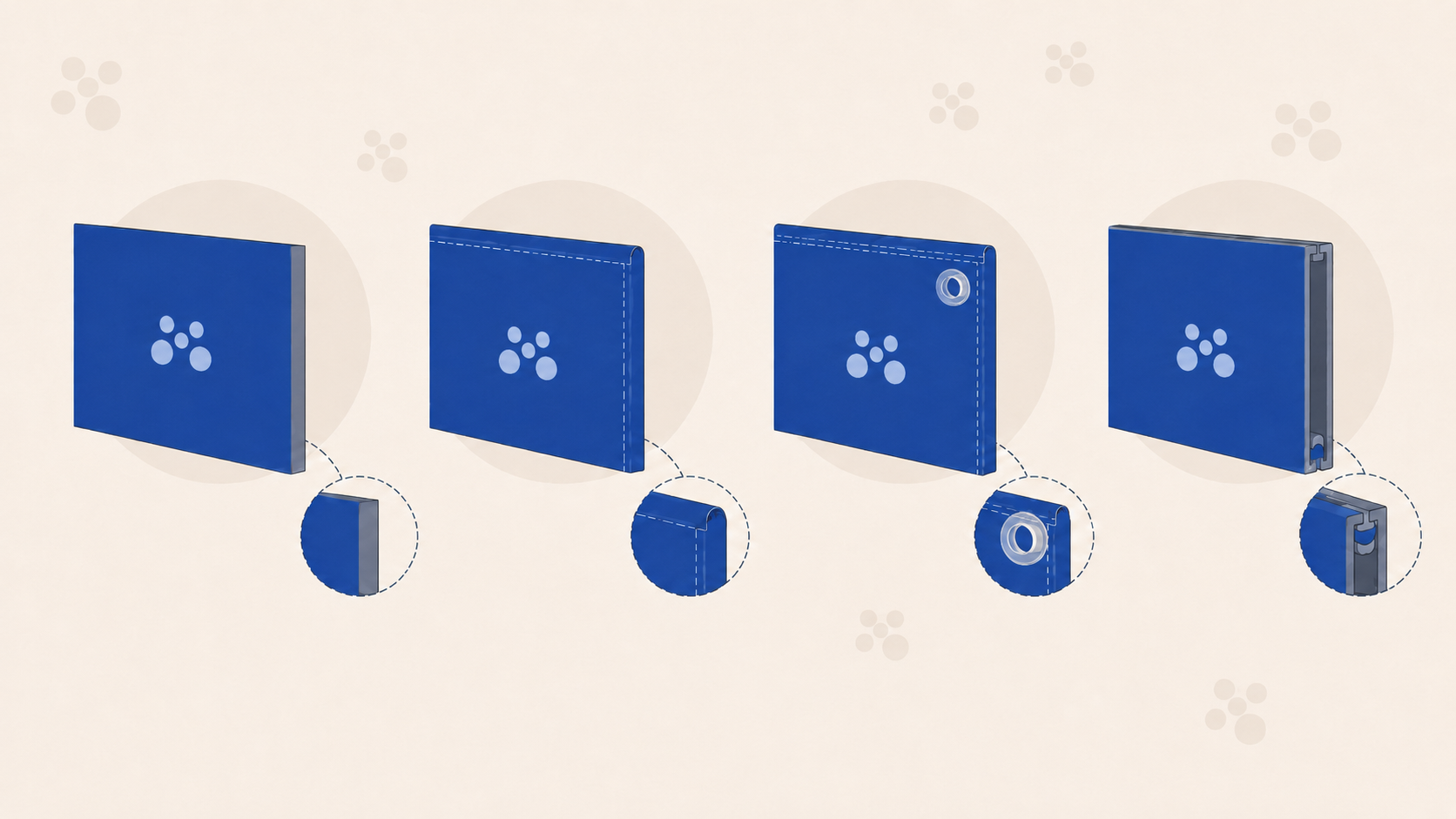
1. Unfinished
Printed and cut to size: no hem, no fixings. It suits sign shops doing their own finishing, frame systems that capture raw edges, and banners wrapped around a structure or trimmed on site. It's the cheapest option and a legitimate trade choice. Avoid it for anything tensioned or wind-exposed: a raw edge under load is where tears start.
2. Hemmed
The edges are folded back and welded, creating a double-thickness border that carries load and handling without peeling open. The hem is the foundation almost every other finish builds on. Choose it for any banner that will be handled, transported, reused or fixed by a method that stresses the edge. Skipping the hem on a reused banner is a false saving, because edge wear is what kills reused banners.
3. Hem and eyelets
The welded hem fitted with eyelets for cable-tying or bungeeing to fences, scaffold and railings. This is the default for fence and hoarding work. We fit clear 12mm polymer eyelets, PVC-free and UV protected. They blend into the artwork instead of showing as metal rings, and they can't rust and streak stains down the face.
4. Hem and rope
A rope sewn into the hem along the edge. It's for larger banners tensioned along a whole edge rather than at points: the rope turns the edge into the load path, so tension spreads along its length instead of gathering at holes. Don't spec rope if the crew will cable-tie the banner to a fence; they need eyelets.
5. Keder
A welded 7.5mm keder edge, in white or black, that slides into any 7.5mm aluminium sail-track frame. The frame does the tensioning, the face sits drum-flat with no visible fixings, and graphics can be swapped. It's the spec for shopfront frames, wall frames, display systems and exhibition work. Order to the frame system's stated graphic size, not its visual opening. The keder banners guide covers ordering for a specific frame.
Quick match
- Sign shop finishing it, or a frame that captures raw edges: unfinished
- Handled, reused or edge-stressed: hemmed, at minimum
- Tied point-by-point to fences, scaffold or railings: hem and eyelets
- Tensioned along the edge on a larger structure: hem and rope
- Sliding into a sail track or frame: keder
The one question that answers most of it is how the banner is physically being fixed on site. Tell us that at quoting.
Eyelet placement
Eyelet placement affects tension, wind performance, sag and how long the banner lasts. You choose it when you order, and it flows through pricing and production, so the banner is made exactly as specified. Options:
| Placement | Best for |
|---|---|
| All 4 sides, 300mm spacing | Large banners, outdoor installs, windy sites, long-term hoarding |
| All 4 sides, 500mm spacing | Most standard fence and railing jobs |
| All 4 sides, 1000mm spacing | Smaller banners and low-stress installs |
| 4 corners | Lightweight, short-term or indoor banners needing minimal fixing |
| Top corners | Hanging banners where the bottom edge hangs free |
Closer spacing means more fixing points and less flapping and edge stress. On site, fix through every eyelet and tension evenly. Cranking two corners tight and leaving the rest loose puts the wind load on those corners, and that's how eyelets tear out in the first storm.
How long a PVC banner lasts outdoors
Our UV-printed banner ink is rated for 2+ years outdoors, and the heavy stock typically outlasts the print. Full northern sun, horizontal or high-wind placement and heavy dark ink coverage shorten that. Shade, vertical mounting and good tension extend it. A banner left to flap wears itself out: every gust is mechanical fatigue.
PVC or mesh?
Solid PVC gives full opacity and the strongest colour. Mesh gives up some punch to let wind through. Exposed, windy fence lines generally favour mesh; high-impact positions with manageable wind favour PVC. See mesh banner vs PVC banner, and hoarding banners for construction sites.
Sizes: up to 2400mm × 20 metres
We print PVC banners up to 2400mm wide by 20 metres long in one piece, which covers everything from small fence signs to full hoarding runs and building banners without joins. At the big end, think about handling, transport and how the banner will be tensioned, and give us the finished size and install method together so the finishing suits the job.
Artwork and finishing
Supply a print-ready CMYK PDF at finished size with 3mm bleed and fonts outlined. Keep logos and text away from the edges: hems fold material back, eyelets sit in the border, and keder disappears into the track. Banners are read at a distance, so use bold contrast and big type. The PVC banner artwork setup guide has the full detail.
Frequently asked questions
What weight are your PVC banners?
Premium 500gsm frontlit: a woven polyester base with 1,000 denier yarn, PVC coated both sides and UV stabilised.
What finishing options do you offer?
Five: unfinished, hemmed, hem and eyelets, hem and rope, and 7.5mm keder in white or black.
What are the eyelets made of?
Clear 12mm polymer, PVC-free and UV protected, fitted into a welded hem. They blend into the print and can't rust.
What eyelet spacing should I choose?
300mm for large, outdoor or windy installs; 500mm for most standard jobs; 1000mm for small, low-stress banners. Corner-only options suit lightweight or hanging banners.
Eyelets or rope?
Eyelets if the banner ties point-by-point to a fence or railing. Rope if it's tensioned along a whole edge on a larger structure.
How long will a PVC banner last outside?
The ink is rated for 2+ years outdoors. Shade, vertical mounting and good tension extend it.
What's the largest banner you can print?
2400mm × 20m in one piece.
Key takeaways
- Premium 500gsm frontlit PVC: woven polyester base, coated both sides, UV stabilised.
- Five finishes. Let the fixing method on site choose it.
- The welded hem is the foundation; clear 12mm eyelets blend in and can't rust.
- Eyelets at 300, 500 or 1000mm on all sides, or corners only. Fix every eyelet and tension evenly.
- 2+ years outdoors; up to 2400mm × 20m in one piece.
Order PVC banners
Mediapoint prints trade-only, blind-shipped PVC banners finished to suit the install. See PVC vinyl banners with eyelets or PVC banners with keder for live trade pricing, or send your job through with the size and install method for a quote.