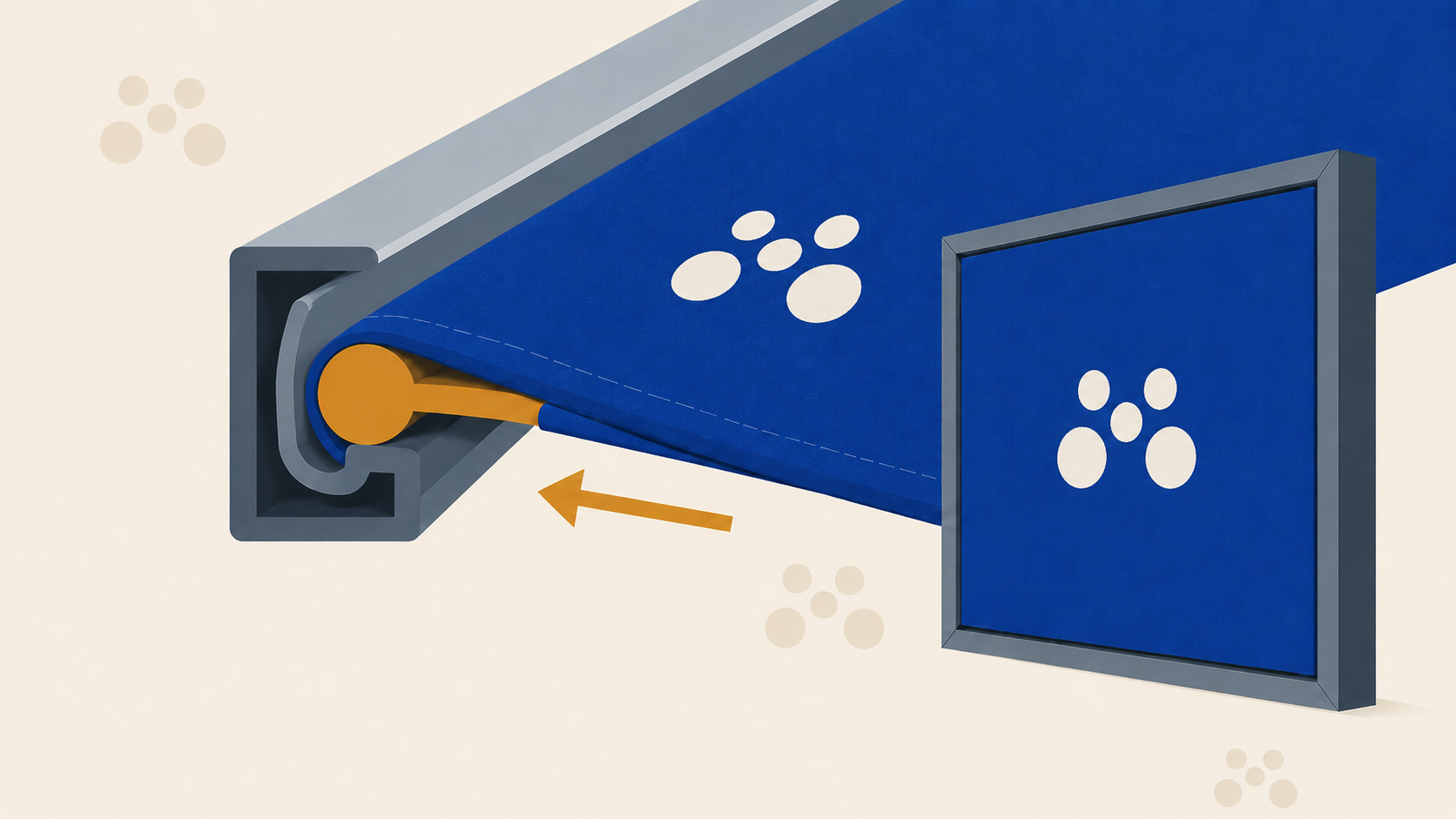
Keder is one of those trade terms that quietly gatekeeps a whole category of banner work. Buyers who know it spec it without thinking; buyers who do not end up cable-tying an eyeleted banner into a job that deserved a clean framed finish. The concept takes two minutes to understand, and once it clicks, a lot of installs get simpler.
Here is what keder is, when to spec it over eyelets, and how our keder banners are made.
What keder actually is
Keder is a welded edge bead running along the edge of a banner: a flexible PVC cord wrapped in fabric, fused to the banner edge, giving the banner a rounded rib along its perimeter.
That rib is the whole trick. It slides into the channel of an aluminium extrusion, commonly called sail track, and once it is in, the banner cannot pull out sideways. Tension the banner along the track and you get a drum-tight face with no visible fixings at all: no eyelets, no ties, no fixings interrupting the print.
Ours is a 7.5mm keder, available in white or black, and it fits any 7.5mm sail track extrusion. That compatibility is the practical headline: if the frame, rail or structure on site runs standard 7.5mm sail track, our keder banners slide straight in. Common Australian systems like the Rite Sailtrack-X, for example, are built specifically for 7.5mm-diameter keder, so banners from us drop straight into them.
Where keder banners get used
Sail track extrusion is everywhere once you start looking for it, and every one of those channels is a keder banner waiting to happen:
- Shopfront and facade frames — aluminium frames with sail track on all sides, giving retail signage a tensioned, printed face that swaps out in minutes.
- Wall-mounted banner frames — interior and exterior frames where the graphic needs to sit perfectly flat with clean edges.
- Display and exhibition systems — frame-based displays where graphics are changed regularly and the hardware stays put.
- Awnings, blinds and structures with sail track — anywhere a track is already part of the build, a keder edge turns it into a graphic mount.
- Fences and hoardings fitted with track — for sites that want a cleaner, more tensioned result than tied eyelet banners.
The common thread: the hardware is permanent and the graphic is changeable. Slide the old banner out, slide the new one in, and the frame does the tensioning. For clients who update messaging seasonally, that swap-ability is the quiet economic argument for specifying track and keder once, then paying only for print thereafter.
Keder versus eyelets: how to choose
Both are legitimate finishes, and the install decides it:
Choose keder when there is a track. If the job involves a frame, rail or extrusion with a 7.5mm channel, keder gives the best result available: fully tensioned, dead flat, no visible fixings, and fast to change over. It is the premium look because the fixing method is invisible.
Choose hem and eyelets when there is not. Fences, scaffold, railings and one-off tie-down installs are eyelet territory, the banner fixes to whatever structure exists, point by point. Our PVC banner guide walks through the full finishing menu, including rope and unfinished options.
The mistake to avoid is forcing one into the other's job: an eyeleted banner tied inside a frame never tensions truly flat, and a keder banner has nothing to fix to without a track.
White or black keder?
The keder bead is hidden inside the track once installed, so the choice is mostly about what shows at any exposed track ends or gaps, and about matching the frame hardware. Track systems typically come with capping in finishes like mill, black and pearl white, so the rule of thumb follows the hardware: black keder with dark or charcoal frames and capping, white with silver, mill or light frames. If in doubt, tell us the frame colour at quoting and we will match it.
How our keder banners are made
The banner itself is our premium 500gsm frontlit PVC: a high-tenacity woven polyester base, PVC coated both sides, UV stabilised, with an ultra-smooth face that holds fine print detail. The keder is welded to the banner edge, a fused bond rather than stitching alone, which is what lets the edge carry sustained tension across the whole banner face without peeling or creep.
Print is UV, with ink rated 2+ years outdoors, and banners run up to 2400mm x 20 metres in a single piece, which comfortably covers shopfront frames through to long facade and hoarding track runs.
Ordering and artwork notes
To quote a keder banner accurately we need:
- The finished banner size, which for framed jobs means the size the frame system requires, not the visual opening. Frame systems typically spec the banner slightly under or over the frame dimensions depending on how they tension, so if you have the frame supplier's graphic spec, send it with the job.
- Which edges carry keder. Track on all four sides, top and bottom only, or another combination, the install dictates it.
- Keder colour, white or black.
Artwork follows our standard setup: print-ready CMYK PDF at finished size, 3mm bleed minimum, fonts outlined. Keep critical content away from the edges, the perimeter zone of a keder banner disappears toward the track, so logos and text belong safely inside the visible face.
Frequently Asked Questions
What is keder on a banner? Keder is a welded edge bead, a flexible cord fused along the banner's edge, that slides into the channel of an aluminium sail track extrusion. Once inserted and tensioned, the banner sits drum-tight with no visible fixings, which is why it is the standard finish for framed and track-based banner installs.
What size keder do you supply? 7.5mm, in white or black, which fits any standard 7.5mm sail track extrusion, including common Australian systems such as the Rite Sailtrack-X, which is designed for 7.5mm-diameter keder. If the frame or structure on site runs 7.5mm track, our keder banners slide straight in.
Should I choose keder or eyelets? Let the install decide. If there is a frame, rail or track, keder gives a flatter, cleaner, fully tensioned result with no visible fixings. If the banner ties to a fence, scaffold or railing, hem and eyelets is the right finish. Neither substitutes well for the other.
Which colour keder should I pick? The bead hides inside the track, so match it to the hardware for any exposed ends: black keder with dark frames, white with silver or light frames. Tell us the frame colour if you are unsure and we will match it.
What size should a keder banner be for a frame? Whatever the frame system specifies, which is often slightly different from the frame's visual opening because systems tension differently. Send the frame supplier's graphic size spec with the job and we will produce to it, and tell us which edges need keder.
How long do keder banners last outdoors? The print is rated 2+ years outdoors, and the 500gsm stock typically outlasts the ink. Because a tracked banner is held in constant even tension rather than flapping, keder installs also avoid the mechanical wear that shortens tied banners' lives.
Key takeaways
- Keder is a welded 7.5mm edge bead that slides into any 7.5mm sail track extrusion, giving a tensioned face with no visible fixings.
- Available in white or black, matched to the frame hardware.
- Spec keder wherever there is a track: shopfronts, wall frames, display systems, and structures fitted with sail track. Eyelets remain the finish for fences and tie-down installs.
- The hardware is permanent, the graphic is changeable, which makes keder the economical spec for messaging that updates.
- Banners run on 500gsm frontlit PVC, welded keder, UV print rated 2+ years, up to 2400mm x 20m.
- Order with the frame system's graphic size spec, the keder edges required, and the keder colour.
Order keder banners for any 7.5mm track
If the job has sail track, we have the banner that fits it. Mediapoint prints trade-only, blind-shipped PVC banners with keder, 7.5mm in white or black, on premium 500gsm stock up to 2400mm x 20m. Send the frame spec and artwork through for a quote and we will produce it ready to slide in.