Hoarding banners are among the hardest jobs a banner can be asked to do. They sit on temporary fencing for months, fully exposed on windy open sites, carrying a builder's brand or the development render that's selling the project. For sign shops and resellers quoting this work, mesh is almost always the right material. This guide covers why, which mesh weight to choose, how to size a run for Australian temporary fence panels, how to fix it, and what changes when the hoarding is marketing a development. For live trade pricing, see our fixed height mesh banners.
Mediapoint is a trade-only printer in Derrimut, Melbourne, printing mesh hoarding and fence banners for sign shops and print resellers Australia-wide since 2006 — blind-shipped under your brand, so the builder or developer only ever sees you.
Standard hoarding sizes at a glance
Most Australian temporary fence panels are about 2.4m wide and 2.1m high, so a hoarding banner is usually 1800mm high and as long as the run. Use these as a starting point and measure the actual fence before you order, as clamps and gaps between panels add a little length.
| Job | Banner size (height x length) | Product |
|---|---|---|
| One temporary fence panel | 1800 x 2400mm | Fixed Height Mesh |
| One panel, lower drop | 1600 x 2400mm | Fixed Height Mesh |
| 5-panel run | 1800mm x about 12m | Fixed Height Mesh |
| 10-panel run | 1800mm x about 24m | Fixed Height Mesh |
| 20-panel run | 1800mm x about 48m | Fixed Height Mesh |
| Custom height (600 to 1800mm) | Any length up to 50m | 9x9, 6x6 or 12x12 custom mesh |
| Longer than 50m or taller than 1800mm | Split into several pieces | Plan artwork so logos don't fall across a join |
Fixed Height Mesh in 1600mm or 1800mm is the lower-cost option for standard fences. Choose custom-height mesh when the site needs a different height.
Why mesh is the standard for hoarding
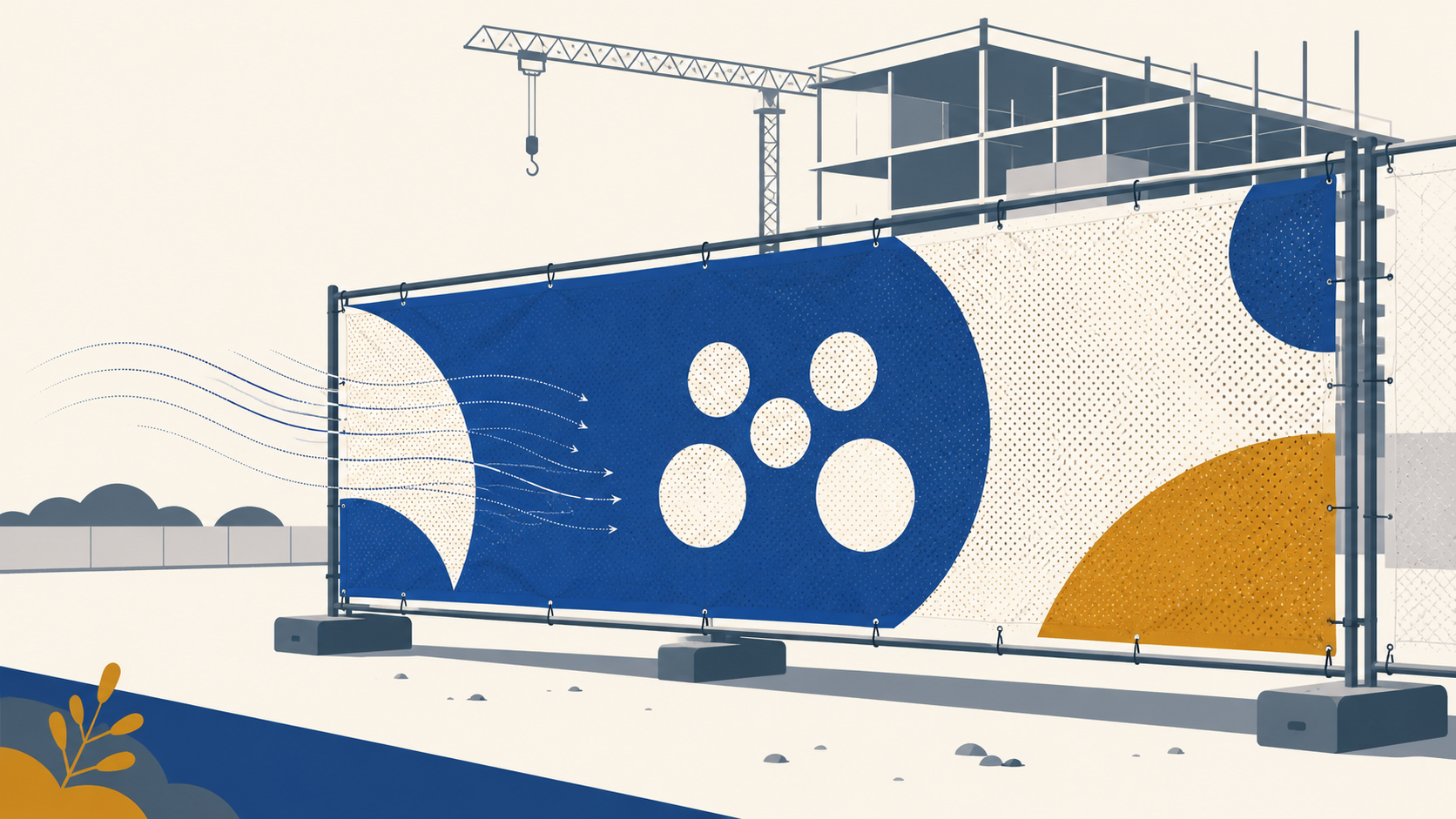
The defining problem with hoarding is wind. A solid PVC banner on a temporary fence acts like a sail: the wind can't pass through, so the full load goes into the fence panels and their feet. On an exposed site that's enough to lean panels, drag feet or bring a run down. Mesh is perforated, so much of the wind passes straight through.
Mesh is also lighter to handle, sheds water instead of pocketing it, and doesn't whip and snap in gusts. Solid PVC still has its place on sheltered, short-term jobs. See mesh banner vs PVC banner for where each wins.
Choosing the mesh weight
We print on three mesh weaves:
- 6x6 open mesh passes the most wind. Best for the most exposed runs.
- 9x9 standard mesh is the everyday choice and covers most hoarding jobs well.
- 12x12 premium mesh has a tighter weave, looks more solid and prints richer, but catches more wind.
As a rule, the more exposed the run, the more open the weave. For a sheltered courtyard or short return, a tighter weave gives a more solid-looking image.
Sizing a hoarding run
Australian temporary fence panels are typically around 2.4m wide and 2.1m high, depending on the supplier. Our fixed height mesh comes at 1600mm or 1800mm high, at whatever length you need. Mesh can run up to 50 metres in one continuous piece.
Run the height across the panel and the length along the fence. At 1800mm, a single drop covers most of a 2.1m panel, and one continuous banner across many panels looks like a finished wall rather than a row of joined sheets. For runs longer than 50m or taller than 1800mm, build the hoarding from several pieces and plan the artwork so logos and key render detail don't fall across a join. Standard mesh banner sizes has more sizing detail.
Eyelets, hems and fixing on site
Our mesh is finished with a heat-welded hem and clear plastic eyelets. Plastic won't rust or stain the print on a long, wet or coastal site. You can set eyelet spacing at 300mm, 500mm or 1000mm.
Spacing is the setting that matters most in wind. For exposed hoarding, specify 300mm: more fixing points means less flapping and less pull on the corners. Fix through every eyelet, top and bottom, with UV-stable cable ties or banner ties. Skipping eyelets to save install time is how banners tear after the first big blow. Wider 500mm or 1000mm spacing is fine on sheltered sites. Mounting hardware for mesh banners covers the fixing options.
How long hoarding lasts
Our mesh has an outdoor life of approximately 12 months, which lines up with most build programs. The print fades gradually with UV rather than failing suddenly, so on longer projects a mid-project replacement is a planning decision, not an emergency. Build it into the quote.
Development and real estate hoarding
On a property development, the hoarding is a marketing asset as well as a site barrier. It carries the project name, the render, developer, builder and agent branding, and usually a call to register interest. Common applications:
- The development site perimeter, usually the biggest and most visible piece
- Land estate and display village entry fencing
- "Coming soon" and "now selling" hoarding before display suites open
- Co-branded runs carrying developer, builder and agent logos
Renders and close-up viewing. Mesh is perforated, so up close a render reads slightly softer and loses a little fine detail. From across the road it's invisible. For a sheltered feature panel where buyers stand right in front of the hero render, consider solid PVC for that one panel and keep mesh for the long exposed runs.
Refreshes suit the sales cycle. Many developments outlast 12 months of hoarding, and the message changes anyway, from coming soon to now selling to final release. Planning a refresh at each stage keeps the hoarding sharp when buyers are deciding.
Quote the full sign suite. Development jobs also need rigid signage, such as sale boards, lot signs and directional signs to the display suite. Those are Corflute® jobs; see real estate Corflute® signs.
Artwork tips for hoarding
- Design to the panel module so logos don't split across fence joins.
- Keep type bold and generous. Fine detail and small reversed text lose definition on the perforated weave.
- See mesh banner file setup for resolution and bleed.
Council and site requirements
Hoarding can need council approval, especially in inner-city and heritage areas, and some contracts specify wind ratings. We supply the printed mesh to your specification; we don't provide engineering certification or council approval. Confirm requirements with the principal contractor or council before you order.
Frequently asked questions
Why mesh instead of solid PVC for hoarding?
Mesh lets much of the wind through instead of loading the temporary fence. On long, exposed runs that's the difference between a banner that stays put and one that brings panels down.
What sizes can you print?
Fixed height mesh comes at 1600mm or 1800mm high, and mesh runs up to 50 metres in one piece.
What eyelet spacing for a windy site?
300mm, fixed through every eyelet. 500mm or 1000mm is fine for sheltered sites.
How long does mesh hoarding last?
Approximately 12 months outdoors. Plan a refresh on longer projects.
Do renders look good on mesh?
From a distance, yes. Up close they read slightly softer, so consider solid PVC for sheltered feature panels.
Do you handle council approval?
No. Confirm any approval or wind-rating requirements with the principal contractor or council before ordering.
Key takeaways
- Mesh is the standard for hoarding because it lets the wind through.
- Choose the weave by exposure: 6x6 for the windiest runs, 9x9 for most jobs, 12x12 for sheltered sites.
- 1600mm or 1800mm high, up to 50m in one piece.
- 300mm eyelet spacing for exposed sites; fix through every eyelet.
- About 12 months outdoors, so plan refreshes on long builds.
- On developments, consider solid PVC for close-up hero panels, and quote the Corflute® suite with the hoarding.
Order hoarding banners
Mediapoint is trade only and blind ships, so the hoarding reaches your client under your brand. See fixed height mesh banners for live trade pricing, or open a trade account. Send us the run length, height, mesh weight and eyelet spacing and we'll quote to your install date.