Mesh and solid PVC are the two workhorses of outdoor banner printing, and they are not interchangeable. Choosing the wrong one is one of the most common and most expensive mistakes on a banner job, because it usually shows up after install when a banner is flapping, fading or pulling a fence over. This guide sets out the real difference between the two and gives you a clear way to pick the right material for each job.
For the wider product background, see The Complete Guide to Mesh Banner Printing in Australia. This article is about the choice between mesh and PVC.
The core difference: perforated versus solid
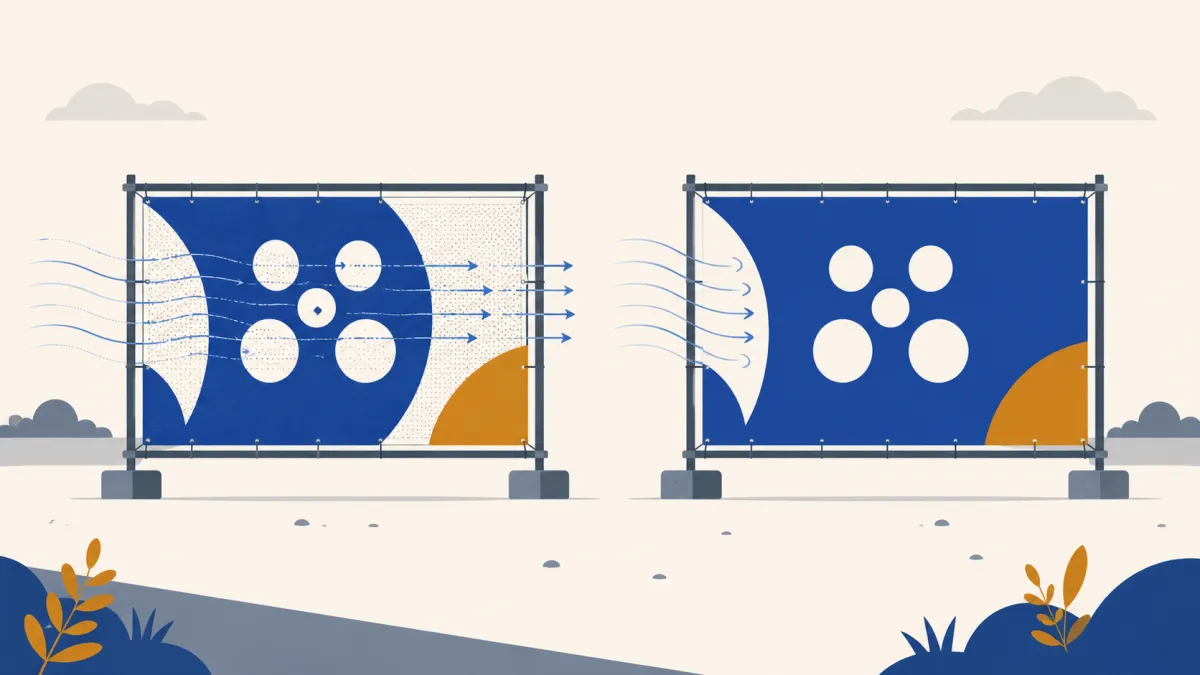
The whole decision comes down to one physical property. Mesh is a perforated material, so wind, light and water pass through it. Solid PVC banner vinyl is a continuous sheet, so it blocks all three.
Everything else follows from that. Because mesh lets wind through, it is the safer choice in exposed and windy locations. Because solid PVC blocks light and is fully opaque, it delivers a richer, more solid looking image. Neither is better in the abstract. The right answer depends on the site and on what the banner needs to do.
When to choose mesh
Mesh is the right call whenever wind is a factor or the banner is up for an extended period outdoors.
A solid banner in an exposed position acts like a sail. The wind cannot pass through, so the full load transfers into whatever the banner is fixed to. On temporary fencing that is enough to lean panels or bring a run down. Mesh lets a large share of the wind through, which is why it is the standard for construction hoarding, scaffold wrap, and any long outdoor run. The detail on hoarding specifically is in Construction Hoarding Banners.
Choose mesh when the banner is:
- On temporary fencing, scaffold or any exposed outdoor structure
- Up for weeks or months rather than days
- Large, where wind load builds quickly across the area
- In a coastal or open site where wind is unpredictable
Mesh is also lighter to handle, sheds water rather than holding it in a pocket, and does not snap and whip in gusts. Its outdoor life is approximately 12 months, which suits most medium term outdoor applications.
When to choose solid PVC
Solid PVC is the better material when wind is not a concern and the image needs to read as richly and solidly as possible.
A continuous vinyl sheet gives you full opacity and the strongest colour. Nothing shows through from behind, and fine detail and small text hold up far better than they do on a perforated surface. For an indoor backdrop, a sheltered shopfront, a short term promotional banner, or anywhere the visual impact of the image is the priority, solid PVC is the stronger choice.
Choose solid PVC when the banner is:
- Indoors or in a well sheltered position
- Up for a short period, such as an event or a sale
- Carrying fine detail, small text or a photographic image that needs to look sharp
- A backdrop where you do not want anything visible through the material
- Used as a blockout, where light must not pass through
The trade off is that solid PVC is heavier, holds water, and is unsuitable for exposed positions where wind would load it.
Image quality and the visual trade off
This is the factor that catches people out. Mesh is perforated, so up close the image has tiny holes across it and reads slightly softer than solid vinyl. At distance, which is how most large outdoor banners are viewed, this is barely noticeable and mesh looks excellent. Up close, or for a banner where someone will stand right in front of it reading detail, solid PVC will always look cleaner.
So the question is not only where the banner goes, but how it will be seen. A hoarding banner viewed from across a road is a perfect mesh job. A product banner behind a reception desk that people stand a metre from is a solid PVC job.
A quick way to decide
If you want a single rule of thumb, ask two questions in order.
First, is it exposed to wind for any meaningful length of time. If yes, choose mesh, almost regardless of anything else. Safety and durability outrank image sharpness on an exposed site.
Second, if wind is genuinely not a factor, does the image need maximum sharpness, opacity or blockout. If yes, choose solid PVC. If the image is bold and viewed at distance, either material works and other factors such as cost and weight can decide.
Get the size right for whichever material you choose. The sizing logic for mesh, including the 1800mm print limit, is covered in Standard Mesh Banner Sizes in Australia.
Getting the right material for your job
Mediapoint is a trade only printer supplying sign shops, resellers and agencies, and we blind ship so the finished banner reaches your client under your own brand. If you are weighing up mesh against solid for a particular job and are not sure which suits the site, the team can advise based on the location and install. View our fixed height mesh banners, custom-size 12x12 premium mesh banners or PVC banners with eyelets for trade pricing and ordering options. To order, set up a trade account here: https://www.mediapoint.com.au/authorization/registration/personal-information.
Frequently asked questions
What is the difference between a mesh banner and a PVC banner?
Mesh is a perforated material that lets wind, light and water pass through it. Solid PVC banner vinyl is a continuous sheet that blocks all three. Mesh is the safer choice in exposed and windy positions, while solid PVC gives a richer, fully opaque image for sheltered or indoor use.
Is a mesh banner or a PVC banner better for outdoors?
For exposed outdoor positions where wind is a factor, mesh is better because it lets wind pass through and reduces the load on the structure. Solid PVC can be used outdoors in sheltered positions or for short periods, but it acts like a sail in wind and is not suited to exposed sites.
Does a mesh banner look as good as a solid PVC banner?
At distance, mesh looks excellent and the perforations are barely noticeable. Up close, solid PVC reads sharper and holds fine detail and small text better, because mesh has tiny holes across the image. Choose based on how close the banner will be viewed.
Which lasts longer outdoors, mesh or PVC?
Both can be used outdoors. Mesh has an outdoor life of approximately 12 months and is built for exposed, longer term use. Solid PVC is generally better kept to sheltered positions or shorter campaigns outdoors, since wind exposure is its main weakness.
Can I use a solid PVC banner on a construction fence?
It is not recommended on an exposed construction fence. A solid banner catches the wind and transfers the load into the temporary fencing, which can lean or topple panels. Mesh is the standard material for construction hoarding for exactly this reason.