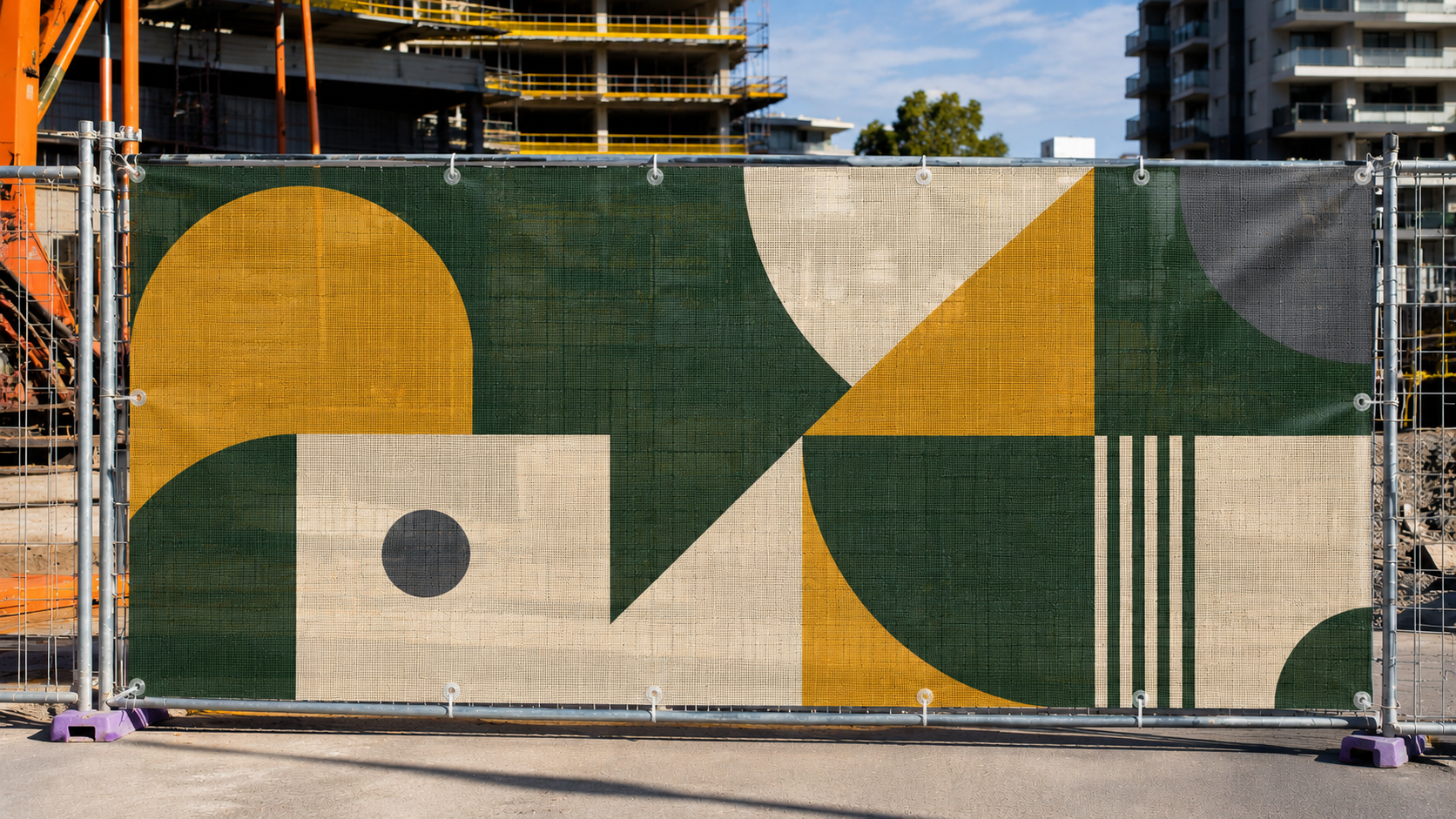
Mesh banners are the workhorse of large-format outdoor signage for construction sites, temporary fencing, scaffold wrap, and event work across Australia. The wind-permeable substrate handles outdoor wind loads that solid vinyl banners can't, the print surface accommodates the large-format graphics that construction and event projects need, and the production economics suit short-to-medium term outdoor application work.
This guide is the trade customer's reference for mesh banner work at Mediapoint — for sign shops, design studios, and trade resellers fulfilling construction, event, real estate, and outdoor signage briefs for end-customer clients. The aim is to give you the technical, application, and operational knowledge to specify mesh banners correctly, advise clients well, and head off the artwork issues that cause prepress delays. The article covers mesh weight selection, sizing, finishing, file setup, the wind-load engineering behind mesh weight choices, and honest scoping on what Mediapoint does and doesn't do in the mesh banner category.
Mediapoint is a trade-only printer in Derrimut, Melbourne, printing mesh banners for sign shops and print resellers Australia-wide since 2006 — blind-shipped under your brand, so your client only ever sees you.
For trade customers fulfilling construction-specific mesh hoarding work, the construction site mesh hoardings supporting article goes deeper on construction context. For broader large-format outdoor signage decisions including the choice between mesh and solid vinyl, see the mesh banner vs vinyl banner comparison. For Corflute® signage work (a related but distinct outdoor signage category), the Corflute® signage cluster covers that ground separately.
Important: the specifications and application guidance in this article reflect Mediapoint's current mesh banner production capabilities and general industry context. Specific outdoor signage applications may require site-specific engineering, council compliance considerations, or wind-load calculations beyond the scope of this article. Mediapoint prints supplied artwork; the customer is responsible for confirming the product is fit for the intended application. For construction or council-regulated signage applications, verify compliance requirements with the relevant authority.
Why mesh banners exist — the wind-load engineering
Mesh banners exist for one fundamental reason: solid vinyl banners catch wind. On a temporary construction fence, a scaffold structure, or an outdoor event setup, a solid vinyl banner acts as a sail. Sustained wind load on a sail-shaped surface creates structural stress on the mounting points (eyelets, fence panels, scaffold poles) and can fail the entire installation — banner ripping, fence panels blowing over, scaffold connections loosening.
The engineering solution: an open weave substrate that lets wind pass through rather than catching it. A mesh banner's open structure dramatically reduces wind load on the mounting structure while still providing the printed visual surface the project needs. The trade-off is image fidelity (the holes in the substrate are visible in the print, particularly at close viewing distance), but for outdoor signage viewed from 5-50 metres away, the visual quality is more than adequate.
This is why mesh banners dominate construction hoardings, scaffold wrap, fence-mounted event signage, and outdoor sports event signage. It's not aesthetic preference — it's wind-load engineering.
Mediapoint's mesh range — three weights, three engineering profiles
Mediapoint offers three distinct mesh weights, each engineered for different wind-exposure conditions. The right mesh for any job is downstream of where the banner will be installed and what wind conditions the site faces. The three options:
12×12 mesh — the premium, dense option
Threads: 12 × 12 per inch. Weight: approximately 280gsm. Open area: approximately 30%. Tensile strength: 1,200N warp, 1,100N weft per 5cm. Tear strength: 160N warp, 150N weft. UV stabilised.
12×12 is the densest mesh option in Mediapoint's range. The higher thread count produces better image quality (smaller holes mean less visual distortion of printed graphics, particularly noticeable on photography and detailed designs), and the heavier substrate handles sustained outdoor exposure more robustly than lighter mesh weights. The trade-off is reduced wind permeability — at 30% open area, 12×12 lets less wind through than the lighter options.
Best use: premium positioning where image quality matters (high-profile development hoardings, premium event signage, signage viewed at relatively close range), sites with moderate wind exposure, projects where the brand presentation justifies premium substrate cost.
Pricing note: 12×12 is Mediapoint's premium-priced mesh. The denser substrate carries higher material cost and pricing reflects this. For trade customers quoting client work, the 12×12 premium is worth flagging — clients comparing quotes across mesh printers should be comparing like-for-like substrate weight, not just headline pricing.
9×9 mesh — the workhorse, balanced choice
Threads: 9 × 9 per inch. Weight: approximately 200gsm. Open area: approximately 40%. Tensile strength: 900N warp, 810N weft per 5cm. Tear strength: 140N warp, 130N weft. High tenacity base fabric. UV stabilised.
9×9 is the popular choice for general construction fencing — the balanced option that trades a small amount of image clarity for meaningfully better wind permeability. The 40% open area handles standard Australian outdoor wind conditions well without imposing excessive wind load on fence panels or scaffold structures. The image quality is genuinely good for outdoor viewing distances (5-30 metres), even though it doesn't match 12×12 at close-range inspection.
Best use: general construction site hoardings, scaffold wrap on standard-height scaffolds, fence-mounted event signage in typical outdoor conditions, the default specification when the brief doesn't justify premium 12×12 or high-wind 6×6 selection.
6×6 mesh — the high-wind, maximum airflow option
Threads: 6 × 6 per inch. Weight: approximately 180gsm. Open area: approximately 50%. Tensile strength: 720N warp, 650N weft per 5cm. Tear strength: 160N warp, 150N weft. High tenacity base fabric. UV stabilised.
6×6 has the most open knit structure in Mediapoint's range — maximum wind permeability, minimum wind load on the mounting structure. The image quality is the lowest of the three options (50% open area means more substrate holes visible in the print), but the wind performance is genuinely valuable in high-exposure sites where solid or denser mesh would create real structural risk.
Best use: high-wind construction sites (coastal exposure, exposed elevation, multi-storey scaffolding), large-scale fencing installations where wind load is the primary engineering concern, projects where the substrate's wind permeability is more important than print resolution.
Choosing between the three
The decision framework is straightforward:
- Default to 9×9 unless there's a specific reason to choose differently. It's the general-purpose option for Australian construction and event work.
- Specify 12×12 when image quality genuinely matters or when premium positioning justifies the cost premium (high-profile development hoardings, premium events, signage viewed at close range).
- Specify 6×6 when the site is high-wind exposed and reducing wind load on the structure is more important than image quality.
The substrate decision should be made at the brief stage, not the quote stage. Trade customers receiving construction signage briefs should ask about site exposure (coastal, exposed elevation, sheltered urban) before specifying mesh weight.
Outdoor durability — honest framing
Mesh banners are temporary outdoor signage products. Mediapoint's mesh range is rated for approximately 12 months of outdoor service under typical Australian conditions, matching the typical construction project build timeline. This isn't a multi-year permanent installation product.
The 12-month rating reflects the realistic combination of substrate UV degradation, weather exposure, ink fade, and physical stress from wind. Specific projects may exceed or fall short of 12 months depending on exposure conditions:
Likely to reach or exceed 12 months:
- Sheltered installations (urban sites with surrounding buildings)
- Lower-wind environments
- Sites without sustained direct sun on the banner face
- Standard construction project timelines (typical Australian residential or commercial builds)
Likely to fall short of 12 months:
- Coastal exposure (salt air accelerates substrate degradation)
- High-wind sites with sustained mechanical stress
- Direct sun-facing installations in northern Australia
- Sites with sustained physical contact (foot traffic, vehicle proximity)
For projects requiring multi-year outdoor signage — permanent property identification, long-term hoardings on stalled or delayed projects, semi-permanent fence-mounted signage — mesh banners are the wrong product. For sustained outdoor durability beyond a typical construction cycle, the right answer is rigid signage substrates (ACM for permanent installations, or solid printed substrates with specialist coating for extended service).
This is honest framing that protects everyone in the chain. Trade customers who sell mesh banners on 24-month construction projects without flagging the durability picture put their client relationship at risk. The conversation up front — "12 months service is what to expect; if the project runs longer, plan for a banner refresh" — sets correct expectations and positions the trade customer as the knowledgeable specifier.
Eyelets, hemming, and Mediapoint's finishing configuration
Every Mediapoint mesh banner ships with the same finishing configuration: hemmed perimeter edges and PLASTGrommet plastic eyelets. There is no plain-edge mesh banner option in the Mediapoint range — the hemmed-edge-with-eyelets specification is the product.
Why hemmed edges
Mesh substrate frays at cut edges if left unfinished. The hemmed edge folds and welds the perimeter material back on itself, creating a doubled edge that resists fraying through the banner's service life. For outdoor mesh banners exposed to wind, the unhemmed edge would fray progressively from day one — within weeks, the edge would degrade visibly. Hemmed edges are standard outdoor banner production for this reason.
Why PLASTGrommet plastic eyelets, not metal
Mediapoint uses PLASTGrommet 12mm clear plastic eyelets exclusively. This is a deliberate product choice over the brass and aluminium eyelets used by some banner printers. The reasons:
- No rust. Metal eyelets in sustained outdoor exposure eventually rust at the substrate contact point. The rust stains the banner around the eyelet, then progresses to weaken the eyelet itself. Plastic eyelets eliminate this failure mode entirely.
- UV stability. PLASTGrommet plastic eyelets are tested to 250-hour Xenon exposure (equivalent to approximately 3.5 years) with no colour change — comfortably exceeding the banner substrate's service life.
- Recyclability. PLASTGrommet plastic eyelets are designed to be recyclable with PP and HDPE banner substrates without requiring separation before recycling. The banner can go to the appropriate plastic waste stream as a complete unit. AIMPLAS certified.
- Substrate stress. Plastic eyelets are lighter than metal equivalents and impose less stress on the substrate at the eyelet contact point — particularly relevant on the lighter 6×6 mesh weight where substrate strength is comparatively lower.
- Compliance certifications. PLASTGrommet eyelets are food-grade certified (EU and FDA), Cal Prop 65 compliant, and free of PVC, heavy metals, chlorides, and phthalates.
For trade customers servicing clients with sustainability requirements (construction companies with ESG commitments, event companies positioning around sustainability, councils with environmental procurement criteria), the PLASTGrommet positioning is worth flagging in the brief — Mediapoint's mesh banners are recyclable as a complete unit, which most competitor banner offerings can't claim.
Eyelet spacing options
Mediapoint offers three eyelet spacing options along the banner perimeter. The right spacing depends on mounting environment and wind exposure:
- 300mm spacing — closer eyelet pattern for high-wind sites and applications where the banner needs maximum tension stability. The closer spacing distributes wind load across more mounting points, reducing stress on each individual eyelet and the substrate around it. Use for: coastal sites, exposed elevation, scaffold wrap on multi-storey structures, sites with sustained high winds.
- 500mm spacing — standard general-purpose spacing for typical construction and event work. Balances installation efficiency with adequate mounting density for Australian outdoor wind conditions. Use for: standard construction site hoardings, fence-mounted event signage in normal outdoor conditions, the default specification when nothing about the site demands tighter or wider spacing.
- 1000mm spacing — wider eyelet pattern for sheltered installations and protected environments. Reduces material and labour cost compared to tighter spacing options where the additional mounting density isn't needed. Use for: indoor or partially-sheltered installations, low-wind environments, applications where minimal visible eyelet pattern is preferred.
For trade customers: the default specification is 500mm spacing unless the brief explicitly requires otherwise. Confirm with the client which spacing matches their installation conditions before locking the spec.
Production envelope — maximum size and panel joining
Mediapoint's mesh banner production envelope is 1800mm wide by 50m long. This accommodates most standard mesh banner sizes without joining:
- Construction hoardings at standard 1800 × 2400mm or 1500 × 3000mm — fit comfortably within the envelope
- Scaffold wrap panels at standard widths up to 1800mm with any practical length — within envelope
- Event signage at common sizes up to 1800mm wide — within envelope
- Real estate hoardings at typical sizes for development sites — within envelope
For banners wider than 1800mm — which includes the very large hoardings sometimes used on major developments, large-scale event signage, and stadium-scale banner work — Mediapoint produces the banner as panels and joins them. Panel joining is a standard production technique but introduces a visible seam at the join line. For trade customers quoting work over 1800mm wide:
- Discuss the join line with the client before quoting — they should know the seam will be visible
- Design considerations: avoid critical brand elements crossing the join line where possible
- Larger total widths may require multiple panels (e.g., a 5400mm wide hoarding = three 1800mm panels with two join seams)
For applications requiring single-piece banners wider than 1800mm without any seam, route to specialist large-format banner printers with wider production capability. This is a real limit of Mediapoint's mesh banner production rather than a workaround.
Standard sizes for Australian mesh banner applications
Mesh banner sizing varies significantly by application. The right size for a job is downstream of the mounting environment — fence panel dimensions, scaffold pole spacing, hoarding structure, event setup. Worth knowing the common size ranges by application before quoting client work.
Construction site hoardings
Standard temporary fence panels in Australia are typically 2400mm long × 1800mm tall. Mesh banner hoardings for these fence panels are typically sized to match — 2400 × 1800mm being the dominant single-panel hoarding size. Larger continuous hoardings on multi-panel runs may be sized to match the panel run length (4800mm for two panels, 7200mm for three, etc.), produced as panels joined together.
Scaffold wrap
Standard scaffold heights and bay widths drive scaffold wrap sizing. Common configurations:
- Single-bay scaffold wrap: typically 1800mm wide × 2400-3000mm tall
- Multi-bay scaffold wrap: produced as panels matching bay widths, typically 2400-3000mm tall
- Multi-storey scaffold wrap: produced as panels matching the storey height, joined vertically
Event signage
More variable than construction sizing. Common event mesh banner sizes:
- Fence panel signage at 2400 × 1200mm or 3000 × 1500mm
- Bridge/banner signage at custom widths
- Sporting event mesh banners at variable sizes matching the venue's mounting points
Real estate and property development hoardings
Property development hoardings often combine standard fence panel sizing with custom branding panel sizing. A typical development hoarding installation might combine 2400 × 1800mm fence panels with larger 4800 × 2400mm "coming soon" branding panels at the entry point.
For the deeper sizing reference covering aspect ratios, custom shapes, and production efficiency considerations, see the standard mesh banner sizes article.
File setup essentials for mesh banner artwork
The artwork file setup essentials for mesh banner work. For the full file setup walkthrough, see our mesh banner file setup guide. The headline requirements:
PDF artwork at 100% of finished size
Banners are an exception to most artwork sizing conventions — for very large mesh banners, files may be supplied at scale (typically 1:10) with that scale clearly noted in the file name. Confirm with Mediapoint trade support which approach suits your specific banner job.
3mm minimum bleed, 5mm preferred for larger banners
Standard 3mm bleed applies. For larger banners or banners with critical content near the trim, 5mm bleed adds insurance against trim drift.
45mm eyelet safe zone — critical for eyeleted artwork
This is the file setup requirement that distinguishes mesh banner artwork from other product categories. Eyeleted banners require a 45mm safe zone in each corner and along all edges. The eyelets sit within this safe zone; critical design content must stay outside it.
The reason: eyelets are physical hardware punched through the substrate, with a 12mm internal diameter and 26.25mm flange diameter. Around each eyelet, additional clear space ensures the eyelet doesn't interfere with critical design content. Combined with the corner clearances needed for hemmed edges and corner eyelets, 45mm becomes the required safe zone.
For trade customers receiving client artwork: critical brand elements (logos, headlines, key product photography) must sit at least 45mm inside the trim edge on all sides. Edge-to-edge design with critical content right at the boundary won't work — the eyelets will overlap or clip the content. Flag this with the client's designer before artwork submission.
Lower image resolution acceptable for outdoor viewing distance
Mesh banners are typically viewed from 5-50 metres. The substrate's 30-50% open area also affects perceived resolution (the substrate holes interrupt fine detail regardless of source resolution). Source imagery at 100-150dpi at finished size is typically adequate; 300dpi is rarely necessary and can produce unnecessarily large files. For trade customers receiving artwork: don't reject mesh banner artwork for lower-than-standard resolution unless the design specifically requires close-range inspection.
CMYK colour space, Pantone Coated references for brand colours
Standard requirements. Same as other Mediapoint product categories. Brand colours should be specified as Pantone Coated (C) references; brand-critical work warrants a sample check before full production.
Fonts converted to outlines before export
Standard requirement to prevent RIP font substitution.
Common artwork problems on mesh banner submissions
The recurring file-level issues Mediapoint's prepress team sees on incoming mesh banner artwork. For trade customers checking client artwork before submission:
Critical content positioned within 45mm of trim edge
Consequence: eyelets clip or interfere with key design content; banner installation reveals overlap. Watch for: brand logos, headlines, or product photography running close to the design edge. Fix: confirm critical content sits at least 45mm inside trim on all sides before submission.
No bleed or insufficient bleed for the banner size
Consequence: white slivers at trim edges, particularly visible on large outdoor banners viewed at close range. Watch for: artwork built to exact trim dimensions. Fix: extend background colour and imagery 3mm minimum (5mm preferred for larger banners) beyond trim on all four sides.
Image resolution unnecessarily high or genuinely too low
Consequence: oversized files that stress the production workflow, or pixelated final output on close-range viewing applications. Watch for: 600dpi source files on a 6m banner (unnecessarily large), or 72dpi web-resolution images on banners viewed at close range. Fix: aim for 100-150dpi at finished size for typical viewing distances; verify with the client whether close-range viewing matters for the application.
RGB images placed without CMYK conversion
Consequence: shifted brand colours, particularly noticeable on photography and brand-colour-critical designs. Watch for: images sourced directly from RGB workflow (photography exports, web graphics) placed in CMYK design files without conversion. Fix: convert images to CMYK in Photoshop before placing in the artwork.
Wrong file size or scale specification
Consequence: banner produced at the wrong final size, requiring reprint at customer expense. Watch for: artwork supplied at scale (1:10, 1:5, etc.) without clear notation in the filename, or supplied at 100% when the production workflow expected scaled. Fix: clearly note any scaling in the filename (e.g., "240mm x 180mm 1:10 scale for 2400x1800mm banner.pdf") and confirm with Mediapoint trade support which approach suits the specific job.
What Mediapoint does and doesn't offer in mesh banners
Honest scoping helps trade customers route work correctly.
What Mediapoint offers
- Three mesh weight options: 12×12 (premium, 280gsm), 9×9 (standard, 200gsm), 6×6 (high-wind, 180gsm)
- Hemmed perimeter edges on every banner
- PLASTGrommet plastic eyelets in three spacing options: 300mm, 500mm, 1000mm
- Maximum single-panel size: 1800mm × 50m
- Banner sizes over 1800mm wide produced as joined panels
- Standard fast trade turnaround
- Trade pricing for design studios, sign shops, and resellers running regular mesh banner volume
What Mediapoint doesn't offer
- Plain (unhemmed, no-eyelet) mesh banners — hemmed-with-eyelets is the only product configuration
- Pole pocket finishing — banners designed for insertion into top and bottom pole sleeves
- Rope hem finishing — banners with rope sewn into hemmed edges for tensioning
- Reinforced corner patches — extra material at corner eyelets for extreme high-stress applications
- Velcro edges or non-eyelet mounting hardware — alternative attachment methods
- Metal eyelets — brass, aluminium, or other metal eyelet hardware (PLASTGrommet plastic only)
- Single-piece banners wider than 1800mm — wider work is produced as joined panels with visible seams
- Long-term outdoor durability beyond ~12 months — mesh banners are short-to-medium term outdoor signage; not a multi-year permanent installation product
- Specialty mesh substrates beyond the three weights listed — perforated vinyl, mesh-look printed vinyl, fabric-style outdoor banners, or specialty large-format substrates outside the standard mesh range
For applications requiring any of the above, route to specialist banner printers with the relevant capability. The honest conversation with the client up front prevents disappointment after production.
Frequently asked questions
Which mesh weight should I quote when the client doesn't specify?
Default to 9×9 unless the brief contains specific information about the site that suggests otherwise. For coastal sites, high elevation, or projects flagged as wind-exposed, suggest 6×6 and explain the wind permeability advantage. For premium positioning where image quality matters, suggest 12×12 and explain the cost premium. The default 9×9 covers the bulk of standard Australian construction and event work.
What's the realistic outdoor life of a Mediapoint mesh banner?
Approximately 12 months under typical Australian construction project conditions. This is intentionally honest framing — actual service life varies with exposure conditions. Coastal exposure, sustained high winds, and direct sun in northern Australia all shorten the realistic life. Sheltered urban installations may last longer. For projects running 18+ months, plan for a banner refresh at the 12-month mark.
Can I order a banner without eyelets — just the printed hemmed mesh?
No. Mediapoint's mesh banner product configuration is always hemmed-perimeter-with-eyelets. There is no option to skip the eyelets. For applications requiring alternative mounting hardware or no mounting points, the standard Mediapoint mesh banner isn't the right product — route to a specialist banner printer with the relevant configuration.
My client wants pole pockets or rope hem instead of eyelets — what do I quote?
Mediapoint doesn't offer pole pocket or rope hem finishing on mesh banners. Route the work to a specialist banner printer with those finishing options. This is typical "Mediapoint plus specialist printer" routing — Mediapoint handles the volume mesh-with-eyelets work; specialty finishing goes to specialists.
Can I run banners wider than 1800mm?
Yes, as joined panels with visible seams. A 3600mm wide banner is produced as two 1800mm panels joined at the centreline; a 5400mm hoarding as three panels with two seams. For applications requiring single-piece banners over 1800mm wide with no seams, route to specialist large-format printers.
Are the eyelets really recyclable with the banner?
Yes — the PLASTGrommet plastic eyelets are designed for recycling with PP and HDPE mesh substrates without requiring separation. The complete banner can go to the appropriate plastic waste stream. This is an AIMPLAS-certified process. For clients with sustainability requirements, this is a genuine differentiator worth flagging in the brief.
What's the maximum banner length Mediapoint can produce?
50 metres. For practical purposes, this is essentially unlimited — applications requiring banners longer than 50 metres are extremely rare and typically use joined panels anyway.
Why does my client's competitor's mesh banner have brass eyelets if plastic is better?
Different banner printers make different product choices. Brass eyelets are traditional and well-understood; plastic eyelets are a more recent product evolution with the specific advantages described above. Neither is universally "better" — Mediapoint's product choice is plastic for the rust, recyclability, and substrate-stress advantages. Other printers prioritise different factors.
Key takeaways
The points worth remembering when quoting your next mesh banner job.
Mediapoint offers three mesh weights — 12×12 (premium, 280gsm), 9×9 (standard, 200gsm), 6×6 (high-wind, 180gsm). Default to 9×9 unless the brief justifies premium or high-wind selection.
All mesh banners ship with hemmed perimeter edges and PLASTGrommet plastic eyelets. No plain-banner option, no metal eyelet option. The hem-with-eyelets configuration is the product.
Three eyelet spacing options: 300mm (high-wind), 500mm (standard), 1000mm (sheltered). Default to 500mm unless the brief specifies otherwise.
Maximum single-panel size is 1800mm × 50m. Wider banners produced as joined panels with visible seams. Single-piece banners over 1800mm wide route to specialist printers.
Outdoor life is approximately 12 months under typical Australian construction conditions. Coastal exposure, high winds, and northern direct sun shorten realistic life. Multi-year applications need different product categories.
45mm eyelet safe zone is the file setup requirement that distinguishes mesh banner artwork — critical content must sit at least 45mm inside trim on all sides.
PLASTGrommet plastic eyelets are recyclable with the banner substrate as a complete unit. Worth flagging in briefs with sustainability requirements.
Image resolution requirements are lower for mesh banners than other product categories due to outdoor viewing distance and substrate open area — 100-150dpi at finished size is typically adequate.
Working with Mediapoint on mesh banners
Mediapoint produces mesh banners for design studios, sign shops, and trade resellers servicing construction, event, real estate, and outdoor signage clients across Australia. Standard turnaround starts from the next business day after file approval, for files received before the daily cut-off. Trade pricing is available for design studios and resellers running regular mesh banner volume.
View our mesh banners product page for current ordering options across the three mesh weights, eyelet spacing options, and standard sizes. For construction-specific guidance, see the construction site mesh hoardings reference. For the broader product decision between mesh and solid vinyl banners, see the mesh banner vs vinyl banner comparison.
A final note on application suitability: the guidance in this article reflects Mediapoint's experience as a trade banner printer and general industry context. Specific outdoor signage applications may require site-specific engineering, council compliance considerations, or wind-load calculations beyond the scope of this article. The customer is responsible for confirming the product is fit for the intended application. For construction signage with structural mounting considerations, council-regulated signage, or applications in regulated outdoor environments, verify compliance requirements with the relevant authority before committing to large production runs.