Property development sites are a natural home for mesh hoarding. They sit exposed for the length of a build, they carry the renders and branding that sell the project, and they front busy roads and footpaths where the public sees them every day. This guide covers why mesh suits real estate and development hoarding, the applications it covers, and the one trade off worth thinking about carefully before you commit a premium render to a perforated surface.
For the full product background, see The Complete Guide to Mesh Banner Printing in Australia. This article is about real estate and development use.
Why mesh for development hoarding
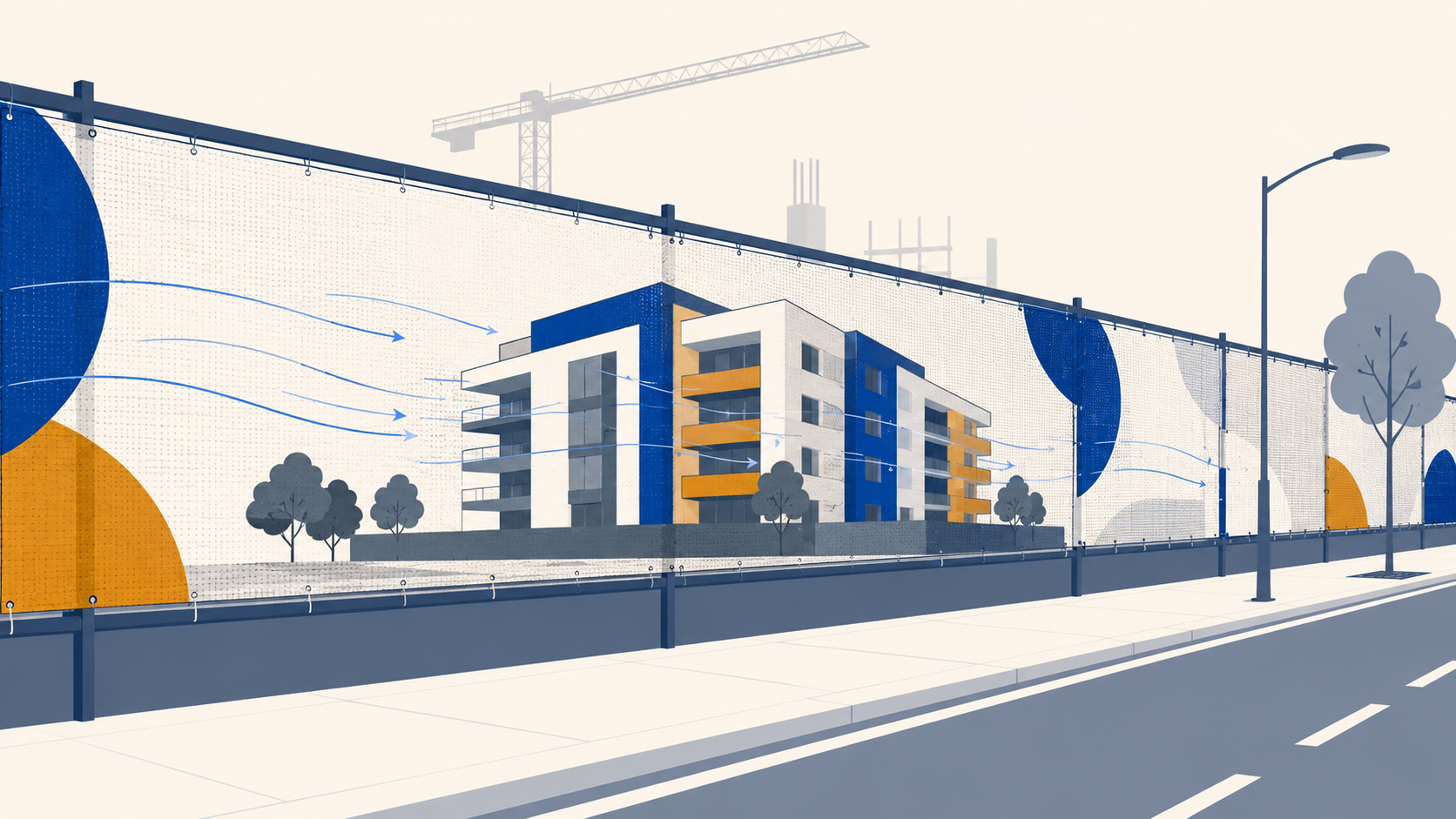
A development site has the same wind problem as any construction site. The hoarding wraps temporary fencing or scaffold on an open site, often for many months, and a solid banner in that position loads the fence and risks coming down. Mesh lets the wind through and stays put, which is why it is the standard for long site runs. The general hoarding detail is in Construction Hoarding Banners.
What makes real estate hoarding different from plain construction branding is the purpose. This hoarding is a marketing asset. It carries the project name, the development render, the agent and builder branding, and often a call to register interest. It is working to sell apartments or land while the build goes on behind it, so it needs to look the part for the full duration.
Common real estate hoarding applications
Mesh covers most of the large format outdoor branding on a development.
Development site perimeter. The long hoarding run around the site boundary, carrying the project render and branding, is the headline application. It is usually the largest and most visible piece on the job.
Display village and land estate fencing. New land estates and display home villages use mesh along entry fencing and lot frontages to brand the estate and direct visitors.
Now selling and coming soon hoarding. Early stage sites use mesh to announce the project and drive registrations before display suites open, often well before construction is visibly underway.
Agent and builder co-branding. Real estate hoarding frequently carries two or more brands, the developer, the builder and the selling agent, which needs to be laid out cleanly at large scale.
The render question: mesh and close up viewing
This is the one decision worth pausing on for real estate work. Real estate hoarding leans heavily on renders and lifestyle imagery, and it is often viewed up close by people walking past on the footpath. Mesh is perforated, so up close the image reads slightly softer than solid material, and fine detail in a render loses a little crispness.
At distance, across a road or along a frontage, this is invisible and mesh looks excellent. The question is how the hoarding will mostly be seen. For an exposed perimeter viewed from the street, mesh is the clear choice and the perforation does not matter. For a sheltered, premium display frontage where buyers stand right in front of a hero render, weigh mesh against a solid material for that specific panel. A common approach is mesh for the long exposed runs and solid material for the sheltered feature panels. The full comparison is in Mesh Banner vs PVC Banner: When to Choose Each.
Sizing long site runs
Development hoarding is usually a long continuous run. Mediapoint mesh prints to a maximum of 1800mm in one direction and up to 50 metres in the other, so a hoarding line can run as a single continuous banner along the fence at up to 1800mm high rather than as separate panels with visible gaps. A continuous run looks far more like a finished marketing wall than a series of joined sheets. The full sizing logic is in Standard Mesh Banner Sizes in Australia.
For runs longer than 50 metres, or taller than 1800mm, the hoarding is built from multiple pieces. Plan the artwork around those breaks so the render and key branding do not fall across a join.
Durability across a development and planned refreshes
Mesh has an outdoor life of approximately 12 months. Many developments run longer than that, so plan for a refresh partway through rather than expecting one print to last the whole build. This is often a feature, not a cost, because the marketing message changes as a project moves from coming soon to now selling to final release, and a refresh is the natural moment to update the hoarding to match the sales stage.
Build the refresh into the quote and the timeline when you take on a development, so the client expects it and the hoarding never looks tired at the point buyers are deciding.
Fixing on site
Development hoarding is long term, so it is fixed like construction hoarding rather than like an event. UV stable cable ties through every eyelet, top and bottom, hold the banner tight against the wind for the full site life. Order closer 300mm eyelet spacing for exposed frontages. The full range of fixing options is in Mounting Hardware for Mesh Banners.
Pairing mesh with corflute for the full sign suite
Mesh hoarding rarely works alone on a property job. The same project usually needs rigid signage as well, such as coming soon and now selling boards, lot signs across a land estate, and directional signage to the display suite. Those are corflute jobs, not mesh. Quoting the mesh hoarding and the corflute signage together lets you supply the whole project sign suite from one order. For the rigid side, see our guidance on real estate and coming soon corflute signs.
Ordering real estate hoarding from Mediapoint
Mediapoint is a trade only printer supplying sign shops, resellers and agencies, with blind shipping so the finished hoarding reaches your client under your own brand. We print trade mesh banners hemmed with plastic eyelets, sized to your site run. To order, set up a trade account here: https://www.mediapoint.com.au/authorization/registration/personal-information. Give us the finished size, the mesh weight and the eyelet spacing, and we will quote and turn it around to your project timeline.
Frequently asked questions
Why is mesh used for real estate development hoarding?
Development sites are exposed for the length of a build, and a solid banner would catch the wind and load the temporary fence. Mesh lets the wind through and stays put, while still carrying the project render and branding that market the development. It is the standard for long, exposed site runs.
Do renders look good on mesh hoarding?
At distance, such as across a road or along a frontage, renders look excellent on mesh. Up close the perforation reads slightly softer and fine detail loses a little crispness. For a sheltered premium frontage where buyers view a hero render up close, consider a solid material for that panel and keep mesh for the long exposed runs.
How long does real estate mesh hoarding last?
Mesh has an outdoor life of approximately 12 months. Many developments run longer, so plan a refresh partway through. This often suits the marketing anyway, since the message changes from coming soon to now selling to final release, and a refresh is the natural point to update the hoarding.
Can development hoarding be printed as one continuous banner?
Yes. Mesh prints up to 50 metres long in one piece at up to 1800mm high, so a hoarding line can run as a single continuous banner rather than separate panels with gaps. Runs longer or taller than that are built from multiple pieces, with the artwork planned around the joins.
What other signage does a development site need alongside mesh hoarding?
Most property jobs also need rigid signage, such as coming soon and now selling boards, lot signs and directional signage to the display suite. Those are corflute rather than mesh, and quoting them together lets you supply the full project sign suite from one order.