Choosing a label stock sounds like a small decision until the wrong one peels off a chilled bottle, fades on a windowsill, or scuffs to nothing in a courier bag. The stock is the single biggest driver of whether a label survives its job, and most people ordering custom roll labels are not sure what to ask for.
This guide walks through the roll label stocks we run, what each one is genuinely good for, and how to match the stock to the product. It is written from a trade print production point of view, so the advice is about what actually holds up in the real world, not what looks good in a mockup.
The short version: four stocks, one adhesive
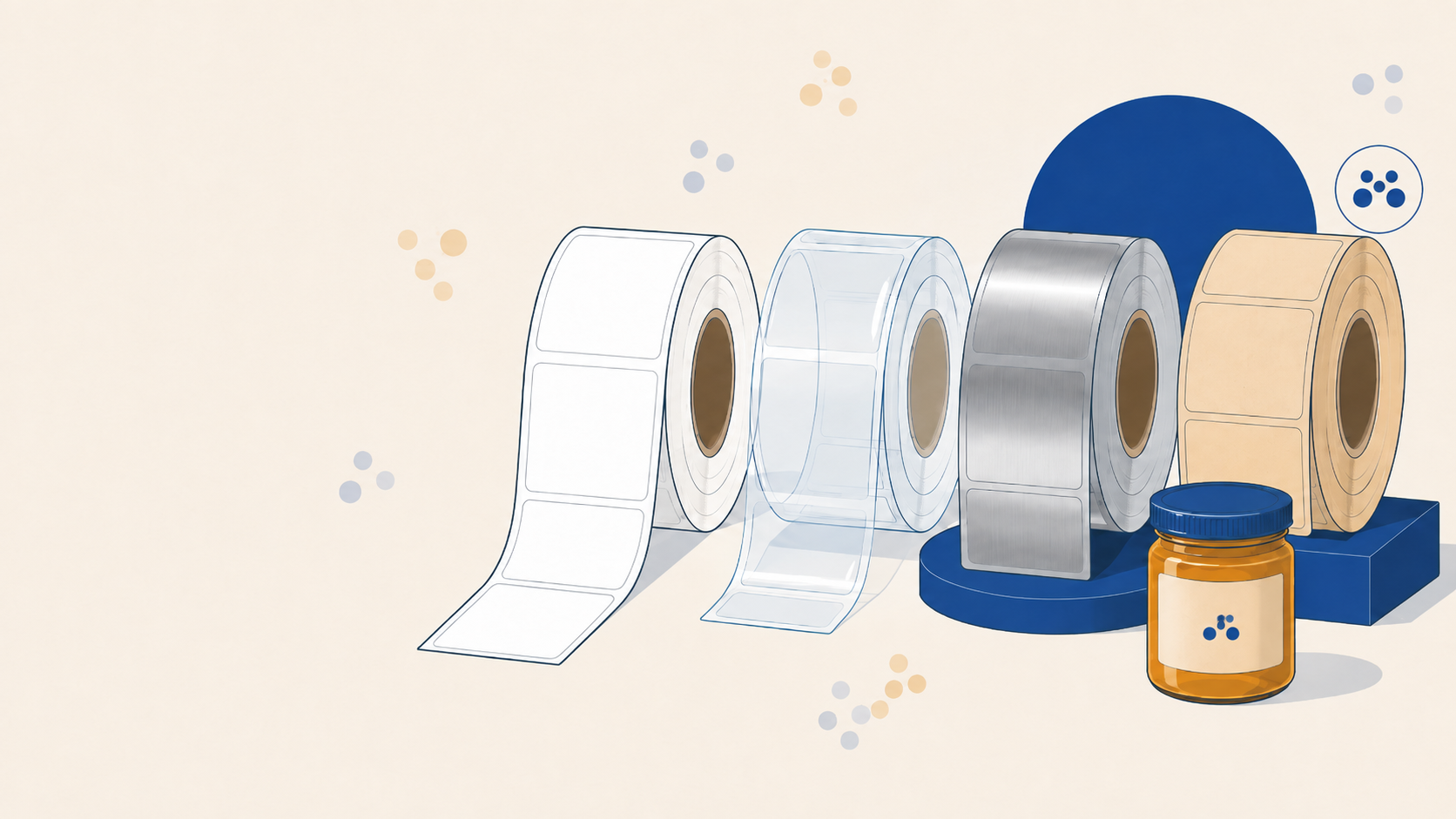
We run four roll label stocks, and they cover the large majority of product labelling jobs:
- White BOPP — the everyday workhorse. Durable synthetic film, water-resistant, cost-effective.
- Clear BOPP — for a partial "no-label" look on glass or clear plastic, printed with a white underprint.
- Silver (metallic) BOPP — for a premium, high-end finish, usually with a white underprint and lamination.
- Matt paper — a softer, more natural look for brands that want a non-plastic feel.
All four run on a single acrylic permanent adhesive. It is a genuine all-rounder: it holds on chilled and frozen product without the label lifting, which is where a lot of cheaper labels fail. We do not run removable, high-tack, or hot-melt adhesives, so if a job specifically needs a peelable or repositionable label, we are not the right fit and it is better to know that upfront.
Lamination sits on top of any of these as an optional durability layer, and it is the single most useful upgrade for labels that get handled hard.
Which stock for which job
The right stock is almost always decided by where the product lives and how it gets treated. Here is how we steer it.
Fridge, freezer, or ice bucket
Go BOPP. It is a synthetic film, so condensation and moisture do not break it down the way they break down paper. The acrylic permanent adhesive holds through the cold, which is exactly where a lot of labels quietly let go and start curling at the corners. For anything chilled, frozen, or sitting in ice, BOPP is the safe answer.
Handled, rubbed, or scuffed a lot
Laminate it. Whatever the base stock, a laminate is what stops scuffing, smudging, and abrasion from wrecking the print. Cosmetics, tools, anything that gets picked up and put down constantly, anything that rides in a courier bag: lamination is the difference between a label that still looks new and one that looks tired in a week.
Premium, high-end look
Silver BOPP, laminated, with a white underprint. The metallic base gives a genuine premium feel that paper and white film cannot match, the white underprint keeps your colours solid and true over the metallic, and the laminate protects the finish. This is the combination we reach for when a brand wants the label itself to signal quality.
Cheapest option that still works
White BOPP, unlaminated. It is the most cost-effective stock we run and still gives you a durable, water-resistant synthetic label. For a lot of everyday product labelling, this is all the job needs.
A softer, non-plastic look
Matt paper. When a brand wants a natural, understated, non-shiny feel, matt paper delivers it in a way film cannot. Just match it to the environment: paper is the least moisture-tolerant of the four, so it suits dry, indoor, gently-handled products rather than anything chilled, wet, or heavily abraded.
A fully clear "no-label" look
Clear BOPP gets you most of the way there, printed with a white underprint so your artwork stays solid rather than translucent on the glass or plastic. Worth setting expectations: we do not run an optically clear stock, so this is a clear-film look rather than a true invisible-label finish. For most applications the difference is minor, but if a completely invisible substrate is essential, we are not the right supplier for that specific job.
The outdoor and UV question
This one is worth being straight about, because it is where labels get chosen wrong most often.
Roll labels are not an outdoor-durable product. Unlaminated BOPP outdoors will hold for a few months at most before the print starts to go, and even laminated it is not built to live in Australian sun long term. If the job genuinely needs to survive weeks or months of direct outdoor exposure and UV, a label is the wrong product. That need points to printed stickers or decals on outdoor-rated media, which is a different product built for the job.
Choosing an indoor label for an outdoor application is a false economy. Better to spec the right outdoor product from the start than to reprint in three months.
Colour and print: what to know before you design
A few first-party realities that catch people out, worth building into your artwork rather than discovering on the proof.
Clear and silver stocks need a white underprint. On clear film and metallic silver, your colours print translucent or muted unless there is a layer of white ink laid down first. The white underprint is what makes the artwork read as solid and true. We handle this as part of the setup, but it is worth knowing it is happening, because it affects how your colours will look.
Design for cut movement. The die or laser cut can move by roughly 1 to 2mm during production. That is normal and within tolerance, but it means thin borders are risky. A 1mm keyline around the edge of a label will look uneven if the cut shifts even slightly, showing more border on one side than the other. Either avoid thin edge borders, or make them generous enough that a small shift does not show. This is the single most common artwork mistake we see on labels.
Our inks are UV-cured (Durst Tau), not food-grade. That is important to state plainly: our labels are suitable for labelling food and beverage packaging, but the inks are not certified for direct food contact. If a label will touch food directly rather than sit on the outside of packaging, we are not the right choice for that application.
What makes our label production different
A couple of things worth knowing if you are comparing trade suppliers.
Laser cutting, done properly. Our labels are laser cut with no white edge and a cut depth tuned so it never cuts too deep into the backing. The white-edge problem, where a poorly cut label shows a thin pale line around its border, is a common giveaway of cheap production. Clean laser cutting is what gives a label a crisp, finished edge.
Trade-only and blind shipped. Like everything we produce, our roll labels are trade-only and white-label. They ship blind, with no Mediapoint branding, so resellers, designers, and print brokers can supply them as their own.
Fast turnaround. Standard custom roll label orders start at two business days.
Frequently Asked Questions
What is the most durable roll label stock? Laminated BOPP. The BOPP film is water-resistant and synthetic, and the laminate adds abrasion and scuff resistance on top. For the most premium and protected result, laminated silver BOPP with a white underprint is the strongest combination we run. Paper is the least durable of the stocks and suits dry, gently handled products.
Will your labels survive the freezer? Yes. BOPP stock combined with our acrylic permanent adhesive holds on chilled and frozen product without lifting, where cheaper labels and paper stocks tend to curl and let go. Choose BOPP rather than paper for anything cold or damp.
Can I get a completely clear, invisible label? We run clear BOPP, which gives a clear-film "no-label" look with a white underprint to keep colours solid, but we do not run an optically clear stock, so it is not a truly invisible finish. For most glass and clear-plastic applications clear BOPP looks great; if a fully invisible substrate is essential, we are not the right supplier for that specific job.
Are your labels waterproof? The BOPP stocks are water-resistant and handle moisture, condensation, and chilled or damp environments well. They are not, however, built for long-term outdoor UV exposure. For products that live outdoors for months, a sticker or decal on outdoor-rated media is the correct product rather than a roll label.
Can I use these labels on food? They are suitable for labelling food and beverage packaging, but our inks are UV-cured and not certified for direct food contact. If the label will contact food directly rather than sit on the outside of the packaging, we are not the right choice for that use.
Do you offer removable or repositionable labels? No. We run a single acrylic permanent adhesive, which is ideal for labels meant to stay put, including in cold environments. We do not offer removable, high-tack, or hot-melt adhesives, so a job that specifically needs a peelable label is outside what we supply.
Key takeaways
- We run four roll label stocks: white BOPP, clear BOPP, silver BOPP, and matt paper, all on acrylic permanent adhesive.
- BOPP is the answer for anything chilled, frozen, or damp. Paper suits dry, gently handled, natural-look products.
- Laminate any label that gets handled or scuffed hard. It is the most useful durability upgrade.
- Silver BOPP, laminated, with a white underprint is the premium choice.
- White BOPP unlaminated is the cost-effective everyday option.
- Roll labels are not built for long-term outdoor UV. That need points to stickers or decals instead.
- Design for 1 to 2mm cut movement: avoid thin edge borders, and remember clear and silver stocks need a white underprint.
Order custom roll labels
Once you have matched the stock to the product, the rest is straightforward. Mediapoint runs trade-only, blind-shipped roll labels across all four stocks, laser cut with a clean edge and turned around from two business days. Have a look at roll labels or send through your artwork for a quote, and we will help you confirm the right stock before it goes to print.