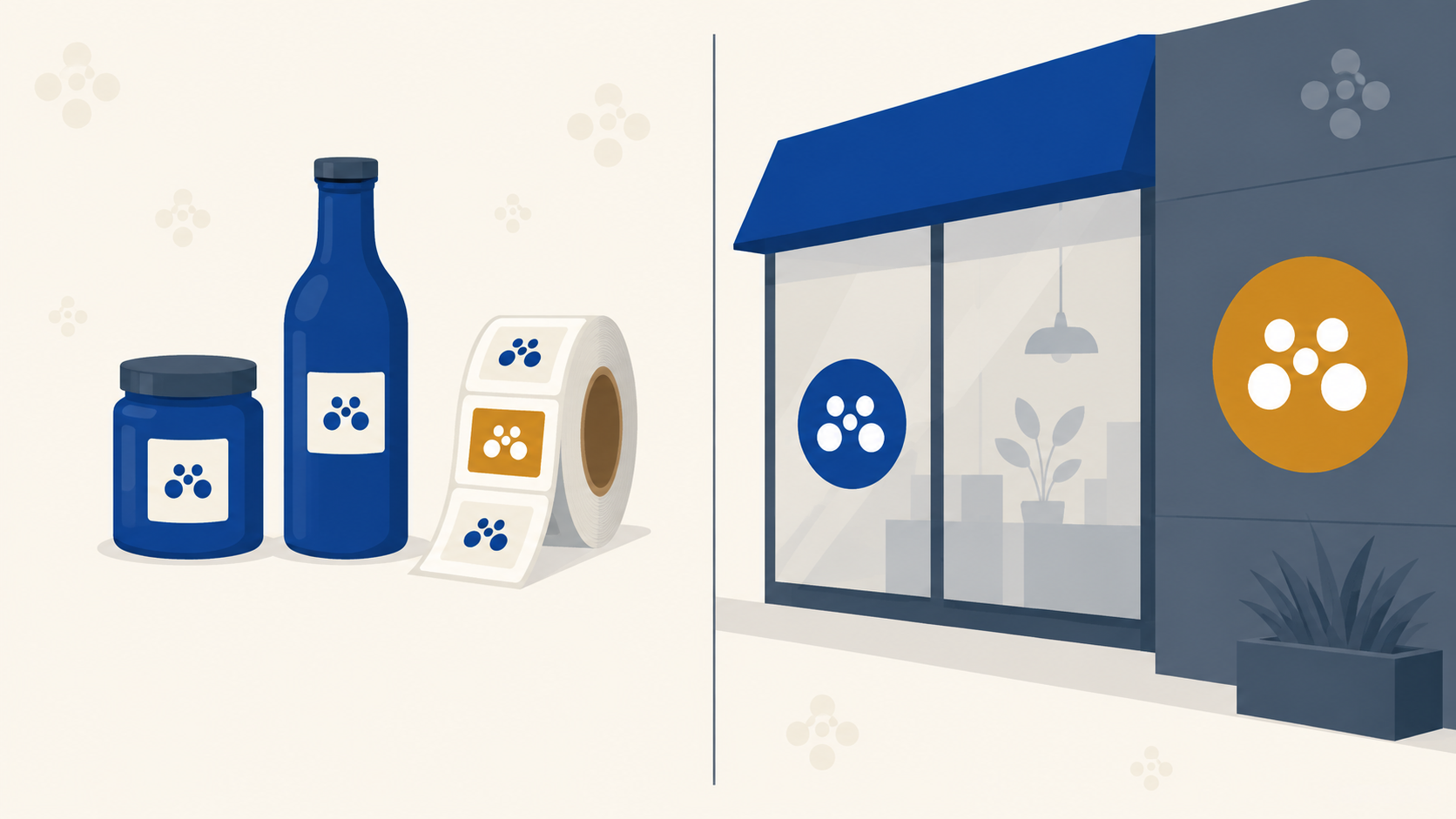
"Sticker" and "label" get used interchangeably right up until it is time to order, and then the difference suddenly matters. They are different products, made on different equipment, at different sizes and price points, for different jobs. Ordering the wrong one is how you end up with product labels that fade on a window, or paying sticker prices for something a label run would have done for a fraction of the cost.
Here is the honest split, from a floor that produces both.
The one-line answer
Products get labels. Surfaces get stickers.
If it is going on a jar, bottle, tub or package, you want roll labels. If it is going on a window, wall, floor, vehicle or sign, you want large format stickers. Nearly every real order resolves cleanly with that rule, and the rest of this guide is the reasoning behind it.
Two different production lines
The deeper reason the products differ is that they are made differently.
Roll labels run on our dedicated digital label press. Labels are printed and laser cut in continuous runs, supplied on 76mm cores, outside wound, ready for hand application or a label applicator. The process is fast and efficient, which is why the per-unit cost is low and why labels suit volume: hundreds or thousands of identical pieces for product packaging.
Large format stickers are UV printed on heavier self-adhesive vinyls and individually cut on our Zund digital cutters. Each sticker is a bigger, tougher piece of print, built for surfaces and weather rather than packaging lines, and priced accordingly.
Same family, different machines, different economics. That is why a 60mm product label and a 600mm window sticker are not just different sizes of one thing.
Size ranges tell the story
- Roll labels: from 30 x 30mm up to 297 x 1000mm, at product-labelling scale.
- Large format stickers: built for bigger work, shopfront glass, wall graphics, floor decals, vehicle panels.
There is overlap in the middle, and when a job sits in that overlap the deciding factors are the ones below: quantity, surface, and exposure.
Quantity: rolls win on volume
Need 500 or 5,000 of the same design for packaging? That is label territory, and the label press's economics are the reason: continuous production on rolls is substantially cheaper per unit than individually cutting stickers.
Need five window graphics, twenty wall decals, or one floor graphic per store? That is sticker territory, where individual cutting is exactly what the job calls for.
As a rule of thumb: high quantity of one design at small-to-medium size points to rolls; low quantity at larger size points to stickers.
Surface and exposure: the deciding factor for anything outdoors
This is the line we repeat most often, because it prevents the most failed jobs:
Roll labels are not an outdoor product. Label stock handles fridges, moisture and product life well, but it is not built for months of Australian UV. A label in direct sun will visibly degrade within a few months.
Stickers are the outdoor product. Sticker vinyls run 2 to 3 years outdoors unlaminated, with lamination adding roughly 1 to 2 more, and the range includes films for brick and render, slip-rated laminate for floors, and reversed stickers that live protected behind glass. Our outdoor durability guide covers the honest numbers.
So the exposure question overrides everything else. Even if the job "feels like" a label, if it lives outside for months, it is a sticker.
Adhesive options differ too
- Roll labels run a single acrylic permanent adhesive, an all-rounder that holds through cold and damp, ideal for labels meant to stay on a product for its life. There is no removable label option in our range.
- Stickers come in permanent and removable versions. Removable vinyl releases cleanly for up to around a year, which is what makes stickers the right call for retail windows, seasonal campaigns and surfaces you do not own.
If clean removal is part of the brief, that alone decides it: sticker, removable stock.
Quick decision guide
- Product packaging, jars, bottles, tubs → roll labels.
- Hundreds or thousands of one design → roll labels.
- Fridge, freezer, damp product environments → roll labels (BOPP stock).
- Windows, walls, floors, vehicles, signage → stickers.
- Anything outdoors for months or years → stickers, laminated for long-term.
- Needs to come off cleanly later → stickers, removable vinyl.
- Shopfront glass, message faces the street → reversed stickers, applied inside.
- Brick, block or rendered walls → stickers, textured-surface film.
- Sheet format, a few designs per backing → our kiss-cut sticker sheet product (up to five kiss cuts per sheet).
For the full stock detail on each side, see the roll label material guide and the sticker material guide.
Frequently Asked Questions
What is the difference between a sticker and a label? In our range, labels are produced in continuous runs on a digital label press, supplied on rolls for product labelling, while stickers are individually printed on heavier vinyl and cut on digital cutters for application to surfaces like windows, walls, floors and vehicles. The practical rule: products get labels, surfaces get stickers.
Which is cheaper, labels or stickers? Per unit, roll labels, by a wide margin at volume, because continuous roll production is a faster, more efficient process than individually printing and cutting stickers. Stickers cost more per piece because each one is a larger, tougher, individually cut product. The comparison only really arises when a job sits in the size overlap; quantity usually settles it.
Can I use labels outdoors instead of stickers? Not for anything beyond a few months. Label stock is built for product environments, including fridges and moisture, but not for sustained Australian UV, and it will visibly degrade outdoors within months. Outdoor jobs belong on sticker vinyl, laminated for multi-year exposure.
Do you do removable labels? No, our roll labels run permanent adhesive only. Removable is a sticker option: our removable vinyl releases cleanly for up to around a year, which covers retail windows, campaigns and temporary signage.
What if my job is in between, medium size, medium quantity? Tell us the surface, the quantity and how long it needs to last, and we will spec it honestly, including telling you when the cheaper option genuinely does the job. Exposure usually decides it: outdoor or long-term points to sticker, product packaging at volume points to label.
Key takeaways
- Products get labels; windows, walls, floors and vehicles get stickers.
- Labels run on a label press in continuous rolls, which is why they are substantially cheaper per unit at volume.
- Stickers are individually cut on heavier vinyl, built for surfaces and weather.
- Exposure overrides everything: months outdoors means sticker, regardless of what the job resembles.
- Removable exists only on the sticker side; labels are permanent adhesive only.
- When a job sits in the overlap, quantity, surface and lifespan decide it, and we will spec it straight if you tell us those three.
Order the right product first time
The fastest way to a good outcome is telling us three things: what it is going on, how many you need, and how long it has to last. Mediapoint produces both trade-only, blind-shipped roll labels and large format stickers, so we have no reason to steer you to the wrong one. Send the job through for a quote and we will match it to the right line.