Large format printing costs vary significantly between providers, formats, and volumes — which is why getting a straight answer on pricing can be difficult. The question of how much a job will cost ultimately comes down to a small number of underlying drivers, and understanding them helps print resellers, agencies, and signage companies price their own work more confidently and choose the right production partner.
This article breaks down the five main factors that determine large format printing costs, explains how pricing is calculated in practice, and outlines why trade printing typically delivers better margins than in-house production for high-volume resellers.
What Drives Large Format Printing Costs?
Five factors account for the bulk of large format printing costs:
- Equipment cost and capacity — the capital outlay on printers, amortised across output
- Ink consumption — measured per square metre, varies significantly by machine
- Floor space and warehousing — needed for equipment, stock, and dispatch
- Finishing equipment and labour — often more expensive than the printer itself
- QA, packaging and dispatch — substantial for oversize formats
Each of these is examined below, along with how they combine into a final price.
1) Equipment Cost and Capacity
Large format printers represent a significant capital investment. That capital cost is amortised across every sheet produced, which means the more sheets a printer can run per hour, the lower the equipment cost per job.
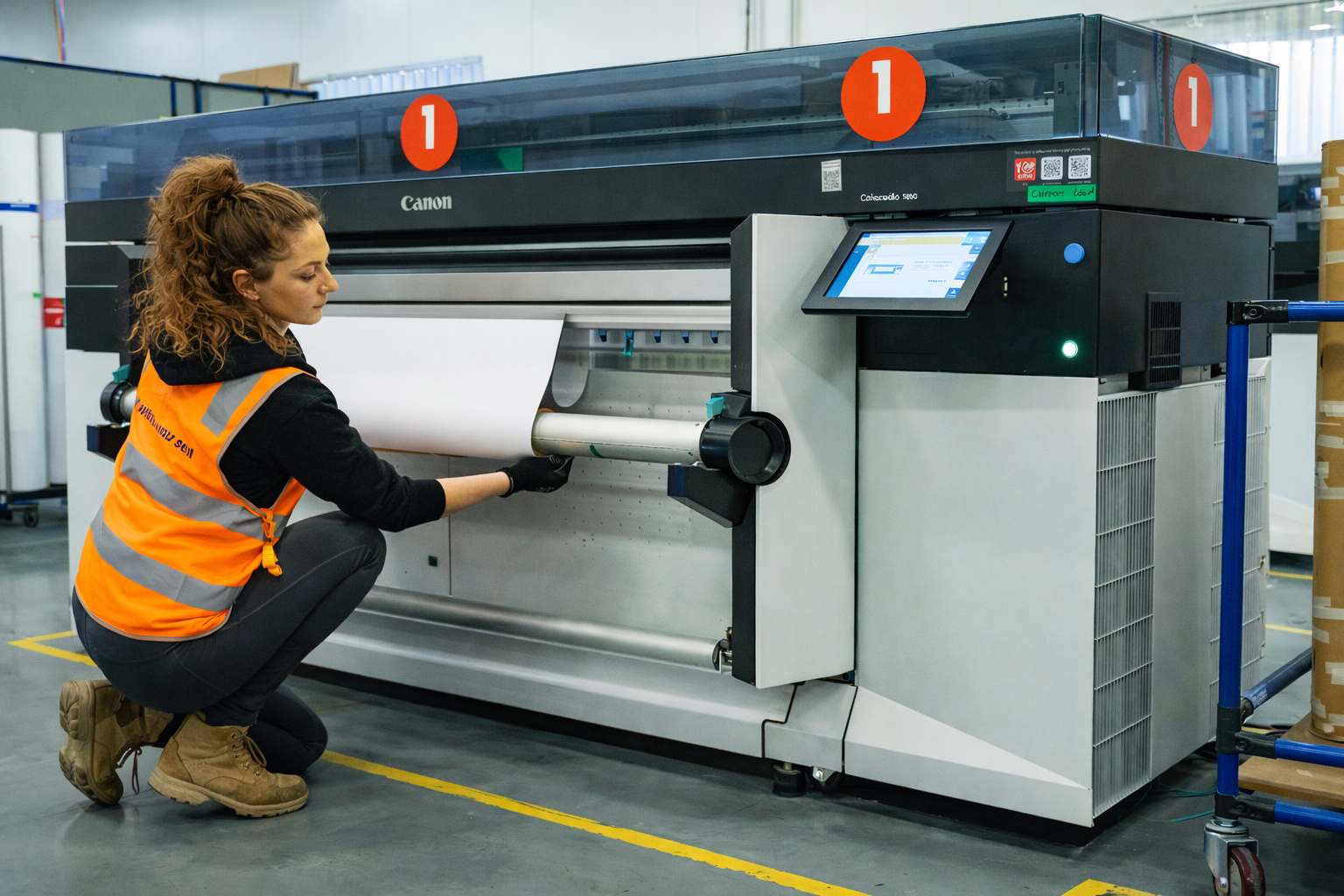
This is why high-capacity equipment matters. Mediapoint operates premium Durst printers configured for high-volume throughput. Combined with streamlined batching processes — grouping similar jobs together to maximise machine utilisation — more output passes through the same equipment in less operational time. The fixed equipment cost gets spread across more square metres of print, which lowers the cost per job and creates the margin we pass on to trade clients.
For high-volume print resellers, this is the optimal trade-off. There are inevitable compromises — limited proofing, batched production windows, standardised quality modes — which is why it's worth understanding the full picture when evaluating a partner. We've covered the questions to ask in our guide on how to evaluate a trade printer.
2) Ink Consumption
Ink is unavoidable, and at scale it becomes one of the largest variable costs in large format printing. Ink usage is measured per square metre and varies considerably between machines. Entry-level and budget equipment tends to be less efficient with ink — the print may still look acceptable, but the cost per square metre is materially higher.
Mediapoint's Durst printers are run in a single optimised print mode. This delivers consistent quality across all jobs while keeping ink usage efficient at high volume. For resellers, this matters because ink efficiency directly affects the wholesale rate available — every cent saved per square metre on ink is a cent of margin or competitive pricing.
3) Floor Space and Warehousing
Large format equipment needs substantial floor space — not just for the printers themselves, but for stock handling, work-in-progress, finishing, and dispatch. Mediapoint operates from over 2,000 sqm of internal warehouse space in Melbourne. That footprint allows the team to work safely and efficiently at volume, and creates room for future capacity expansion.
Floor space is one of the most overlooked costs in print production. It's also one of the biggest barriers for print shops trying to scale capacity in-house. Once existing equipment hits capacity, the next step isn't just buying another printer — it usually means leasing additional floor space or relocating to a larger premises. That step-change in overhead is typically passed through to customers as higher pricing, which puts pressure on commercial relationships and margins.
For a reseller, the alternative is to scale via a trade printer. Capacity becomes a variable cost rather than a fixed one — you only pay for the production you actually need.
4) Finishing Equipment and Labour
Finishing is the part of the process that's most often underestimated. Cutting, eyeleting, hemming, laminating, mounting, and welding all require specialised equipment, and that equipment is frequently more expensive than the print equipment itself. On top of that comes the cost of trained staff, ongoing training, and the operational time required to finish each job to spec.
Finishing is also where economies of scale show up most clearly. A trade printer running consistent finishing workflows on high volume can absorb the equipment and labour cost across thousands of jobs. A print shop running occasional jobs in-house is paying for the same equipment but spreading the cost across far fewer outputs — which is why high-volume, repetitive work is so difficult to justify producing in-house.
5) QA, Packaging and Dispatch
Large format jobs require quality assurance before they ship. The size of the output, the variety of substrates, and the durability requirements (particularly for outdoor signage) mean that visual checks, dimensional checks, and finishing inspection all need to happen before dispatch.
Packaging and freight are also non-trivial. Rolled banners, rigid panels, and finished signage need protective packaging that suits the format and handles the journey to the customer. Larger formats often require palletised freight rather than standard parcel networks. All of this adds to the final cost of a job.
How Large Format Printing Pricing Is Calculated
In practice, large format printing pricing is built up from a combination of the cost drivers above plus a margin. The exact formula varies between providers, but most calculations follow a similar structure:
- Base material cost per square metre (substrate + ink)
- Finishing charges per linear metre or per piece (hemming, eyelets, cutting)
- Setup or minimum charges for small jobs (covering the fixed cost of starting a job)
- Volume discounts as quantity increases (fixed costs amortised across more output)
- Freight based on size, weight, and destination
Two implications matter for resellers:
Volume changes the maths. A single small banner carries a high cost per square metre because setup and minimum charges dominate. The same banner ordered as one of fifty drops dramatically in cost per unit. This is why bulk and repeat work is the natural fit for trade printing.
Specifications matter more than headline price. Comparing two quotes only works if substrate grade, ink type, finishing inclusions, and turnaround are like-for-like. A quote that looks cheaper may exclude eyelets, use a lower-grade substrate, or rely on a slower lead time.
Why Trade Printing Usually Costs Less Than In-House
For print resellers and signage companies, the question often comes down to whether to invest in in-house equipment or partner with a trade printer. The cost drivers above explain why trade printing is usually the more profitable option for high-volume resellers:
- Equipment cost is amortised across far more output
- Ink is purchased and used more efficiently at scale
- Floor space, finishing, and dispatch infrastructure are already paid for
- Capacity scales as a variable cost rather than a step-change capital outlay
For a deeper comparison, see our breakdown of trade printing vs in-house production. Getting the artwork right before submission also keeps costs down — our guide on avoiding common artwork mistakes covers the five issues that most often cause rework charges and delays.
Frequently Asked Questions
How much does large format printing cost per square metre?
The cost per square metre depends on the substrate, ink type, finishing requirements, and volume. Trade printing rates are significantly lower than retail rates because fixed costs are spread across higher production volume.
How is large format printing priced?
Pricing typically combines a base material cost per square metre, finishing charges per linear metre or per piece, any applicable setup or minimum charges, and freight. Volume discounts apply as quantities increase.
Why does large format printing vary so much in price?
The main drivers are equipment cost, ink consumption, floor space and overhead, finishing equipment and labour, and QA and dispatch. Each varies by provider, and small differences in efficiency compound across high-volume production.
Is trade printing cheaper than printing in-house?
For high-volume resellers, almost always. Trade printers spread equipment, ink, floor space, and finishing costs across far more output, which produces a lower cost per unit than most in-house operations can match.
How can I get an accurate large format printing quote?
Provide the finished size, substrate, finishing requirements (eyelets, hemming, cutting), quantity, and delivery address. Trade printers with online portals can return pricing instantly once these details are supplied.
Get a Live Trade Quote
Understanding the cost drivers above is one half of the picture. The other half is having a partner that delivers consistent pricing and turnaround at trade rates.
Mediapoint provides live, transactional pricing through the customer portal — no quote requests, no waiting. Get a live quote at www.mediapoint.com.au to see trade pricing for your jobs in real time.