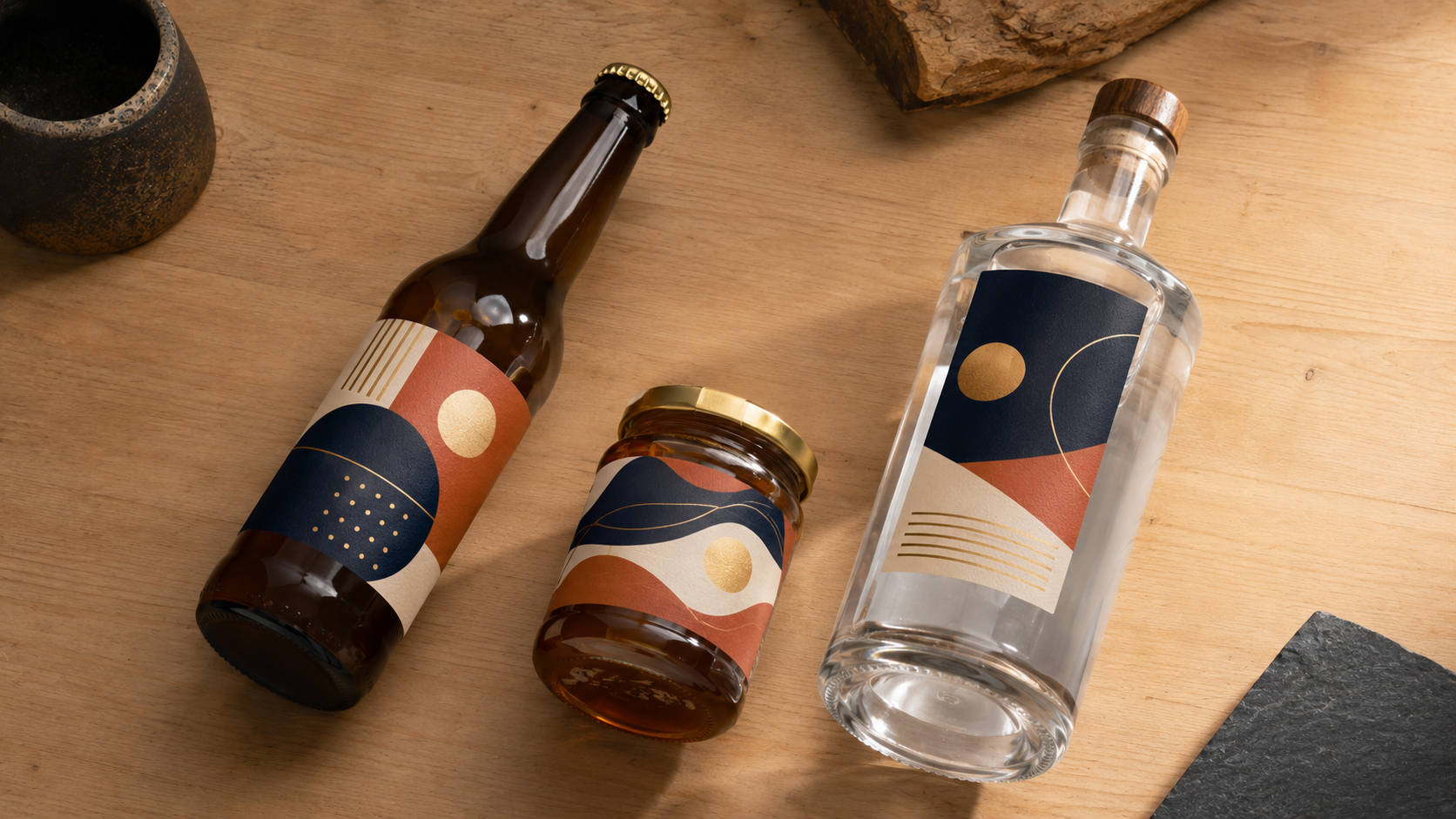
Food and beverage labelling is the highest-volume trade label segment in Australia outside of wine. For sign shops, design studios, and trade resellers fulfilling food and beverage label orders, the work spans craft beer and cider, spirits and ready-to-drink beverages, packaged food products, condiments and sauces, dairy and refrigerated foods, frozen products, and the long tail of specialty food manufacturers.
This guide covers the food and beverage trade label landscape — who the customers are, what they need, how the work differs from wine label trade work, and the substrate decisions, compliance considerations, and operational realities that affect day-to-day fulfilment. The audience is trade customers in the middle: designers and resellers servicing food and beverage producer clients.
For wine-specific guidance, see our wine label printing guide. For broader substrate selection across applications, see the roll label materials guide and our roll label materials guide. This article focuses specifically on the non-wine food and beverage segment.
Important: the information in this article is general reference for trade label work. Food labelling in Australia is regulated under FSANZ standards and state-based food safety legislation. Mediapoint prints supplied artwork; the food and beverage producer (or their regulatory advisor) is solely responsible for ensuring artwork meets all applicable regulatory requirements. The compliance framework summarised here is not legal or regulatory advice.
The food and beverage label customer landscape
Understanding who orders food and beverage labels in Australia helps trade customers position client work correctly and identify the relationships worth investing in.
Craft beverage producers (breweries, distilleries, cideries)
Australia's craft beverage sector has grown substantially over the past decade. Independent breweries, craft distilleries, cideries, and small-batch beverage producers are now meaningful customers for trade label work. The typical customer profile: small-to-mid producers running multiple SKUs with frequent label refreshes for seasonal releases, limited editions, and varietal launches.
Trade label characteristics for this segment:
- Multiple SKUs per producer (different beers, different gin botanicals, different cider styles)
- Frequent release cycles (seasonal beers, monthly limited editions, vintage spirits)
- Strong brand-design focus (craft positioning depends on label aesthetic)
- Price-sensitivity within the trade-printer tier (competing with consumer-facing brands like Vistaprint)
- Bottle vs can format mix (some producers run both, requiring two label specifications)
For trade customers: craft beverage clients are often long-term high-value relationships because of the multi-SKU, multi-release pattern. A single craft brewery can generate 20-40 label jobs annually across its product range. The relationship investment pays back over years.
Specialty food manufacturers (sauces, condiments, preserves, snacks)
The Australian specialty food sector includes pasta sauces, premium oils, condiments, hot sauces, jams and preserves, honey, snacks, dry goods, and the broad range of artisan and small-batch food producers selling through delis, farmers' markets, specialty retailers, and direct-to-consumer channels.
Trade label characteristics for this segment:
- Smaller producers with limited ranges (often 3-15 SKUs total)
- Less frequent release cycles than craft beverage (annual seasonal launches rather than monthly)
- Strong craft and provenance positioning in many cases
- Mixed substrate preferences (matt paper for craft positioning, BOPP for moisture-prone products)
- Often sold direct-to-consumer with brand storytelling on the label
For trade customers: specialty food clients typically have lower per-client volume than craft beverage but stronger creative collaboration potential. The label design often becomes a central part of the brand identity.
Dairy and refrigerated food producers
Cheese makers, yoghurt producers, butter and dairy specialty producers, refrigerated ready-meal manufacturers, deli product producers. The substrate decision is constrained by refrigeration requirements (BOPP only for sustained refrigerated storage), and the compliance framework includes both general food labelling and dairy-specific requirements.
Trade label characteristics:
- Higher regulatory complexity than non-dairy food labelling
- BOPP substrate dominant (paper doesn't survive sustained refrigeration humidity)
- Often time-sensitive (best-before dates, vintage runs, seasonal product launches)
- Mix of small artisan producers and larger commercial operations
Frozen food producers
Ice cream, frozen meals, frozen seafood, frozen specialty products. The substrate must adhere through deep cold storage and survive temperature variation through defrost and refrigeration cycles.
Trade label characteristics:
- BOPP substrate required (paper fails at frozen temperatures)
- The acrylic adhesive holds on chilled and frozen product without lifting
- Often higher production volumes than dairy or specialty food
- Mix of contract manufacturing and direct producer relationships
Packaged food brands (mass-market, supermarket-tier)
Larger packaged food brands typically have established label printing relationships with high-volume label printers. The trade label opportunity in this segment is usually limited supplementary or specialty work — limited editions, promotional runs, regional variants. Not typically the core trade customer base.
For trade customers: don't chase mass-market packaged food brands as your primary client base. The volume requirements and pricing expectations rarely fit trade printer economics. Focus on the craft, specialty, and mid-market producers where Mediapoint's trade pricing and turnaround are competitive.
What food and beverage label work needs that wine label work doesn't
Wine label trade work and food and beverage label trade work share substrate options, pricing structure, and order workflow. But there are meaningful differences worth understanding.
Broader compliance framework than wine
Wine labels are governed primarily by FSANZ Standard 2.7.1 (Labelling of alcoholic beverages), Wine Australia regulations, and Country of Origin requirements — for a detailed wine compliance reference, see our wine label compliance requirements guide. Food labels are governed by a wider range of FSANZ standards covering general food labelling, nutrition information, ingredient declarations, allergen warnings, country of origin, organic claims, health and nutrition claims, and category-specific requirements (dairy, meat, infant formula, supplements, etc.).
For trade customers: the compliance recognition checklist for food labels is broader than for wine labels. The general framework — ingredients list, nutrition information panel, allergen warnings, country of origin, producer details, lot identification, best-before/use-by dating — applies to most food products but with significant variation by category. Don't try to be the compliance authority; recognise that food clients should be engaging with regulatory advisors before submitting artwork.
Nutrition information panels (NIPs) — mandatory on most foods
Unlike wine (which is currently exempt from nutrition information panels until the August 2028 energy statement requirement), most packaged food products require a Nutrition Information Panel showing energy, protein, fat, saturated fat, carbohydrate, sugars, sodium, and any other declared nutrients per serving and per 100g/100mL.
The NIP must follow a prescribed tabular format. Food producers typically have NIP software or use a regulatory advisor for the calculation. The NIP must be positioned legibly on the label and survive at the printed size.
For trade customers: when a food label artwork file arrives without a Nutrition Information Panel, that's a strong signal the artwork isn't compliance-complete. Raise it with the client before submission. The NIP is genuinely complex (specific format requirements, calculation methodology, legibility thresholds) and is the area where food labels most commonly fail compliance.
Ingredient lists with allergen highlighting
Food labels typically require an ingredients list in descending order by weight, with mandatory allergen declarations highlighted (currently using bold or otherwise emphasised text per FSANZ requirements). The allergen highlighting requirements are stricter than wine allergen declarations — they apply to a longer list of allergens (peanuts, tree nuts, milk, egg, fish, shellfish, soy, wheat, sesame, lupin, plus sulphites at higher concentrations).
Best-before and use-by dates
Most food products require best-before or use-by date marking. The format and visibility requirements vary by product category. Highly perishable products (fresh dairy, meat, ready-meals) require use-by dates; shelf-stable products typically use best-before dates.
For trade customers: best-before/use-by dating is usually applied at the packaging stage rather than printed onto the label itself, but the label artwork should leave appropriate space for date stamping. Confirm with the client whether the date is being printed on the label, stamped on the package, or applied via separate sticker.
Health and nutrition claims
If the food product makes any health or nutrition claim ("low fat," "high fibre," "source of protein," "gluten free," "organic," etc.), the claim is regulated and the producer must be able to substantiate it. Some claims require specific qualifying criteria; others require regulatory approval before use.
For trade customers: health and nutrition claims on incoming artwork are the producer's compliance responsibility, not the trade customer's. But recognising that these claims are regulated helps you have the right conversation with clients about whether they've worked through compliance with their regulatory advisor before submitting artwork.
Organic certification
If the product is labelled as organic, biodynamic, or similar claims, certification from an accredited body is typically required (such as Australian Certified Organic, NASAA, or Demeter for biodynamic). The certification body's logo and certifier number must appear on the label. Without certification, organic claims may be considered misleading under Australian Consumer Law.
Substrate decisions for food and beverage trade work
The substrate selection logic from the broader comparison article applies, but with specific food and beverage emphasis worth covering.
Craft beer bottles and cans
Glass bottles: white BOPP for most craft beer applications. The substrate survives ice bucket service, fridge condensation, and varied retail conditions. Silver BOPP for premium positioning, limited editions, anniversary releases.
Aluminium cans: white BOPP for can wrap labels. The substrate's flexibility handles can curvature; the acrylic adhesive holds reliably on aluminium. Can wrap labels are typically larger format (200-250mm wide for standard 375mL cans, 250mm+ for tallboy or specialty cans), so confirm production format compatibility with Mediapoint before quoting.
Cider, ready-to-drink beverages, soft drinks
Same logic as craft beer. White BOPP for moisture-prone refrigerated applications. Silver BOPP for premium ready-to-drink positioning. Matt paper rarely the right answer for chilled beverage applications.
Spirits (gin, vodka, whiskey, rum, liqueurs)
The substrate decision varies significantly by spirit positioning:
- Premium spirits in clear bottles: clear BOPP with white ink underlayer for the "no label look" that's become standard premium spirit positioning. Gin and vodka particularly benefit from clear BOPP showing the bottle through.
- Standard premium spirits: white BOPP with matt lamination for the soft-touch premium feel.
- Ultra-premium and limited editions: silver BOPP for metallic positioning, or route to specialist printer for foil and embossing work.
- Liqueurs and flavoured spirits: white BOPP standard, often with matt lamination.
Specialty food products (jams, sauces, oils, condiments)
The substrate decision depends primarily on storage environment and brand positioning:
- Ambient shelf, room-temperature storage: matt paper works for craft positioning. White BOPP for premium or moisture-prone products.
- Products that may be refrigerated after opening: white BOPP avoids substrate degradation through fridge moisture cycles.
- Premium gift packaging or limited editions: silver BOPP or matt lamination on white BOPP.
- Artisan and craft positioning: matt paper for the warm tactile feel — particularly suited to honey, jam, preserves, dry goods.
Dairy products
White BOPP standard across the dairy category. The substrate's moisture resistance handles refrigeration; Labels go on the outside of the packaging only: the adhesive is not food grade, so it must not contact the product. Matt paper isn't suitable for sustained refrigerated storage.
Frozen food products
White BOPP only. The acrylic adhesive holds through frozen storage. Apply labels to packaging at room temperature before the product goes into the freezer, not to already-frozen surfaces.
Cosmetic-adjacent food products (botanical extracts, infused oils, premium hot sauces)
Many food products positioned with cosmetic-style premium aesthetics — botanical-infused olive oils, premium hot sauces with elevated branding, specialty vinegars — benefit from substrate choices typically associated with cosmetic positioning. Clear BOPP for see-through bottle aesthetics, silver BOPP for premium positioning, matt lamination on white BOPP for soft-premium feel.
Operational realities of food and beverage trade work
How food and beverage label trade work runs day-to-day, and where it differs from wine label work.
Higher SKU velocity than wine for many clients
Craft beverage producers in particular can run a high number of label jobs annually — seasonal beers, limited editions, single-batch releases, festival editions. A single craft brewery with 8-10 core beers plus seasonal releases might generate 25-40 label jobs per year. Wine producers typically run fewer total SKUs but more bottles per SKU.
For trade customers: build workflow efficiency for high-SKU clients. Templated quote forms, streamlined file handling conventions, and clear naming conventions across multiple jobs per client save meaningful time over an annual relationship.
Tight bottling and packaging timelines
Craft beverage and specialty food production often runs to tight schedules. Brewers tank a batch, plan the bottling date, and need labels in hand 5-7 business days before bottling. Specialty food producers planning a launch need labels well before the product is packed.
The cascade of timing matters: artwork received by the trade customer needs to allow time for prepress submission, production turnaround, finishing, and shipping to arrive ahead of the producer's bottling or packaging date. Building 10-14 business days of buffer between artwork approval and producer's needed-by date is standard practice.
Multi-SKU orders combined for production efficiency
Mediapoint runs single-design jobs (each unique label is a separate production run), but multiple jobs can be combined within a single order for shipping and pricing efficiency. For craft beverage producers running 4-8 SKUs through label refresh, combining jobs into one order makes sense operationally.
For trade customers: when a client orders multiple labels at once, submit them as separate files with clear naming conventions (e.g., "Brewery Name - Beer Name - 90x110mm qty 1000.pdf") within one order. Each design runs separately at the press but the order workflow stays consolidated.
Mock-ups and sample orders for brand-critical work
Food and beverage producers launching new products or refreshing core brand identity often want printed samples before committing to a full production run. Sample orders confirm colour fidelity, substrate behaviour, and overall print quality before the producer commits to large volumes.
For trade customers: build sample ordering into the workflow for new client relationships and brand-critical work. The cost of a sample is much smaller than the cost of a reprint after the producer signs off on inaccurate colour reproduction.
Repeat production patterns
Unlike wine label work where vintage changes drive frequent design refreshes, much food and beverage label work involves repeat production of the same artwork — reordering the same SKU multiple times throughout the year as stock depletes. The first production run involves more setup work (file checks, sample approval, colour matching); subsequent runs are typically straightforward reproductions.
For trade customers: track repeat-order patterns for established clients. The marketing investment in winning a new craft brewery client pays back over years of repeat label production on stable SKUs.
Common artwork issues on food and beverage label submissions
The recurring artwork problems Mediapoint's prepress team sees on incoming food and beverage label files. None are Mediapoint's responsibility to fix — the client owns the artwork's compliance and accuracy — but recognising them helps trade customers flag issues before submission.
Nutrition Information Panel missing or incorrectly formatted
Watch for: food label artwork without an NIP, or with an NIP that doesn't follow the prescribed FSANZ tabular format. Consequence: non-compliant for most packaged food products. Action: raise with client immediately; the producer's regulatory advisor or NIP software should produce a compliant panel.
Ingredients list missing, incomplete, or without allergen highlighting
Watch for: artwork with no ingredients list, an incomplete list, or a list without mandatory allergen highlighting (bold or otherwise emphasised). Consequence: non-compliant. Action: confirm with client that the ingredients list is complete and allergens are correctly highlighted per FSANZ requirements.
Health or nutrition claim without substantiation
Watch for: claims like "high in protein," "low sugar," "source of fibre," "gluten free," "organic," "natural" appearing without obvious regulatory framework. Consequence: potentially non-compliant under FSANZ and Australian Consumer Law. Action: confirm with client that the claim has been worked through with a regulatory advisor and meets the qualifying criteria.
Organic claim without certification details
Watch for: "organic," "biodynamic," or similar claims appearing without certification body logo and certifier number. Consequence: potentially misleading under Australian Consumer Law. Action: confirm with client whether the product is certified organic and the certification body details should appear on the label.
Country of origin claim unclear or potentially misleading
Watch for: "Australian Made" or similar claims on products with imported ingredients, or origin claims that don't match the product's actual production. Consequence: potentially non-compliant under Country of Origin Food Labelling Information Standard 2016. Action: confirm with client that the origin claim accurately reflects production.
Use-by or best-before date placement missing
Watch for: artwork without designated space for use-by or best-before dating, when the date is being printed on the label rather than stamped separately. Consequence: dating may not be legible or correctly positioned on production runs. Action: confirm dating workflow with client and ensure artwork accommodates it.
Standard food label substrate problems
The substrate-related issues from the broader comparison article apply to food and beverage work equally: matt paper specified for refrigerated products (substrate degradation), white ink missing on clear or silver BOPP (washed-out colour), inadequate bleed for trim drift tolerance, fonts not outlined causing RIP substitution issues.
Frequently asked questions
Can my client run their food label as a sticker order rather than a roll order?
Mediapoint runs roll label production. Sheet stickers (individual stickers on a sheet rather than continuous roll) are a different product category — for that work, route to a sticker printer. Roll labels are for applicator-line application; sheet stickers are for hand application.
What's the difference between food labels and beverage labels at the printer level?
Operationally minimal. The substrate decision logic applies similarly. The compliance framework differs (beverages don't require NIPs under current regulations until the 2028 energy statement requirement for alcoholic beverages; most packaged foods do require NIPs). The label dimensions and applicator considerations differ by package format (bottle vs jar vs pouch vs box).
Can Mediapoint produce labels for export to international markets?
Yes — Mediapoint prints supplied artwork regardless of destination market. The compliance responsibility is the producer's; if the labels are being prepared for export, the producer must engage with destination-market regulatory requirements separately. Mediapoint doesn't verify export market compliance.
My craft beverage client wants matching label sets across multiple SKUs — how does that work?
Each unique label design is a separate production run. For a craft brewery with 8 core beers using consistent brand identity but different beer-specific design, that's 8 jobs. They can all be combined within one order for shipping and pricing efficiency, but each design runs separately at the press.
For brand-colour consistency across multiple SKUs: specify Pantone Coated references in all the files, request sample orders for brand-colour-critical jobs, and confirm substrate consistency across the range. Same logic as wine label work for multi-SKU consistency.
My client wants a label that doubles as a tamper-evident seal — can Mediapoint produce that?
Mediapoint produces standard adhesive labels. Tamper-evident specialty adhesives, perforated labels designed to fracture on opening, or other security label features are outside the standard product range. Route to a specialist label printer for tamper-evident work.
What's the smallest text Mediapoint can reliably reproduce on a food label?
Digital roll label printing reproduces fine detail well, but practical limits apply. Text under 5-6pt becomes difficult to read once printed, especially on textured substrates or with light colours on dark backgrounds. For compliance content (ingredients lists, allergen declarations, NIPs) where regulatory legibility is required, ensure text is sized appropriately for the substrate and finish.
Can Mediapoint advise on whether my client's food label is compliant?
No. Mediapoint is a trade printer, not a regulatory advisor. The producer (or their regulatory advisor) is solely responsible for ensuring food label artwork meets all applicable FSANZ standards, Australian Consumer Law requirements, and category-specific regulations. For specific compliance questions, the producer must consult FSANZ (foodstandards.gov.au) or a qualified regulatory advisor.
Key takeaways
The points worth remembering when servicing food and beverage label clients.
Craft beverage producers (breweries, distilleries, cideries) are typically the highest-value food and beverage trade label customer category, with multi-SKU multi-release patterns generating sustained annual work.
Food labels typically require a Nutrition Information Panel; alcoholic beverages currently don't (until the August 2028 energy statement requirement). The food compliance framework is broader than wine.
White BOPP is the workhorse substrate across most food and beverage applications — moisture resistance and broad temperature tolerance cover most use cases. All our labels are for the outside of packaging; the adhesive is not food grade.
Frozen food applications specifically require BOPP (not paper) and rely on the acrylic adhesive holding through frozen storage.
Brand-design focus tends to be strong in craft food and beverage segments — premium positioning often calls for matt lamination on white BOPP or silver BOPP.
Multiple SKUs from the same producer combine within one order for efficiency but run as separate production jobs. Build naming conventions and file handling for multi-SKU clients.
Build 10-14 business days of buffer between artwork approval and the producer's needed-by date to allow for prepress, production, finishing, and shipping.
Compliance is the producer's responsibility. Trade customers can flag obvious issues (missing NIP, unhighlighted allergens, unsubstantiated claims) but aren't the compliance authority.
Working with Mediapoint on food and beverage label production
Mediapoint prints digital roll labels for design studios, sign shops, and trade resellers servicing Australian food and beverage producers across craft beverage, specialty food, dairy, frozen, and packaged product categories. Standard turnaround is from two business days after artwork approval. Order minimum is $120 + GST per job. Trade pricing is available for design studios and resellers with regular volume.
View our roll labels product page for current substrate variants and ordering options. For comprehensive substrate selection guidance, see the roll label materials guide and our roll label materials guide. For wine-specific guidance, our wine label printing guide covers the full trade brief for wine label work.
A final note on compliance responsibility: food labelling in Australia is regulated under FSANZ standards, Australian Consumer Law, Country of Origin Food Labelling Information Standard 2016, and category-specific regulations covering dairy, organics, health and nutrition claims, and other product categories. Mediapoint prints supplied artwork as a trade service and does not verify regulatory compliance of supplied artwork. The food or beverage producer (or their regulatory advisor) is solely responsible for ensuring artwork meets all applicable requirements before submission to print. For authoritative compliance information, consult FSANZ at foodstandards.gov.au or engage a qualified regulatory advisor with food labelling expertise.