Construction Site Signage in Australia: Corflute, Compliance and Common Sense
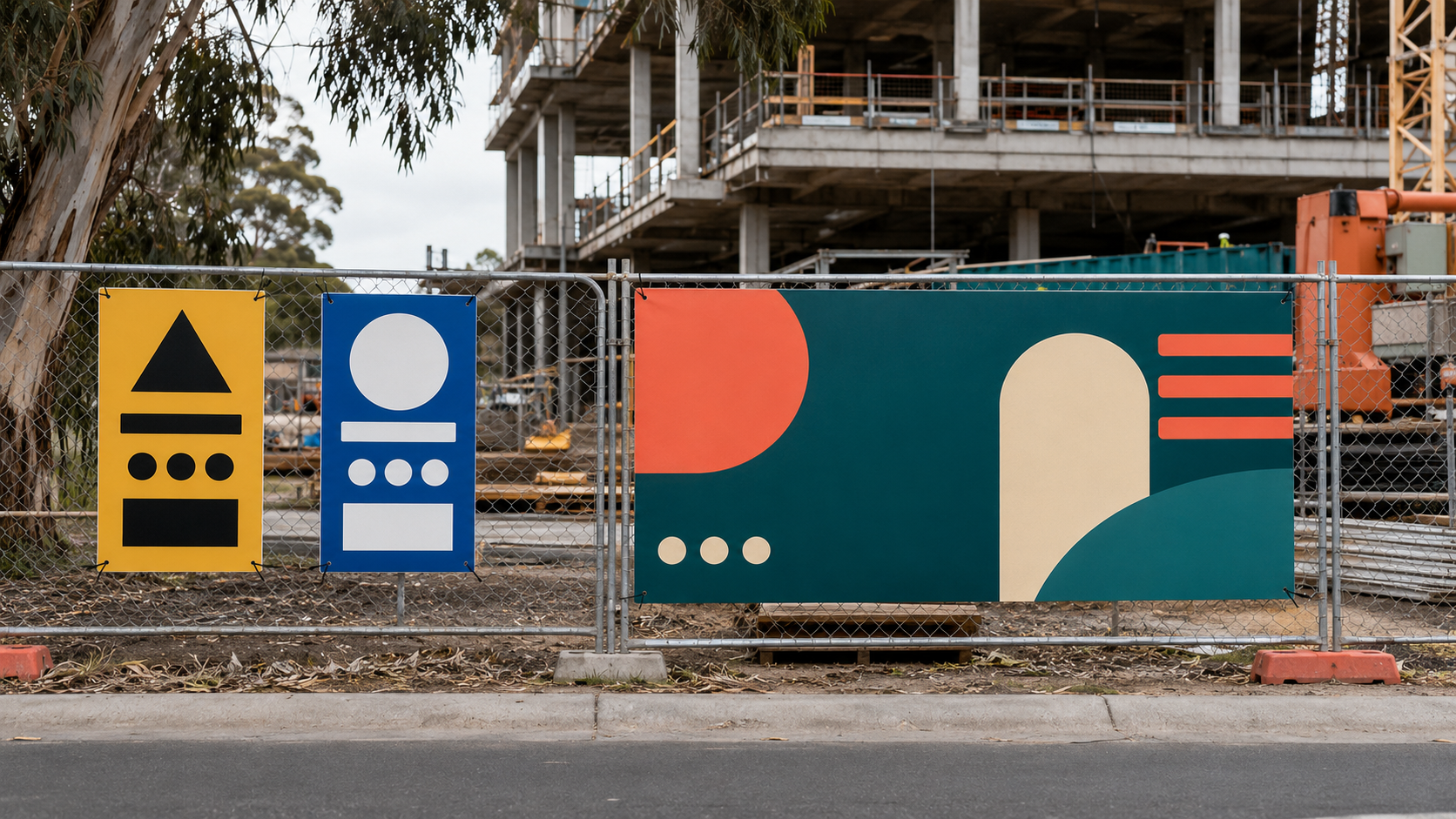
Construction sites generate one of the highest volumes of corflute signage in Australia. A typical commercial build needs site safety signage at every access point, hoarding panels around the site perimeter, project identification at the main entrance, contractor branding on the fencing, and a steady stream of replacement signs throughout the build phase. The economics of corflute (cost per piece at volume, fast turnaround for late-stage signage needs, easy replacement when signs are damaged or stolen) make it the substrate of choice for almost all temporary site signage.
This article is for site managers, project managers, contractor administrators, and signage suppliers serving construction clients. It covers AS 1319 compliance, standard sizes for site work, mounting methods (especially cable-tie on temporary fencing), substrate selection for different sign categories, and operational planning around the construction lifecycle.
For the comprehensive overview of corflute signage in Australia, see our guide to corflute signs. This article is the focused companion piece on construction.
Important: this article provides general guidance on construction site signage based on Mediapoint's product knowledge and general industry practice. It is not legal advice or formal compliance guidance. AS 1319 compliance and Work Health and Safety obligations are the customer's responsibility and depend on site-specific factors that only a qualified WHS advisor or compliance professional can assess for your project. For specific compliance questions on your site, consult Standards Australia or a qualified WHS advisor before specifying or ordering signage. Mediapoint prints what is supplied and is a print partner, not a compliance authority. The customer is responsible for ensuring artwork and substrate choice meet WHS requirements for the intended application.
Why corflute dominates Australian construction site signage
Corflute became the construction signage default for four reasons that still hold today. Site managers and signage suppliers quoting on construction work should know all four, because each one comes up in client conversations during a typical project.
Cost per piece at volume
A typical construction project orders dozens to hundreds of signs across multiple categories: safety, hoarding, identification, contractor branding. Sheet-based corflute pricing makes the volume work commercially viable. Standard sizes get the best per-piece economics, and project-scale orders typically hit volumes where the unit price drops sharply.
12 to 24 month substrate life matches project duration
Most commercial builds finish within corflute's working life. A typical 12 to 18 month build phase is comfortably inside the substrate's window. Larger multi-year developments may need replacement runs, particularly for project identification that needs to stay looking fresh, but for the bulk of construction signage the substrate outlasts the requirement.
Fast turnaround for late-stage signage needs
Construction signage requirements often emerge late: permit conditions issued during build, safety incident response that needs additional signage fast, contractor changes that require updated branding within days. Mediapoint's next-business-day production fits the construction timeline. The substrate that can be reordered and on site within a week is the substrate that gets specified.
Easy replacement when damaged
Construction sites are hard on signage. Equipment knocks signs off fencing, theft is common at street-facing perimeters, vandalism happens. Cheap-per-piece corflute means replacement runs are economical and don't blow the project budget. The replacement model is built into the way corflute gets used in construction.
When corflute isn't the right call for construction: long-running multi-year developments where premium identification signage stays in place for the full project. ACM is often the right substrate for permanent project identification at major developments — the cost premium pays for itself when the alternative is multiple corflute replacements over 3+ years.
Site safety signage and AS 1319 compliance
Compliance disclaimer for this section: the AS 1319 information below is general reference, not formal compliance guidance. The standard's application to your specific site depends on factors only a qualified WHS advisor or compliance professional can assess. Use this section to understand the framework; consult appropriate professionals for specific compliance decisions.
AS 1319-1994 (also written as AS/NZS 1319) is the Australian Standard for safety signs in the occupational environment. It applies to construction sites because they are workplaces under Work Health and Safety legislation. The standard itself is not automatically legally binding, but it is referenced throughout WHS Regulations and Codes of Practice as the benchmark for compliant workplace signage. Failing to comply with AS 1319 typically means failing the WHS audit.
What AS 1319 covers
AS 1319 sets the requirements for design, colour, shape, size, viewing distance and mounting of safety signs in occupational environments. The standard organises signs into six categories, each with specific colour and shape conventions. Prohibition signs (no smoking, no entry, etc.) use a red circle with a diagonal slash on a white background, with black text. Mandatory signs (must wear PPE, must report, etc.) use a blue circle with a white pictogram and black text. Danger signs use a strict red, black and white format for the highest hazard level. Warning signs use a yellow triangle with a black border, black pictogram and black text. Emergency information signs use a green background with white pictogram and text. Fire protection signs use a red background with white pictogram and text.
Sizing requirements
AS 1319 specifies pictograms at least 15mm per metre of viewing distance and lowercase text at least 4mm per metre of viewing distance, in well-lit environments. The practical implication: a sign read from 4 metres needs pictograms at least 60mm and lowercase text at least 16mm. A sign read from 8 metres needs pictograms at least 120mm and lowercase text at least 32mm. The standard also recommends quarterly minimum inspection to ensure visibility, legibility and structural integrity through the project lifecycle.
What this means for ordering construction signage
Two practical considerations matter when ordering AS 1319-compliant site safety signs. First, the artwork supplied to the printer is what determines compliance. The customer (or their signage supplier) is responsible for ensuring the artwork meets AS 1319 requirements: correct colours for the category, correct pictograms, correct sizing for the planned viewing distance. Mediapoint prints what is supplied. We don't redesign or correct artwork to meet AS 1319.
Second, the substrate doesn't make the sign compliant or non-compliant — the artwork does. Corflute is widely used for AS 1319-compliant temporary site signage, and is appropriate for short-to-medium-term site work. Longer-term or higher-grade installations may require different substrates, but that's a substrate-application question, not a compliance one.
Mediapoint's role and limits: we print AS 1319-compliant signage every day for construction customers. We can quote, schedule and deliver site safety signs in standard sizes with fast turnaround. We are not a compliance authority — we don't certify that a specific sign meets WHS requirements for a specific site. For compliance questions about your specific site, consult Standards Australia (search 'Standards Australia' for the current online store URL) or a qualified WHS advisor.
Standard sizes for construction signage
Construction signage uses a wider range of sizes than real estate or election work, reflecting the variety of applications across a typical site. Four sizes do most of the work, with custom sizes filling the gaps for specific applications.
600 × 900mm
The most common site safety sign size. Compliant with AS 1319 sizing requirements at typical viewing distances of 3 to 6 metres. Used for major hazard signs, mandatory PPE notices, and emergency information at site entry points. Yields 5 per master sheet, which gives strong per-piece economics at the volumes a typical site needs.
600 × 450mm
Smaller safety signs and notices. Often used in concentrated arrays at site entries (multiple signs side-by-side covering different hazards: PPE requirements, no-entry zones, induction-required notices). Yields 10 per master sheet, which makes it the lowest per-piece cost option for high-volume safety signage runs.
1200 × 2400mm (full master sheet)
Hoarding panels around site perimeters. Often used for project identification, contractor branding, and visual screening of the site from public view. Custom artwork covers the full master sheet with no offcut waste, which is why this size gives the best per-piece economics for large-format perimeter signage. For long perimeters with multiple panels, this is the size to design to.
900 × 1200mm
Larger format display for project identification, site information boards, and larger hoarding sections. Yields 2 per master sheet, so the per-piece cost is higher than the 1200 × 2400mm hoarding size, but appropriate for individual feature signs where the full sheet would be over-spec.
Custom sizes
Site office identification signs, directional signs at site entrances, smaller equipment-area warnings. Custom sizes are common in construction work but the sheet yield economics still apply: sizes that tile cleanly into the master sheet are cheaper than sizes that don't.
Substrate selection for different construction sign categories
Not all construction signage uses the same substrate. Worth covering the typical substrate match for each category, because over-spec'ing wastes budget and under-spec'ing means premature replacement.
Site safety signage (AS 1319 compliant)
Corflute Print Only, 5mm gauge, 600 × 900mm or 600 × 450mm. Single-sided is fine because these signs are read from the inside of the site or from passing pedestrian and vehicular traffic on one side. Replacement budget should account for damaged or stolen signs over the project duration. Build a 10 to 15% replacement buffer into the safety signage budget.
Hoarding panels (perimeter screening)
Two options depending on hoarding scale and project duration. For typical commercial builds: full-sheet 1200 × 2400mm corflute panels printed with project artwork or contractor branding, fixed to the hoarding framework. For multi-year major developments: ACM panels last the full project duration without replacement, justifying the 3 to 5 times cost premium for high-value hoarding where the replacement cost adds up.
Project identification at site entrance
For typical projects: 600 × 900mm or 900 × 1200mm corflute, frame-mounted or fixed to hoarding at the main entrance. For premium developments where the project identification stays for 2+ years and brand presence matters: ACM is usually the right call. The cost premium pays for itself when the alternative is multiple corflute replacements over the build phase, plus the ACM looks more premium throughout the project life.
Contractor branding on temporary fencing
Almost always corflute. 5mm Corflute Print Only, 600 × 900mm or 600 × 450mm, cable-tied to fence panels. Contractor branding signs are typically replaced when the contractor demobilises from a site, so the 12 to 24 month corflute lifespan is more than enough for the application.
Cable-tie mounting on temporary fencing
This is the dominant mounting method on construction sites and deserves dedicated treatment. Get it right and signs survive the project. Get it wrong and replacement becomes a recurring line item in the project budget. The cable-tie specifics below are construction-focused — for the broader reference covering eyelet specifications, hole positioning, edge clearance, frame mounting, stake mounting and the full mounting hardware ecosystem for corflute signs, see our eyelets, holes and mounting hardware guide.
Cable tie placement
Four ties per 600 × 900mm sign minimum, one in each corner threaded through the eyelets on the sign and around the fence wire. For larger signs or wind-exposed sites, add additional ties along the edges between the corners. For 1200 × 2400mm hoarding panels, eight to twelve ties spaced along the edges, with closer spacing on the windward side if site exposure is asymmetric.
Eyelet placement on the sign
Eyelets should be at least 30mm from the sign edge to prevent tear-out under wind load. Eyelets too close to the edge can rip along the flute axis, particularly under sustained wind movement. Standard practice is one eyelet in each corner for smaller signs, plus mid-edge eyelets for larger formats where the unsupported span between corners is too long.
Cable tie size and material
Standard 200 to 300mm UV-stable cable ties handle typical site fencing. The UV-stable specification matters: standard nylon ties degrade under sun exposure and can fail at 6 to 12 months on outdoor sites, often before the sign itself shows fade. UV-stable ties cost marginally more and last the full project. Specify them at order time, not as an upgrade after the first batch fails.
Tightness
Snug, not over-tensioned. Over-tightened ties can shred eyelet holes under wind movement, and the failure mode is usually the eyelet tearing through rather than the tie breaking. The sign should be held firmly to the fence with no slack but also no compression. Two-fingertip pressure on the tie is about right; if you can't move the sign relative to the fence at all, the ties are too tight.
Replacement frequency
Inspect cable ties at the same time as quarterly safety sign inspections. Replace any UV-degraded or stretched ties before they fail and signs become hazards. A loose sign on temporary fencing in a wind event becomes a safety risk to passers-by and a council compliance problem for the contractor; both are cheaper to prevent than to fix.
For more on wind-resistance considerations including cable-tie mounting in wind-exposed sites, see our wind damage guide.
Mounting alternatives for non-fence applications
Not all construction signage mounts to fencing. Brief coverage of the other options that come up on a typical site.
Stake mounting
For ground-level signs at site entrances, directional signs, or signs in areas without nearby fencing. Two-stake technique is significantly more wind-resistant than single-stake — worth the marginal extra cost on any exposed installation.
Frame mounting
For premium project identification at main entrances, site information boards, and visitor check-in signs. A-frame and real-estate-frame style mountings work well for signs that need to be read by site visitors at close range and which benefit from looking professional rather than improvised.
Hoarding-panel mounting
Signs fixed directly to plywood or steel hoarding using screws, adhesive, or hoarding-specific brackets. The mounting method depends on the hoarding construction and whether the signs need to come down before the hoarding does.
Site office wall mounting
For indoor construction office signage, adhesive or screw mounting to internal walls works fine. Worth noting that for permanent indoor site office display, Foamed PVC may be a better substrate choice than corflute. The substrate is denser, more dent-resistant, and looks more polished in the office environment.
The forgotten sign at end of job
One of the most common preventable failures of construction site signage isn't a substrate or mounting issue. It's the sign that gets forgotten at end of job. As the project demobilises, fencing comes down, the site clears, and the corflute signs that survived 18 months of construction get left exposed in the final week without their fencing protection. They get hit by a wind event during cleanup, end up in neighbouring yards, and become a council compliance problem for the contractor right at the worst possible moment in the project lifecycle.
Practical advice for site managers running this risk:
Build sign retrieval into the demobilisation checklist, before fencing removal rather than after. The fencing is what's sheltering the signs from full wind exposure; once it comes down, signs that have been holding up for the full project life can fail in the first decent gust. Plan retrieval the week before site clearance, not the day of.
Allocate junior staff or volunteer time specifically to sign retrieval. It's quick if planned, time-consuming if rushed. A site of any meaningful size will have dozens of signs across safety, identification, hoarding and contractor branding categories. Knowing in advance who is responsible for retrieving them prevents the last-minute scramble.
Recycle damaged signs through PP recycling channels rather than skip bins. Corflute is polypropylene (recycling code 5), which is widely accepted at appropriate recycling facilities. Most council kerbside services don't accept signage-grade corflute, but designated PP recycling points do. Worth checking what's available local to your project before demobilisation week.
Store undamaged signs flat for re-deployment on the next project. Generic safety signs, contractor branding panels, and project-neutral hoarding can often be reused on the next site with minimal modification. The retrieval discipline pays off across the contractor's portfolio of work, not just the project the signs came from.
Production turnaround for construction signage
Construction has unique timing pressure that doesn't apply in other corflute verticals. Permit-required signs need to be installed before site work starts. Safety incident response needs additional signage fast. Contractor changes need updated branding within days. Mediapoint's production model fits this rhythm in a few specific ways.
Turnaround starts from the next business day for files received and approved before the daily cut-off. Sheet-based pricing means orders sized to standard 600 × 900mm or 600 × 450mm get the best per-piece economics — see our corflute printing options and pricing for current rates. For hoarding panels, full-sheet 1200 × 2400mm sizing uses the master sheet with no waste, which gives the best per-piece economics for that scale. Multi-design orders (different signs for different site zones) are handled as separate jobs that can be combined within a single order. Trade pricing is available for signage suppliers and construction administrators running regular volume across multiple projects.
Sample orders are recommended for larger projects (typically over $1,000) before committing to full production. This is particularly worth doing when brand colours matter for hoarding panels or project identification, where colour fidelity across a long perimeter affects the visual quality of the brand presence.
Practical advice for construction customers: don't leave signage to the last minute. Permit-required safety signs should be ordered as soon as the build schedule is confirmed. Signage emergencies (post-incident additional signs, contractor changes) get faster response when you're already a known Mediapoint customer with files already in our system. Setting up a trade account at project kick-off pays off across the project life.
When ACM is the right call for construction
Honest section. For some construction applications, corflute isn't the right substrate even though it's the default. Three scenarios where ACM (Aluminium Composite Panel) is the better answer.
Multi-year major developments
If the project is two years or more and the project identification needs to stay visible the entire time, ACM saves the cost of multiple corflute replacements. The cost premium of 3 to 5 times corflute is justified at this scale, particularly for hero signage at the main entrance and key visibility points around the perimeter. The replacement budget for two or three corflute reprints over the project life can match or exceed the upfront ACM cost.
Premium developments where appearance matters
Luxury residential, commercial flagship developments, hospitality projects with public-facing brand presence. ACM looks more premium and stays looking premium across the project life. Corflute fade after 12 to 18 months damages the brand for high-value developments where the project identification is part of the marketing campaign for end-buyers.
Site signage that becomes permanent
Some construction signs transition from temporary to permanent at completion: project sponsor recognition, donor wall identification, building dedication signage. Specify the right substrate up-front rather than reprinting later in a different material. The cost saving of getting it right the first time exceeds the substrate premium.
For a substrate-by-substrate comparison covering corflute, ACM and foamboard, see our corflute vs ACM vs foamboard comparison.
Frequently asked questions
Is corflute AS 1319 compliant?
The substrate itself isn't 'compliant' or 'non-compliant'. AS 1319 is about the sign design — colours, pictograms, sizing, viewing distance. Corflute is widely used for AS 1319-compliant temporary site signage, but the artwork is what determines compliance. The customer is responsible for ensuring artwork meets AS 1319 requirements; Mediapoint prints what's supplied.
What size do I need for site safety signs?
Depends on viewing distance. AS 1319 specifies pictograms at least 15mm per metre of viewing distance, and lowercase text at least 4mm per metre, in well-lit environments. For typical site entry points read from 3 to 6 metres, 600 × 900mm signs give comfortable margin. For very long viewing distances (across large industrial sites or major hoarding panels read from across a road), larger custom sizes may be needed.
How often should construction signage be replaced?
AS 1319 recommends quarterly inspection. Replacement timing depends on visible condition: damaged or faded signs should be replaced immediately rather than waiting for the next scheduled inspection. Most corflute construction signs reach replacement around 12 to 18 months in typical Australian conditions.
Can Mediapoint design site safety signs from scratch?
No. Mediapoint operates as a trade-only printer, which means we don't provide artwork design or manual setup services. Compliant safety sign artwork can be purchased from sign design services or specialist safety signage suppliers. We then print the supplied artwork to your specifications.
What's the lead time for hoarding panels?
Standard turnaround starts from the next business day for files received and approved before our daily cut-off. Larger projects with multiple panels and custom artwork may need additional time for prepress checking; ordering 5 to 7 business days ahead is sensible for major hoarding installations where rework on a large file would be costly.
Can I order signs for delivery to multiple construction sites?
Each Mediapoint order delivers to a single address. For multi-site distribution, we recommend engaging a third-party logistics provider for kitting and onward distribution. We can refer trusted partners on request.
Key takeaways
The points worth remembering when planning your next construction signage order or advising a project client.
Construction is one of the highest-volume corflute use cases in Australia. Sheet-based pricing and 12 to 24 month substrate life match the way construction work actually runs.
AS 1319-1994 is the Australian Standard for workplace safety signs. Compliance is the customer's responsibility, not the printer's. Consult Standards Australia or qualified WHS advisors for specific compliance questions.
Standard construction sizes: 600 × 900mm and 600 × 450mm for safety signs; 1200 × 2400mm full sheet for hoarding panels.
Cable-tie mounting on temporary fencing is the dominant method. Use UV-stable ties; standard nylon degrades and fails before the sign does.
Quarterly inspection is recommended per AS 1319 best practice. Replace damaged or visibly faded signs immediately rather than waiting for the next scheduled inspection.
ACM is the right call for multi-year developments, premium project identification, and signs that transition from temporary to permanent.
Build sign retrieval into the demobilisation checklist before fencing removal. Most preventable construction signage failures happen at end-of-job, not during the build.
Set up a trade account at project kick-off. Signage emergencies get faster response when files are already in the system and the account relationship is established.
Working with Mediapoint on construction signage
Mediapoint prints corflute construction signage for contractors, developers, project administrators and signage suppliers across Australia. Standard turnaround starts from the next business day for files received and approved before the daily cut-off. Sheet-based pricing means standard sizes get the best per-piece economics, and full-sheet 1200 × 2400mm hoarding panels are the most efficient size for perimeter signage. Trade pricing is available for signage suppliers and construction administrators running regular volume across projects.
For corflute-specific information across applications, sizing, file setup and durability, the rest of the corflute cluster is the place to start.
A final compliance reminder: AS 1319 compliance and Work Health and Safety obligations on a construction site are the customer's responsibility, not the printer's. The information in this article is general reference based on Mediapoint's product knowledge and general industry practice — it is not legal advice or formal compliance guidance. For specific compliance questions on your site, consult Standards Australia or a qualified WHS advisor before specifying or ordering signage.