Corflute vs ACM vs Foamboard: Which Rigid Signage Material to Choose
Three rigid signage substrates do most of the work in Australia: corflute, ACM (aluminium composite panel), and foamboard. Each has a use case where it is the right choice and a use case where it is the wrong one. Get the substrate decision right and the rest of the print job follows easily. Get it wrong and you end up with a sign that fails too quickly, costs too much, or doesn't survive the environment it was specified for.
This guide is for designers, sign shops and end clients trying to specify the right material for the job. It covers cost comparisons, durability claims, the application matrix, and the kind of honest 'don't buy this for that job' advice that is genuinely hard to find elsewhere.
Worth saying upfront: Mediapoint prints all three substrates compared in this article, plus several more. We have no incentive to point you toward one over another. Our incentive is to help you make the right choice the first time, because reprints caused by wrong-substrate decisions are bad for everyone.
For the comprehensive overview of corflute signage in Australia specifically, see our corflute signs overview. This article is the broader companion piece on substrate selection.
Important: this article is general guidance for trade customers and end clients, not professional advice. Substrate performance varies with installation, exposure, handling and environmental conditions. The durability ranges, cost ratios and application recommendations in this article are based on Mediapoint's product specifications and general industry experience — your specific job may perform differently. For any installation where substrate failure has significant consequences (premium brand presence, public safety signage, structural mounting), confirm requirements with a qualified signage installer or industry advisor before specifying. Mediapoint prints what is supplied and is not responsible for substrate performance outcomes outside our printing process.
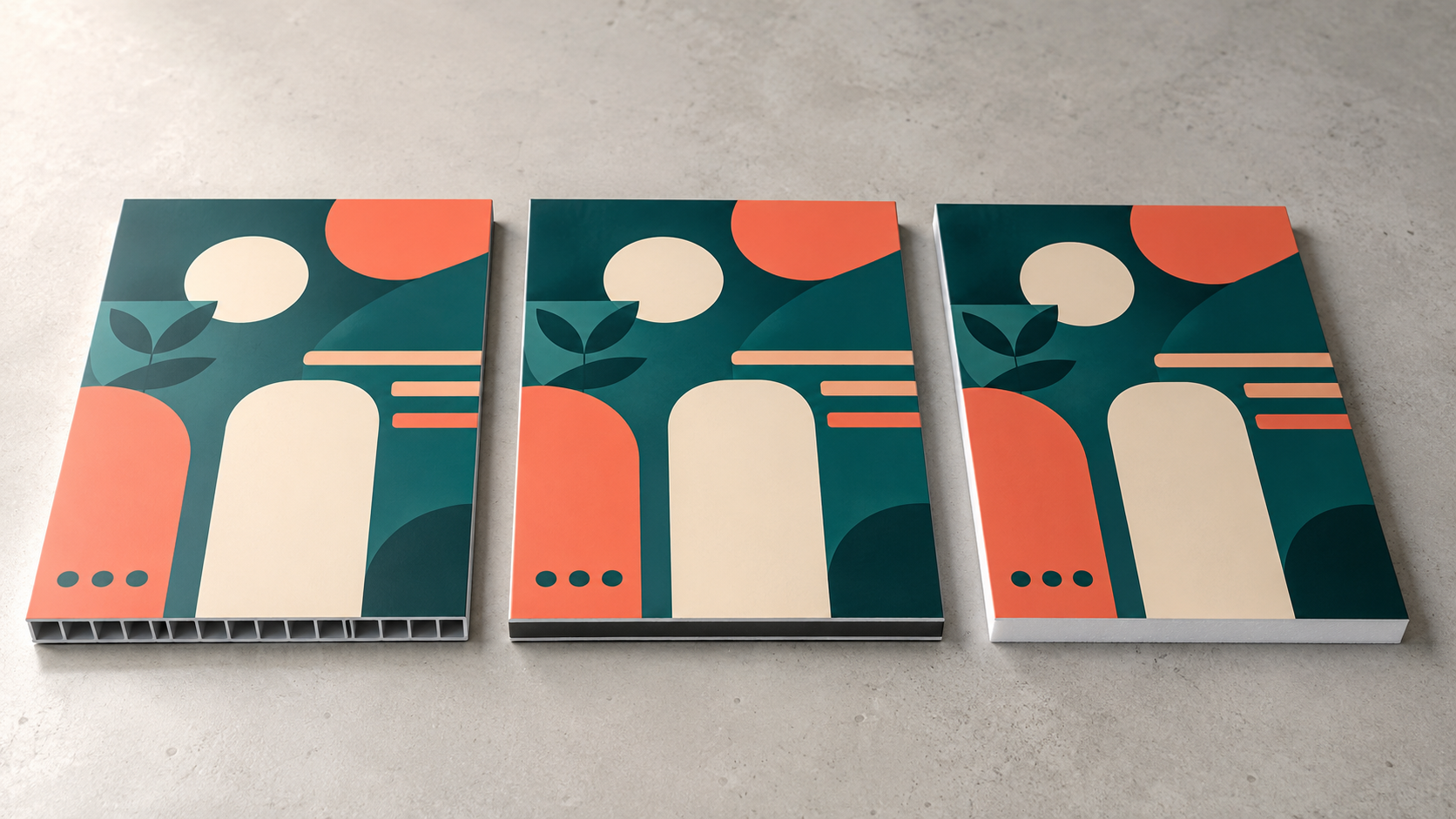
Quick comparison at a glance
If you have only got 30 seconds, here is the comparison. The rest of the article unpacks each substrate in detail with worked examples, but the table below covers the headline differences.
| Corflute | ACM | Foam Core | Foamed PVC | |
|---|---|---|---|---|
| Cost (relative) | 1x baseline | 3-5x corflute | Comparable to corflute | Mid-range |
| Outdoor life | 12-24 months | Substrate years; ink 2 years | Not outdoor-rated | Limited outdoor |
| Indoor life | Years | Permanent | Months to years | Years |
| Weight (600×900mm) | Very light | Heaviest | Lightest | Medium |
| Premium feel | Functional | Premium | Functional | Mid-premium |
| Standard gauge | 3mm or 5mm | 3mm | Standard | 3mm |
| Best applications | Real estate, election, events, short-term outdoor | Wayfinding, brand presence, structural | Indoor display, conference | Indoor POS, reception |
The table is a starting point, not the answer. The right substrate for any specific job depends on outdoor exposure, expected service life, presentation requirements, volume and budget. The rest of this article unpacks each substrate so you can match the right one to your job.
What is corflute (and when to choose it)
Corflute is extruded fluted polypropylene, a lightweight rigid plastic with a hollow internal structure that gives it strength-to-weight ratio. Mediapoint runs corflute in two gauges: 3mm for short-term indoor work, and 5mm as the workhorse for outdoor signage. Single-sided printing on the Corflute Print Only product. Double-sided is available on the Corrugated Plastic product, which is the same substrate set up for two-pass printing with extra bleed for registration.
Strengths
Cost-effective at volume. The sheet-based pricing model means standard sizes get strong per-piece economics, particularly at runs of 50 or more. Fast turnaround, with production starting from the next business day after file approval. Lightweight, which matters when deployment happens via volunteers or one-person installation. Easy disposal and recycling at end of life (polypropylene, recycling code 5). Custom shapes are simple to specify using Thru-cut, with the standard caveats about avoiding sharp internal corners.
Weaknesses
12 to 24 month outdoor lifespan limits permanent use. The substrate itself lasts longer (Corex tests to 3 years), but the printed ink is the limiting factor under sustained Australian UV. Functional rather than premium feel, which matters when the brand presence on the sign is part of the message. Single-sided product means anything visible from both directions needs the Corrugated Plastic product instead, with the bleed requirement going from 3mm to 5mm.
Best for
Real estate signs, election campaigns, construction site signage, event and festival signage, retail point of sale, anything short-to-medium-term outdoor at volume. Corflute owns these categories because the economics, the deployment model and the disposal model all align.
What is ACM (and when to choose it)
Aluminium Composite Panel, often called ACM or ACP, is two thin aluminium sheets bonded to a polyethylene core. The result is a panel that has the smooth premium surface of aluminium with the lightness of a sandwich material rather than solid metal. Mediapoint runs ACM in 3mm gauge, which is the industry standard for printed ACM signage. Single or double-sided printing is available.
Strengths
ACM is the most premium outdoor signage stock available at this price point. The smooth surface takes ink beautifully and gives the printed image a quality that corflute can't match. The structural rigidity of the substrate means it can be properly mounted with hardware rather than zip-tied to fencing. Weather and UV resistant substrate that holds its structural integrity for many years. ACM has overtaken Colorbond as the default go-to signage board for premium outdoor work in Australia.
Weaknesses
Significantly more expensive than corflute, typically 3 to 5 times the price at the same size. The cost premium reflects real input differences: aluminium isn't cheap, ACM is harder to cut than corflute, and the production complexity is higher. Heavier than corflute, which matters for handling and installation. And the printed ink life is still only 2 years — the same limit as corflute. The ACM substrate outlasts the print sitting on top of it.
Worth being honest about ACM ink life: for genuinely long outdoor service (4 to 5 years), Mediapoint's printed ACM is not the right answer. You need a signwriter who can print on a laminated sticker and apply that to the ACM substrate. The lamination protects the ink from UV exposure and extends service life dramatically. We say this on our ACM product page directly. It isn't a sales loss to acknowledge it; it's the right answer for that customer.
Best for
Premium outdoor signage installs, wall panels, suspended ceiling decoration, structural mounting situations, semi-permanent wayfinding, retail brand presence where surface quality matters. Anywhere the cost premium is justified by either visual quality, service life, or both.
Worst for
Short-term disposable signage where the cost premium isn't justified. Volunteer-deployment campaigns where weight matters. Anything that needs to actually last 4+ years (use a signwriter with lamination instead, as covered above).
For full ACM specs and ordering options, see Mediapoint's Aluminium Composite Panel product page.
What is foamboard (and when to choose each variant)
When buyers say 'foamboard', they usually mean one of two distinct products. Both are foam-cored boards designed primarily for indoor display, but they have different applications and different price points. Mediapoint prints both, and the right choice depends on where the sign is going and how it will be handled.
Foam Core
Polystyrene foam core between paper or plastic facing. The lightest of all the substrates in this comparison. Strengths: cheap, very light, smooth printing surface that takes ink cleanly, easy to transport in volume, cost-effective for indoor work. Weaknesses: dents easily if knocked or stacked carelessly, can't be cleaned, not outdoor-rated under any circumstances, and has a relatively short lifespan even indoors in high-traffic areas where it gets handled often.
Best for: hanging advertising, reception branding, seminar and conference collateral, mobile and portable display work that gets packed and unpacked between events, lightweight backing for prints. The right product when weight and cost matter and the environment is gentle.
Foamed PVC
Compressed foam PVC, denser and more dent-resistant than foam core. Mediapoint runs Foamed PVC in 3mm gauge. Strengths: noticeably more durable than foam core, slightly flexible (which makes transport and install easier), high heat tolerance for warm summer environments where other foam products soften. Weaknesses: heavier than foam core, more expensive than foam core, and primarily an indoor product even though some outdoor applications work.
Best for: premium indoor display, point-of-sale displays, reception signage, exhibition panels, headers. The right product when foam core's denting is becoming a problem but you don't need ACM's outdoor rating or its premium price.
Foamed PVC will handle some outdoor display work, but it's not the primary use case. If outdoor is the requirement, corflute or ACM are the cleaner answers.
Side-by-side: cost
This is the section most readers will spend the longest on. Specific where possible, honest about ranges where exact numbers depend on size and quantity.
Corflute is the baseline. The cheapest of the three substrates on a per-piece basis at standard sizes, with sheet-yield pricing that means the standard sizes (600 × 900mm, 600 × 450mm, 900 × 1200mm) get the best economics. Going outside those sizes increases per-piece cost regardless of how the surface area changes.
ACM is significantly more expensive, typically 3 to 5 times corflute pricing at the same size. The cost premium is not a margin call. It reflects real input cost differences: aluminium itself isn't cheap (compared to polypropylene), production cutting is harder, and the substrate positions as a premium product with a longer functional life.
Foamboard cost varies by product. Foam Core is comparable to or slightly more expensive than corflute. Foamed PVC sits between Foam Core and ACM in price, reflecting its position as a premium indoor option.
Cost is more than the substrate price
The headline per-piece price is the start of the cost calculation, not the end. A complete cost comparison includes material cost (per piece, including any setup), transport cost (heavier substrates cost more to ship, particularly for multi-state distribution), installation cost (heavier substrates need more hardware and sometimes a second installer), and replacement cost (cheaper substrates are easier and faster to replace when damaged). For high-volume short-term work, the corflute total cost is dramatically lower than ACM. For low-volume permanent installations, the ACM cost premium can be justified by avoided replacement and installation savings over service life.
A worked example
For a 100-sign election campaign at 600 × 900mm, corflute at 1x baseline cost is straightforwardly the right choice. The signs go up for six weeks, come down after polling day, and get recycled. ACM would be technically possible but absurd — you'd be paying premium pricing for service life the application doesn't need. Conversely, for a permanent retail wayfinding installation at the same size, ACM at 4x cost is justified by the multi-year service life, the surface quality that matches the brand environment, and the structural mounting capability. The wrong cost decision is matching the substrate to the price point rather than to the application.
Side-by-side: durability
Honest substrate-by-substrate assessment of outdoor and indoor service life. Use these as ranges, not absolutes. Real-world performance depends on UV exposure, coastal proximity, handling and installation. For a deeper reference on what determines corflute's realistic outdoor service life, the substrate-versus-ink fade picture, and how to set client expectations on durability honestly, see our corflute outdoor durability guide.
Corflute
Outdoor: 12 to 24 months printed sign life. Substrate lasts longer (Corex tests to 3 years) but Durst UV inks are the limit. Magenta and yellow fade first under sustained Australian UV. Indoor: years of service in typical conditions. Mostly limited by handling damage and visual relevance, not material failure.
ACM
Outdoor: substrate is multi-year, effectively permanent for typical environmental exposure. Mediapoint's printed ACM ink life is 2 years — the same limit as corflute. The aluminium will be fine for a decade; the print on top of it is the failing element. For 4 to 5 years outdoor service, you need a signwriter who can print, laminate and mount a sticker over the ACM substrate. Indoor: multi-year, effectively permanent for indoor service.
Foam Core
Outdoor: not outdoor-rated. Will fail quickly in any outdoor exposure. Don't spec foam core for outdoor work even short-term — it won't survive a single rain event in any structural sense. Indoor: months in high-traffic areas where it gets knocked or moved often. Years in protected display where it sits untouched.
Foamed PVC
Outdoor: limited outdoor capability. Works for short-term outdoor display in protected positions but isn't the primary use case. Indoor is where it earns its premium positioning. Indoor: years of service in typical retail and reception environments. The denser construction handles handling and traffic better than foam core.
Reminder on durability ranges: the lifespan ranges in this section are based on Mediapoint's product specifications and general industry experience under typical conditions. Real-world performance will vary with installation orientation, geographic UV intensity, coastal exposure, handling frequency and protective measures. For any application where substrate failure timing has significant consequences, plan for replacement at the lower end of the range and consider whether testing samples in your specific environment is warranted.
Honest framing for long-life jobs: for genuinely long outdoor life — anything 3+ years — neither corflute nor printed ACM (as Mediapoint produces them) is the right answer. Talk to a signwriter who can apply a laminated print to ACM, or consider whether the application actually needs that lifespan. We'd rather route you correctly than print you something that won't do the job.
Side-by-side: weight and handling
Weight matters more than buyers expect. It affects deployment cost, transport cost, and installation labour. For volunteer-driven campaigns, it can be the substrate decision factor.
Corflute (5mm, 600 × 900mm) is very light. One person can carry 20 to 30 signs and stakes at once. This is why corflute owns election work — the deployment model assumes one volunteer, one car boot, one Saturday.
ACM (3mm, 600 × 900mm) is noticeably heavier. Two-handed handling for larger sizes. Mounting hardware needs to support the weight, which usually means proper brackets rather than zip-ties or rope. Premium look comes with premium weight.
Foam Core at typical thickness, 600 × 900mm, is the lightest of the comparison. Often used specifically because it is so light — easy to pack into a car boot, easy to hang from ceiling fixtures, easy to transport between events.
Foamed PVC (3mm, 600 × 900mm) is medium weight. Heavier than foam core, lighter than ACM. The slight flex helps handling, particularly for installs in awkward spaces.
The operational implication: weight matters most for jobs where the same person handles deployment AND installation. Heavy substrates need more crew, more hardware, and more thought about transport. For volunteer-driven campaigns this is a significant decision factor. For installed permanent signage it matters less, because the install is being done once by someone with proper equipment.
The application matrix
This is the article's most useful section: a decision matrix matching common signage applications to the right substrate. Not every job fits cleanly, but most do.
Real estate signs
Corflute, almost always. Single-sided Corflute Print Only for one-direction frontage; Corrugated Plastic for two-direction frontage. For those jobs, corrugated plastic signs are the pick. ACM is over-spec — you don't need 5-year service life for a 3-month listing campaign, and the cost premium doesn't pencil out at typical agency volumes.
Construction site signage
Mostly corflute. The 12 to 24 month lifespan covers most build phases comfortably. ACM is the right answer for permanent identification signs that survive between projects — think the developer's primary brand panel that goes on every site. Foam products are the wrong answer here; they won't survive the environment. For deeper guidance on construction-specific corflute work covering site compliance, mounting on temporary fencing, and the trade workflow for fulfilling construction clients, see our construction site signage guide.
Permanent wayfinding (offices, retail, public spaces)
ACM is the right answer. Corflute won't last. Foam products won't survive ongoing handling and cleaning. For the longest service life, ACM with signwriter-applied laminated print.
Retail point of sale
Foamed PVC for premium indoor displays where surface quality matters. Foam Core for short-term promotional displays that get cycled out frequently. Corflute if the promotion runs outdoor (sidewalk signs, A-frame inserts visible from the street). ACM for permanent retail brand presence — logo walls, structural elements, anything that's part of the store identity.
Event and festival signage
Corflute for the bulk of the work. Deployment cost matters, lifespan doesn't. Foam Core for indoor event signage that needs to be light and packable across a touring schedule. ACM only for the most premium event installations where brand presence is the point.
Election signage
Corflute. Always. The whole category is built around corflute economics — fast deployment, cheap per piece, light enough for volunteer transport, easy to dispose of after polling day. Other substrates don't fit the campaign model and the budget assumptions don't support them.
Office display, reception, conference collateral
Foamed PVC for permanent reception and display signage. Foam Core for portable conference and event collateral. Foam products own this space — corflute is overkill for indoor stationary use, and ACM is excessive for anything that doesn't need to look like a permanent fixture.
Trade show booth (premium presentation)
ACM for backdrop panels and brand-presence elements where quality of finish matters. Foam Core for mobile inserts, table signs and lightweight directional pieces. Corflute for the parking-lot and external directional signs that drive visitors to the booth from elsewhere on the site.
How to make the right choice
A short decision framework. Four diagnostic questions that lead to the right substrate for most jobs.
Question 1: Is the sign outdoor or indoor?
Outdoor: consider corflute or ACM. Indoor: consider Foam Core, Foamed PVC, or corflute (corflute works indoors too, it's just often overkill).
Question 2 (if outdoor): How long does it need to last?
Under 2 years: corflute. Cost-effective at any volume, and the ink life matches typical campaign and listing cycles. 2 to 3 years: ACM, with the understanding that the printed ink is still ink-limited to 2 years for direct-print signage. 3+ years: ACM with signwriter-applied lamination, which is not a Mediapoint print job. We'd rather route you correctly than oversell.
Question 3 (if indoor): Is presentation premium or functional?
Premium: Foamed PVC or ACM, depending on whether the install is permanent or display-grade. Functional or short-term: Foam Core or corflute.
Question 4: How much volume?
High volume (500+): corflute economics dominate, particularly at standard sizes. Low volume (under 50): substrate cost matters less in the total job cost; choose by application requirements rather than per-piece price.
Most jobs land in clear answers from these four questions. The hard cases are usually about whether ACM's premium is worth the cost, which is a judgement call about brand presence, customer perception, and how visible the sign is in its context. There's no universal answer; it depends on what the sign needs to do.
Working with Mediapoint on rigid signage
Mediapoint specialises in trade printing for resellers, sign shops and designers. Whichever rigid board is right for your job, we likely print it. Trade pricing is available for resellers and sign shops with regular volume, with next-business-day turnaround on standard jobs.
Mediapoint's full rigid boards range. This article focuses on the three substrates buyers most commonly compare. Our full rigid boards range is broader: Corflute Print Only (single-sided), Corrugated Plastic (double-sided corflute), Aluminium Composite Panel (premium outdoor), Foamed PVC (premium indoor), Foam Core (lightweight indoor), Polypropylene (solid sheet, distinct from corflute's fluted structure), Kapaplast (foam-PVC sandwich), and Screenboard (paper-based for short-term display). See our screen board range for indoor display work. For the right substrate for your specific job, browse our rigid boards range or get in touch directly.
Frequently asked questions
Why is ACM so much more expensive than corflute?
Three reasons. Aluminium itself isn't cheap compared to polypropylene. ACM cutting is harder than corflute cutting and slower per piece on the production side. And ACM positions as a premium product with a longer functional life and a better surface finish. The cost premium reflects real input cost differences, not just margin.
Can I get foamboard for outdoor use?
Foam Core: no, not outdoor-rated under any circumstances. Foamed PVC: limited outdoor applications work, but it isn't the primary use case. For outdoor signage where the sign actually needs to perform, choose corflute or ACM. Foam products are the wrong answer outside.
What's the difference between Foam Core and Foamed PVC?
Both are foam-based indoor signage. Foam Core is lighter and cheaper but susceptible to denting and not cleanable. Foamed PVC is denser, more dent-resistant, more expensive, and tolerates heat better. Choose Foam Core for short-term and portable; Foamed PVC for permanent indoor installations.
Will my corflute design work on ACM?
Yes. Both substrates accept the same artwork file structure: 3mm bleed for single-sided (5mm for double-sided), CMYK colour space, 300dpi raster, fonts outlined, PDF export. The substrate change doesn't require a redesign, just confirming the right product before submitting the file.
What if I need a sign that lasts 5 years outdoors?
None of the three substrates compared here, printed at Mediapoint, will reliably hit 5 years outdoor life. The print itself is rated to 2 years on both corflute and ACM. For longer life, you need a signwriter who can print on a laminated sticker and apply that to an ACM substrate. We say this on our ACM product page directly. It isn't a sales loss to acknowledge it.
Can I get the same design printed on different substrates for testing?
Yes. Sample orders are available. For larger projects (typically over $1,000), we recommend ordering small samples on each candidate substrate before committing to the final substrate choice. Print colour shifts slightly between substrates, and feel and weight matter for stakeholder approval. The cost of a sample run is much smaller than the cost of getting the substrate decision wrong on a 500-sign job.
Key takeaways
The points worth remembering when you next need to specify a rigid signage substrate.
Corflute is the volume default for short-to-medium-term outdoor signage. Cheap, fast, light, and the right answer for real estate, election and event work.
ACM is premium outdoor signage. 3 to 5 times corflute cost, but the right answer for permanent installations and brand-presence signage where surface quality matters.
Foamboard is indoor display. Foam Core for light and portable; Foamed PVC for premium permanent indoor work.
Print ink life is 2 years for both corflute and printed ACM. Substrate outlasts ink in both cases.
For 4 to 5+ year outdoor service, ACM with signwriter-applied lamination is the answer, not a direct-print job.
Mediapoint prints all three substrates compared here, plus five more in the full rigid boards range.
Match the substrate to the application, not the substrate to the budget. The wrong cost decision is choosing by price point rather than by what the sign needs to do.
A final note on responsibility: the substrate selection guidance in this article is general and reflects Mediapoint's printing capabilities and industry experience. Substrate performance in your specific application depends on factors outside Mediapoint's control — installation quality, environmental conditions, handling and use. For high-stakes installations, sample testing in your actual environment is genuinely worth the small upfront cost. The customer is responsible for the substrate decision and for ensuring the chosen substrate is fit for purpose in the installation context.