Corflute Election Signs in Australia: A Trade Printer's Reference Guide
Election cycles in Australia drive one of the largest concentrated bursts of corflute signage demand in the country. Federal, state and council elections all rely on corflute as the default substrate for everything from picket signs on stakes to polling-day booth signage. For sign shops, political consultants, signage suppliers and party central printers, an election cycle means weeks of high-volume, deadline-driven production with very little tolerance for rework.
This guide is written for trade customers fulfilling campaign signage. The aim is to give you the technical, operational and compliance knowledge to advise campaign clients well, head off common artwork problems before they reach our prepress queue, and quote multi-electorate or multi-candidate work with confidence. The article covers product fit, sizing, AEC compliance (especially the authorisation statement), state-specific rules including the SA Corflute Act, design considerations, volume planning, and post-election handling.
For the comprehensive overview of corflute signage in Australia, see our corflute signs guide. This article is the focused companion piece on election work.
Important: this article is general guidance for trade customers, not legal advice. Compliance requirements vary by election and jurisdiction. The information here reflects current AEC guidance for federal elections, but campaigns should always confirm specific requirements with the relevant electoral commission, and seek independent legal advice if uncertain. Mediapoint prints what is supplied. The campaign or candidate is responsible for the accuracy and legality of the artwork.
Why corflute dominates Australian election signage
Corflute became the election signage default for four reasons that still hold today. Trade customers quoting on campaign work should know all four, because each one comes up in client conversations during a typical cycle.
Cost per sign at volume
Election budgets are tight and volumes are high. A campaign ordering 500 picket signs at the standard 600 × 450mm size gets very strong unit economics from corflute's sheet-based pricing model. The per-piece price drops sharply at run sizes that election work hits comfortably, which is what gives you margin headroom on the volume jobs while still quoting your campaign clients competitively.
Fast turnaround for late-stage campaigns
Next-business-day production matters most when polling day is two weeks away and the candidate has just had a key endorsement, a media moment, or a sudden reason to go up in additional locations. Other rigid signage substrates (ACM, polypropylene boards) often have longer lead times that don't fit a late-cycle reorder. Corflute's production speed is the reason it gets called for the second batch as well as the first.
Lightweight for volunteer deployment
Election sign deployment usually happens via volunteers, often working evenings and weekends in the lead-up to polling day. Corflute is light enough that one person can carry 20 signs and stakes at once. ACM or aluminium signs of similar size require two people and are much harder to transport in a hatchback. The substrate choice is, in part, a logistics choice.
Easy disposal post-election
Most campaigns retire signs within days of polling day. Corflute is easier to remove, transport and recycle than heavier substrates. Polypropylene (PP, recycling code 5) is recyclable through appropriate channels, which matters increasingly for campaigns whose volunteers and supporters care about not leaving plastic on roadsides after the result is in.
Worth noting: the 12 to 24 month outdoor ink life that matters in real estate or construction work is essentially irrelevant for election signage. Campaign signs are deployed for weeks, not years. The substrate decision is about cost, weight, speed and disposal, not durability.
Standard sizes for election signage
Two standard sizes do almost all the work in Australian election campaigns. Each ties to a specific application and the per-piece economics that make it the right call at scale.
600 × 900mm: the workhorse election sign
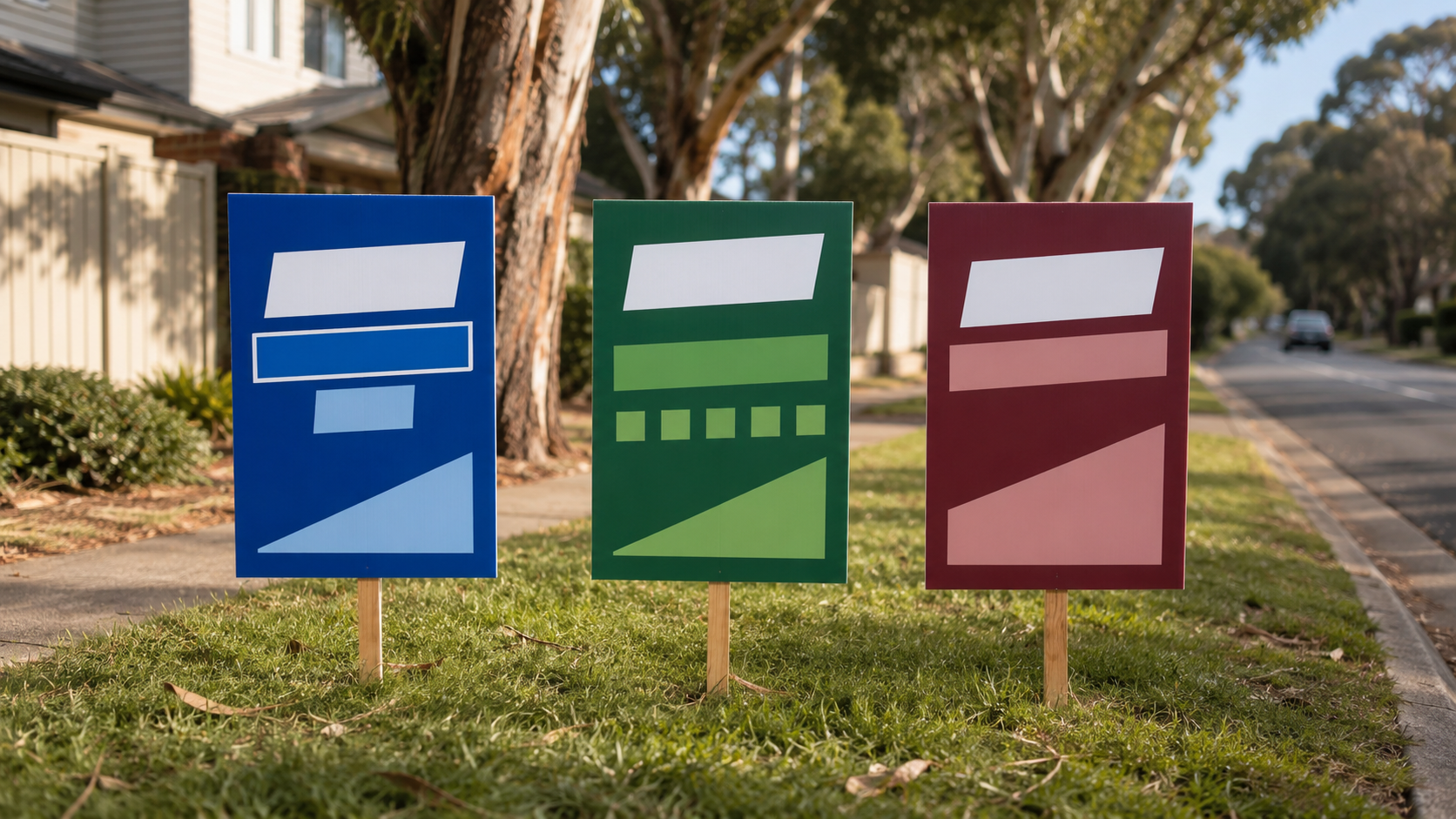
The dominant format for Australian election campaigns. Sits close to A1 paper but slightly larger and a different aspect ratio. Used for roadside picket signs on stakes, polling booth signs, property frontage signs at supporter homes, and prominent display locations. The size that gives candidate names and core messaging enough real estate to be read from passing traffic at 50 to 60 km/h. Yields 5 per master sheet, which gives strong unit economics at typical campaign volumes. 5mm gauge is the default for outdoor durability. For trade customers advising campaign clients on stake mounting, hole positioning and the hardware that determines whether picket signs hold up in the field, see our eyelets, holes and mounting hardware guide.
600 × 450mm: secondary size for specific use cases
Half the height of the 600 × 900mm size. Sits close to A2 paper. Used for handheld signs at events and rallies, smaller A-frame inserts at polling booths, and signs in tight installation spots like narrow nature strips or fence panels. Yields 10 per master sheet, which is the lowest per-piece price point in the cluster and useful for campaigns that need high volume in specific contexts.
Custom larger sizes
Custom sizes are available within Mediapoint's 2400 × 1200mm cut limit. Worth being aware of one critical constraint though: South Australian campaigns must respect the 1 square metre maximum for corflute signs on vehicles, buildings, hoardings or structures under the SA Electoral (Control of Corflutes) Amendment Act 2024. A standard 600 × 900mm sign (0.54 sq m) is well within the limit. Larger custom formats may breach SA law. More on this in the South Australian section below.
AEC authorisation requirements: the legal essentials
This is the most important section in this article and the one most likely to save a campaign client from a legally compromised print run. Every federal election sign in Australia must carry an authorisation statement under Section 321D of the Commonwealth Electoral Act 1918. This is not optional. The purpose is to ensure voters can identify who is responsible for any communication intended to influence their vote.
Trade customers do not write the authorisation statement, but you are often the last set of eyes on a file before it goes to press. Knowing what should be there, and what an obviously-wrong version looks like, can save your campaign client from an entire print run that has to be reissued.
What the authorisation statement must include
Per current AEC guidance, every federal election communication must include the name of the person who authorised the communication, the street address of the authoriser, and the suburb or town. The standard format is: 'Authorised by [Full Name], [Street Address], [Suburb]'. For example: 'Authorised by J. Smith, 123 Sample Street, Melbourne'.
A PO Box is not permitted as the address for federal authorisation. Independent candidates may apply for PO Box exceptions in some state jurisdictions, but for federal communications the rule is street address (or the registered party office address) only. This is the single most common error our prepress team sees on incoming election artwork: a PO Box used because the campaign is run from a virtual office or the candidate doesn't want to publish their home address. The fix is to use a registered party office or a campaign office street address.
Visibility and placement on the printed sign
The authorisation must be 'reasonably prominent' and legible on the printed sign. AEC general practice guidance is that the authorisation statement should be readable at the same distance the rest of the sign is read from. For a 600 × 900mm picket sign read from 5 to 10 metres, the authorisation typically appears at the bottom of the sign in 8 to 12pt minimum, with sufficient contrast to be legible. AEC's 'if in doubt, authorise it' principle applies — when uncertain, include the authorisation.
State and council elections
State and council elections have separate electoral acts, each with their own authorisation requirements. The format may differ from the federal standard. Campaigns should consult their state electoral commission before printing for state or council elections. As a working rule: the federal-style authorisation format is generally a safe baseline, but state-specific requirements may add or modify what's required, so don't assume.
Penalties for non-compliance
Failure to comply with authorisation requirements is an offence under the Commonwealth Electoral Act and may result in civil penalties enforced by the AEC. Specific penalty amounts vary; campaigns should consult AEC guidance or seek legal advice. The practical cost of non-compliance, beyond legal penalties, is usually a forced reprint of an entire sign run if the authorisation is missing or incorrectly formatted. For a 1,000-sign federal campaign run, that is a very expensive mistake.
Mediapoint's role and yours
Mediapoint prints what is supplied. The campaign or candidate is legally responsible for ensuring the authorisation statement is correct. As the trade customer in the middle, you are not legally responsible either, but you are well-placed to flag obvious issues before files go to press. If a campaign client supplies a file with a PO Box authorisation, an authorisation that's buried in 4pt grey type at the edge of the sign, or no authorisation at all, raise it with them. The two-minute conversation up front is much cheaper than the alternative.
Reminder: this section is general guidance based on current AEC publications, not legal advice. Authorisation requirements can change, and state and council elections operate under different acts. Campaigns and trade customers should confirm current requirements with the relevant electoral commission, and seek independent legal advice for anything sensitive or unusual.
South Australian corflute rules
South Australia has unique restrictions that don't apply elsewhere in Australia. Trade customers servicing SA campaigns need to know about this before quoting any non-standard sizes.
The Electoral (Control of Corflutes) Amendment Act 2024 limits campaign signs on vehicles, buildings, hoardings or structures to a maximum of 1 square metre during state and council elections in South Australia. Standard 600 × 900mm signs (0.54 sq m) and 600 × 450mm signs (0.27 sq m) are well within this limit. Larger custom-format signs may breach the 1 m² limit and cannot be legally placed on vehicles, buildings, hoardings or structures during SA state and council elections.
Maximum penalty for breach is $5,000 for individuals and $25,000 for bodies corporate (per the current SA Electoral Act). This restriction is unique to South Australia. Other states do not have a corflute-specific size cap. SA campaigns ordering large-format signs from any printer should confirm dimensions are compliant before placing the order. As the trade customer, this is one of the simplest pre-flight checks you can run on incoming SA campaign artwork: if the sign is over 1 m² and intended for any of the listed surfaces, flag it before submitting.
What to advise campaign clients on design
Trade customers handling election work fall into the same two camps as other categories: the ones who design artwork in-house, and the ones whose campaign clients (or their freelance designers) supply finished files. This section covers what matters either way. If you're designing in-house, these are the rules. If you're receiving client artwork, these are the things worth checking before files reach our prepress queue.
Candidate name prominence
The candidate's name is the most important element on most election signs. It should be the largest text element on the sign and readable from the road in moving traffic. As a working guide for 600 × 900mm picket signs read from 10 to 15 metres on roadside installations, candidate names should be a minimum of 100 to 150pt. For smaller 600 × 450mm signs used in tighter spots or handheld at events, 80 to 120pt minimum. Use clean sans-serif fonts that hold up at distance. Avoid fine serifs that disappear from a moving car.
Number 1 prominence
Most Australian campaigns use 'Vote 1 [Candidate]' or similar messaging for primary preference. The '1' should be visually prominent. Many designs make the number itself a feature element. This is functional design, not decorative. If client artwork buries the '1', raise it.
AEC purple colour caution
The AEC has expressed strong preference that campaigners do not use the colour purple in their communications, because purple is the AEC's own branding colour and use by campaigns can mislead voters about the source of communications. While the AEC has no direct legal authority to prevent purple, using it in a way that could be confused with AEC communications could potentially breach Section 329 of the Electoral Act. If a campaign client supplies artwork that uses AEC-style purple as a primary brand colour, raise it with them. This is a category-specific gotcha that designers outside the political print space often don't know about.
Authorisation statement placement
As covered in the AEC authorisation section above, the authorisation statement is legally required and must be reasonably prominent. Standard practice is to place it at the bottom of the sign in 8 to 12pt, with sufficient contrast to be legible. Don't accept artwork that buries it in a corner or uses a colour that disappears against the background. Better practice is to include the authorisation as a clear strip at the bottom of every design — it reads as intentional and removes any ambiguity about prominence.
High contrast for outdoor visibility
Australian sun is unforgiving on low-contrast designs. Dark text on light backgrounds (or vice versa) is essential. Avoid mid-tone backgrounds with mid-tone text. A useful pre-flight check: view the artwork at thumbnail size. If the candidate name and key messaging are still readable at thumbnail, they will work at distance. If they disappear, the sign will disappear in the field too.
Volume planning for campaigns
Trade customers quoting campaign work need a working sense of typical sign volumes by election level. The numbers below are indicative, not prescriptive — actual volumes depend on electorate size, campaign budget and strategic approach — but they're a useful starting point for scoping conversations with new political clients.
A council ward campaign typically runs 50 to 200 picket signs. A state seat campaign typically runs 200 to 1,000 signs across the electorate. A federal seat campaign typically runs 500 to 2,500 signs depending on electorate area and contest competitiveness. Polling-day booth signs are an additional consideration: each polling place typically needs at least one large 600 × 900mm sign, often more, and a federal electorate may have 30 to 80 polling places. Party central electorate-wide orders for prominent campaigns commonly hit 1,000+ signs.
Practical advice worth giving campaign clients: order in two batches. The initial deployment goes up four to six weeks before polling day. A second smaller batch is often needed for replacement (vandalised signs, additional supporter requests, wind-damaged signs) and for polling-day booth coverage. Building this into the order plan saves time on rushed reprints in the final week, when production capacity industry-wide is at its tightest. For specific guidance on minimising wind-related field failures (the largest single cause of replacement-volume demand), see our wind damage guide for corflute signs.
Production turnaround for elections
Election work has unique timing pressure. Campaigns have a fixed deadline (polling day) and signs must be deployed weeks before, not days before. Mediapoint's production model aligns to that rhythm in a few specific ways.
Turnaround starts from the next business day for files received and approved before the daily cut-off. Sheet-based pricing means orders sized to the standard 600 × 900mm or 600 × 450mm get the best per-piece economics, which gives you margin headroom on the volume work. For multi-design orders (different candidates within a party, or main candidate plus running mate), each design is a separate job, but multiple jobs can be combined within a single order. Trade pricing is available for political consultants and signage suppliers running multi-campaign volume.
Sample orders are recommended for campaigns above $1,000 (typical for state and federal-level orders), particularly when brand colours or candidate photography matter. A sample is much cheaper than a 1,000-sign reprint that arrived with the brand colour slightly off.
The conversation worth having with campaign clients up front: production capacity is finite during election cycles, and concentrated demand across the industry means lead times can stretch in the final two weeks before polling. Order four to six weeks before deployment, allow for one reprint cycle if needed. Trade customers who set this expectation early avoid the worst-case Friday-before-polling rush.
Post-election sign disposal and recycling
What happens to election signs after polling day is genuinely a campaign responsibility. Councils, residents and the AEC don't want abandoned campaign signage on roadsides, and most local councils require campaign signs to be removed within a specified period after the election (typically seven days). Trade customers don't handle disposal directly, but advising clients on the options up front is part of being a useful trade partner.
Recycling
Corflute is polypropylene (PP, recycling code 5), which is recyclable through appropriate channels. Most council kerbside services don't accept signage-grade corflute, so signs need to be dropped at a designated PP recycling facility. Corex Australia operates recycling programs for its materials, but trade partners are not authorised to deliver signage to Corex on behalf of campaigns. Campaigns should arrange recycling independently.
Reuse
Some campaigns store signs for re-deployment in the next election cycle, particularly for evergreen messaging like authorisation panels or generic party branding that doesn't change between cycles. Storage is straightforward: flat, dry, out of UV exposure. Worth raising with campaign clients who run consistent branding across cycles.
Stake recovery
The wooden or steel stakes used for picket signs can typically be reused indefinitely. Many campaigns recover and store stakes separately from the printed corflute, which is a useful efficiency win for clients running back-to-back election cycles.
Mediapoint mentions disposal options at order time but does not coordinate post-election collection. The practical advice for campaign clients is to plan for sign retrieval as part of their volunteer deployment schedule. The team that put the signs up is usually the team that retrieves them.
Ordering election corflute through Mediapoint
The trade workflow essentials for election work. If you're running a trade account with us already, this is familiar territory. If you're considering setting one up to handle a coming election cycle, here's how the process runs.
Files are submitted as PDF, sized at 100%, with 3mm bleed (single-sided), in CMYK colour space, fonts outlined. Filename includes the finished size and quantity ('600mm x 900mm qty 500.pdf'). The authorisation statement must be included on the file before submission. Mediapoint prints what is supplied; we cannot add or amend authorisation text on the customer's behalf.
Turnaround starts from the next business day after file approval, for files received before the daily cut-off. Sheet-based pricing means 600 × 900mm (the typical election size) and 600 × 450mm get the best per-piece economics. Sample orders are recommended for campaigns above $1,000. Trade pricing is available for political consultants and signage suppliers running regular volume.
For multi-electorate or multi-candidate party orders, get in touch directly to coordinate production scheduling across the campaign. Election cycles concentrate demand industry-wide, and large coordinated orders benefit from being slotted into our schedule early rather than competing for capacity in the final fortnight.
Frequently asked questions
Does Mediapoint check that our authorisation statement is correct?
No. Mediapoint prints what is supplied. The campaign or candidate is legally responsible for ensuring the authorisation statement complies with AEC requirements (or the relevant state or council electoral commission for state and local elections). As the trade customer in the middle, you can flag obviously incorrect authorisations to your client before submission, but neither you nor Mediapoint is the legal authority on compliance. Campaigns should consult AEC guidance or seek legal advice if uncertain.
What size should picket signs be?
600 × 900mm is the dominant standard for Australian election picket signs mounted on stakes. The larger format gives candidate names enough size to be legible from passing traffic. 5 signs per master sheet, with strong per-piece economics at typical campaign volumes. 5mm gauge for outdoor durability. The smaller 600 × 450mm format is used for handheld signs at events and tighter installation spots, but isn't the picket sign default.
Can we order signs in our party's brand colours as Pantone matches?
Yes. Specify Pantone C spot colours in the artwork file and our profile produces the closest CMYK match available on corflute substrate. The match is consistent from job to job but not perfect, because corflute is not a coated stock. Important note for designers: AEC strongly discourages campaigners from using purple in their branding, because it can be confused with AEC communications. If a client brand uses purple, raise it before printing.
What's the maximum size for a corflute sign in South Australia?
Under the SA Electoral (Control of Corflutes) Amendment Act 2024, campaign signs on vehicles, buildings, hoardings or structures cannot exceed 1 square metre during state and council elections in South Australia. Standard sizes (600 × 900mm and 600 × 450mm) are well within this limit. Larger custom formats may breach SA law. This restriction is unique to South Australia.
Can we get signs printed for delivery to multiple electorates?
Each Mediapoint order delivers to a single address. For multi-electorate distribution, we recommend engaging a third-party logistics provider for kitting and onward distribution. We can refer trusted partners on request.
How far in advance should campaigns order their signs?
Aim for four to six weeks before deployment, with a smaller second batch ordered two to three weeks before polling for replacements and additional supporter requests. Production capacity is finite during election cycles and concentrated demand can stretch lead times in the final fortnight. Trade customers who set this expectation with campaign clients early protect themselves and their clients from rushed reprints.
Key takeaways
The points worth remembering when quoting your next election job or advising a campaign client.
Corflute dominates Australian election signage because of cost, speed, weight and easy disposal. Outdoor durability is essentially irrelevant — campaign signs are deployed for weeks, not years.
Standard sizes are 600 × 900mm (the workhorse — picket signs, booth signs, frontage) and 600 × 450mm (secondary — handheld signs, smaller installations).
Mediapoint's Corflute Print Only is single-sided, which is the right product for most election signs (picket signs are read from one direction).
Authorisation statement is legally required on every federal election sign: 'Authorised by [Name], [Street Address], [Suburb]'. PO Box is not permitted for federal authorisation.
South Australian campaigns are limited to 1 square metre maximum for corflute on vehicles, buildings, hoardings or structures during state and council elections.
Avoid AEC purple in campaign branding to prevent voter confusion with AEC communications.
Order four to six weeks before deployment, plan a smaller replacement batch closer to polling day.
The campaign is legally responsible for compliance, not the trade printer. Trade customers in the middle should flag obvious issues but should not position themselves as the compliance authority.
Working with Mediapoint on election corflute
Mediapoint runs corflute production for sign shops, political consultants and signage suppliers servicing federal, state and council campaigns across Australia. Sheet-model pricing means standard sizes get the best per-piece economics, which gives you margin headroom on the volume work. Turnaround starts from the next business day for files received and approved before the daily cut-off. Trade pricing is available for political consultants and signage suppliers with regular volume.
View our Corflute Print Only product to plan and order campaign signage for your clients. For multi-electorate or multi-candidate orders, get in touch directly to coordinate production scheduling. Election cycles reward early planning, and we'd rather lock your clients' capacity in early than turn work away in the final fortnight before polling.