Standard Corflute Sign Sizes in Australia: A Reference Guide
Three sizes account for almost every corflute job printed in Australia. They are not arbitrary numbers. They are the sizes that fit cleanly into the master sheet that corflute is manufactured at, which makes them the cheapest sizes to produce per piece. Once you know what they are, and why they are priced the way they are, every other size decision gets easier.
These sizes apply whether you order them as corflute or fluted plastic signs, as it is the same board.
This article gives you the exact dimensions of the three Australian standards, what each one is used for, and the sheet-yield economics that drive their pricing. It is built to be a reference. Bookmark it, jump to the section you need, save the table at the bottom for the next time you are quoting a job.
For the comprehensive overview of corflute signage in Australia (material specifications, durability, custom shapes, file setup) see our corflute signs guide. This article is the focused companion piece on sizing.
The three Australian standard corflute sizes
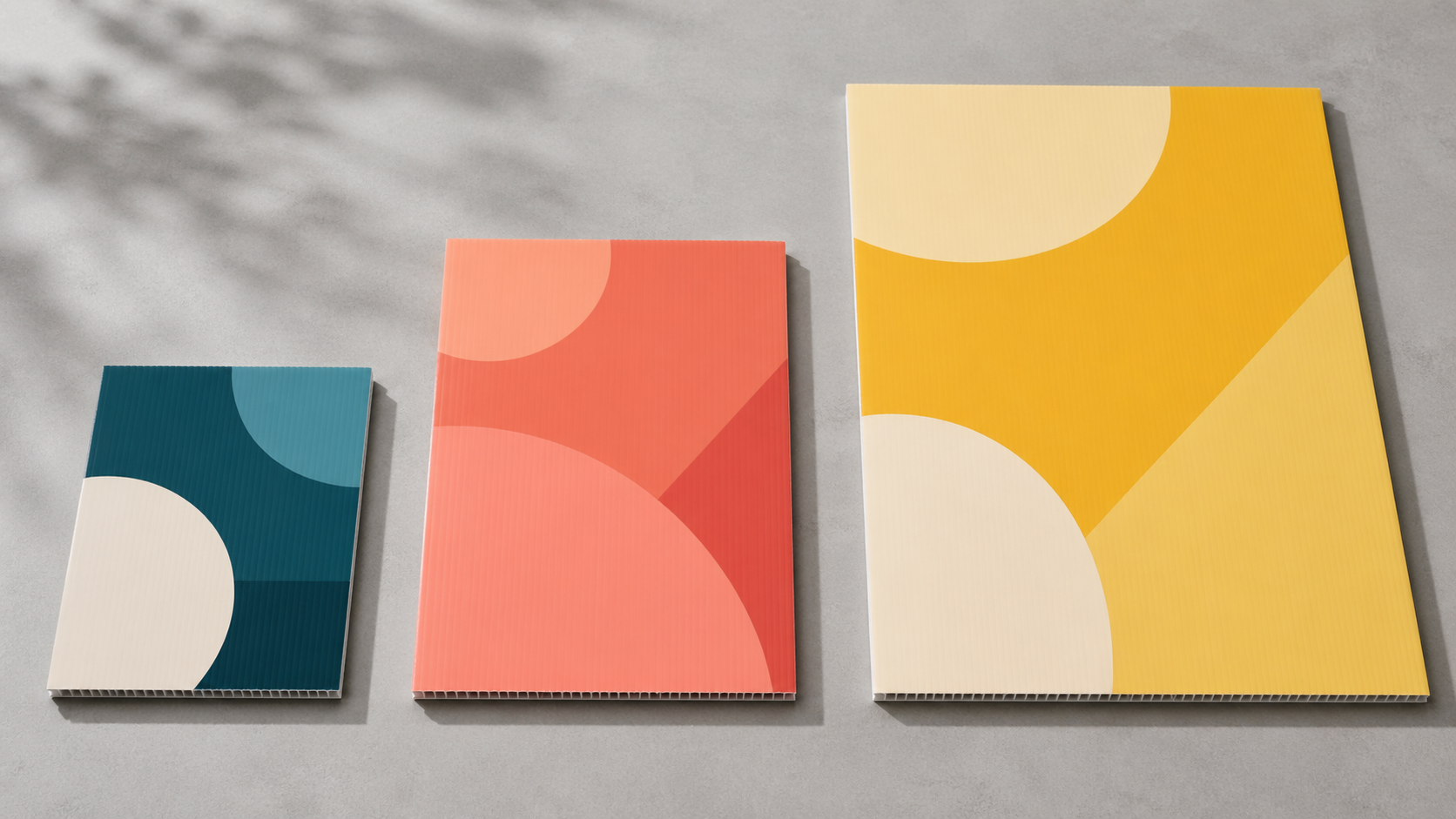
Three sizes do most of the work in Australian corflute signage. Each one ties to a specific application that drives its volume. They sit close to familiar A-sizes (A1, A2 and A0) which makes them easier to visualise if you are working from a brief that uses paper conventions, but they are not the same as A-sizes. The corflute standards are slightly larger and use different aspect ratios. If you are designing to A-size templates, you will need to resize before sending the file across.
600 × 900mm (close to A1)
The most common corflute size in Australia. Slightly larger than A1 paper (which is 594 × 841mm) and a different aspect ratio. Used for real estate signs, lawn signs, auction frames, and the bulk of campaign signage. The default gauge is 5mm for outdoor durability. Yields 5 signs per master sheet, with almost no offcut waste, which is why this is also the cheapest standard size on a per-piece basis.
600 × 450mm (close to A2)
Half the height of the 600 × 900mm size. Noticeably larger than A2 paper (which is 420 × 594mm) but in a similar visual ballpark. The standard size for A-frame inserts and smaller property listings. Default 5mm gauge. Yields 10 signs per master sheet, which makes it the highest-yield standard size and often the lowest per-piece price point for clients running volume work.
900 × 1200mm (close to A0)
Large format display, retail point of sale, and trade show backing panels. Larger than A0 paper (which is 841 × 1189mm) and a different aspect ratio. Default 5mm gauge, although heavier gauges are sometimes specified at this size where the sign needs to be self-supporting. Yields 2 signs per master sheet. The per-piece price is higher than the smaller standards because each sign uses half a master sheet.
Why these three became the Australian standards
Standard sizes do not happen by accident. They emerge over decades when three forces converge. In the case of Australian corflute, those three forces are real estate industry conventions, sheet yield economics, and hardware compatibility.
Real estate industry conventions
The 600 × 900mm format became the agency-frame standard in Australian real estate decades ago. Once that happened, every frame manufacturer, sign installer and signwriter built their hardware and workflow around it. Today, an agent ordering a sign for a Saturday open knows it will fit the frame at the front of the property without anyone having to check. That kind of standardisation is how an industry runs at scale.
Sheet yield economics
The 2440 × 1220mm master sheet produced by Corex Plastics tiles cleanly to all three standard sizes. 600 × 900mm fits 5 times into the sheet with almost no waste. 600 × 450mm fits 10 times. 900 × 1200mm fits twice. Sizes that tile cleanly are cheaper to produce, which means they get specified more often, which reinforces them as the standards.
Hardware compatibility
A-frame inserts, real estate frames, ground stakes, fence-mounting brackets and hanging hardware sold in Australia are dimensioned around these three sizes. If you spec a custom size, you also need to think about the mounting hardware. Spec a standard size and the hardware question disappears.
Worth noting that other countries have different standards. The United States uses imperial sizing for most of its sign trades. The United Kingdom has different real estate conventions and different frame dimensions. The three sizes covered in this article are specifically the Australian standards. If you are sourcing artwork from an overseas designer, do not assume the standards translate. Convert to the Australian dimensions before sending the file across.
How sheet yield drives the economics
This is the single most important concept in corflute pricing. Once you understand it, you can predict roughly what any sign will cost relative to any other size, and you can design jobs that get the best per-piece economics.
Corflute is manufactured in a master sheet of 2440 × 1220mm. Every printed sign is cut from that sheet, no matter what size you order. The economics of trade printing are driven by how efficiently your sign tiles into the master.
The yield maths for each standard size
600 × 900mm fits 5 times into the master sheet with almost no offcut waste. That is the most efficient layout, which is why it is the cheapest standard size on a per-piece basis.
600 × 450mm is exactly half the area of 600 × 900mm, so it tiles 10-up into the same sheet. Same material cost, twice as many signs, roughly half the per-piece price.
900 × 1200mm tiles 2-up into the master sheet. Each sign uses roughly half a sheet of material, which means the per-piece price is higher even though the size is still standard. You are paying for more substrate per sign, even with no waste.
The custom-size trap
A buyer might assume a 700 × 500mm sign should cost less than a 600 × 900mm sign because it is smaller. It usually doesn't. The 700 × 500mm size tiles awkwardly into the 2440 × 1220mm master sheet. Typically only 6 to 8 fit per sheet with significant offcut waste, compared to the 600 × 900mm size that tiles 5-up cleanly. Same material cost, fewer usable signs, higher per-piece price.
This catches buyers out regularly. Surface area feels like it should drive price. It does not. The number of usable signs that come out of the master sheet is what drives price.
The principle
Pricing on corflute is driven by how many signs come out of the master sheet, not by the surface area of the individual sign. Standard sizes are standard because they tile efficiently. Once you have that principle locked in, every other sizing decision becomes easier to make.
When to use each size
The right standard size depends on the application. Here is the practical guidance for the use cases that come up most often.
Real estate signs
600 × 900mm is the standard. Most agency frames are built to this size, and the per-piece economics are excellent for the volume that real estate runs at. 5mm gauge for outdoor durability. Almost always double-sided, so the listing reads correctly to traffic from both directions of the road. For the deeper reference on real estate-specific corflute work covering design conventions, frame compatibility and the trade workflow for fulfilling real estate clients, see our real estate corflute signs guide.
A-frame inserts
600 × 450mm is the standard insert size for the A-frames you see on Australian footpaths outside cafes, retailers and pop-up listings. 5mm gauge. Often double-sided so the message reads to foot traffic from both directions.
Trade show and retail display
900 × 1200mm gives you substantial display presence for trade booths, retail windows and POS panels. Often single-sided when the sign is wall-mounted or sits flat against a backing. 5mm gauge is the default, with heavier gauges where the sign needs to stand on its own.
Construction hoarding
Custom sizes are more common on construction work, often larger panels that use a full master sheet (a 1200 × 2400mm panel uses the entire sheet with no waste). Standard sizes still apply for individual safety, identification and developer signs zip-tied to temporary fencing.
Election signage
600 × 900mm for booth signage, polling-place signs and yard signs. 600 × 450mm for picket-style signs mounted on stakes. The 2-year ink life is irrelevant for election work. Most signs are up for weeks, then retired.
Council and government
Tender specifications often dictate the size, in which case you have no choice. Where the spec allows flexibility, the standard sizes give the best per-piece economics. Worth raising with the procurement team if a tender calls for a slightly off-standard size that could be adjusted to a standard for material savings.
Custom sizes: when they are worth it
Standard sizes win on cost, but they are not always the right answer. Custom sizes are absolutely available and we print them every day. The question is whether the application justifies the cost.
Custom sizing is worth it when the application genuinely requires a non-standard size. Specific frame systems with non-standard dimensions, tender specifications that dictate the size, or brand layouts that only work at a particular ratio. In these cases the size is locked in and the conversation is just about quoting it accurately.
Custom sizing is also necessary when you are using Thru-cut for custom shapes. A house-shaped sign or a speech-bubble cut-out is a custom size by definition, because the silhouette dictates the bounding dimensions. The sheet yield calculation still applies, just based on how the custom shape tiles rather than how a rectangle tiles.
And custom sizing pays off at high volumes when the per-piece efficiency of a custom layout beats the material waste. This is rare, but for very long runs (tens of thousands of signs) the maths can sometimes favour a custom size that uses the master sheet better than a standard size would for that specific job. This is a conversation to have with your printer before locking the spec.
The honest framing is this. If your job can be designed to a standard size, design it to a standard size. If it has to be custom, ask your printer how the size tiles into the master sheet before locking the artwork. Small dimensional changes (50mm here, 50mm there) can dramatically change the per-piece price.
Specifying size correctly on your artwork file
Sizing the file correctly is the difference between a job that moves through prepress without intervention and a job that needs a phone call. Four things to get right. The summary below covers the essentials — for the full file setup walkthrough covering bleed, scale, colour, fonts and the export settings that catch designers out, see our corflute print file setup guide.
Set up artwork at 100% size. Do not send a half-scale file with a note asking us to scale it up at our end. Scaling raster content up in prepress softens the image and changes the colour. Always work to finished size.
Bleed: 3mm minimum for single-sided, 5mm minimum for double-sided. Double-sided needs the extra bleed because of the small registration drift between the two passes. Skip the bleed and you risk a thin white sliver on one edge after trimming.
Filename should include the finished size and quantity. The convention is straightforward, like '600mm x 900mm qty 50.pdf'. This tells us everything we need to schedule, sheet-up and quote the job in one glance. Generic filenames like 'final_v3.pdf' add a step every time the job is touched.
PDF only. No native Illustrator, InDesign, Photoshop, JPEG or PNG. PDF is the only format that reliably preserves vector data, embedded fonts and colour profiles through the prepress workflow. Maximum file size is 2GB, which is more than enough for any sized corflute job.
Standard gauges by size
Corflute is manufactured in 3mm, 5mm, 8mm and 10mm gauges. The right choice depends on application, not size.
3mm
Light, cheap, suitable for short-term indoor display work or hand-held event signage. Not the right choice for outdoor work where wind load matters.
5mm
The workhorse gauge for outdoor signage in Australia. Holds eyelets without tearing, stands up to wind without flexing dramatically, balances cost and durability. Default gauge for all three standard sizes when used outdoors.
8mm and 10mm
Heavier gauges for self-supporting signs, stake-mounted signs in soft ground, and applications where the visual presence of a thicker edge matters. Less common for the three standard sizes but specified occasionally for premium or long-running outdoor jobs. Mediapoint does not offer 8mm or 10mm gauges — we carry 3mm and 5mm corflute only. For heavier-gauge work, you will need to route the job to a specialist printer with the stock.
5mm is the default for the three standard outdoor sizes for a reason. It is the gauge that balances cost, weight and durability for the way Australian signs actually get used.
Quick reference table
The table below summarises the three standard sizes for quick reference. Bookmark this page or save the table for future jobs.
| Size (mm) | Closest A-size | Gauge | Sheet yield | Common application | Bleed |
|---|---|---|---|---|---|
| 600 × 900 | close to A1 | 5mm | 5 per sheet | Real estate, lawn, auction frames | 3mm |
| 600 × 450 | close to A2 | 5mm | 10 per sheet | A-frame inserts, smaller listings | 3mm |
| 900 × 1200 | close to A0 | 5mm | 2 per sheet | Display, retail POS, large format | 3mm |
The closest A-size column is for visual reference only. The corflute standards are slightly larger than the A-sizes shown and use different aspect ratios, so artwork built to A-size templates will need to be resized. Bleed figures are for single-sided work. Double-sided artwork needs 5mm bleed across all three sizes.
Working with Mediapoint on sized corflute jobs
Mediapoint is an Australian trade printer specialising in corflute signage. The sheet-model pricing covered throughout this guide is the same model we use to quote every job. Standard sizes get the best per-piece economics, custom sizes are priced honestly against sheet yield, and turnaround starts from the next business day for files received and approved by cut-off. Trade pricing is available for resellers and sign shops with regular volume.
View our corflute pricing and order options for current standard size pricing, or browse our full product range for everything else we print. If your job sits between a standard size and a custom one, get in touch before locking the artwork. Small adjustments at the design stage can save real money over a production run.
Related: bollard signs