The Complete Guide to Corflute Signs in Australia
Corflute is one of those rare brand names that has become the generic term for an entire product category. Like Esky for an insulated cooler, or Hills Hoist for a rotary clothesline. The word itself is a registered trademark of Corex Plastics, an Australian manufacturer based in Dandenong, Victoria.
But ask any Australian sign maker, real estate agent, or council worker, and they'll call any fluted polypropylene sign 'corflute'. It doesn't matter who made it.
What is corflute (and what isn't)
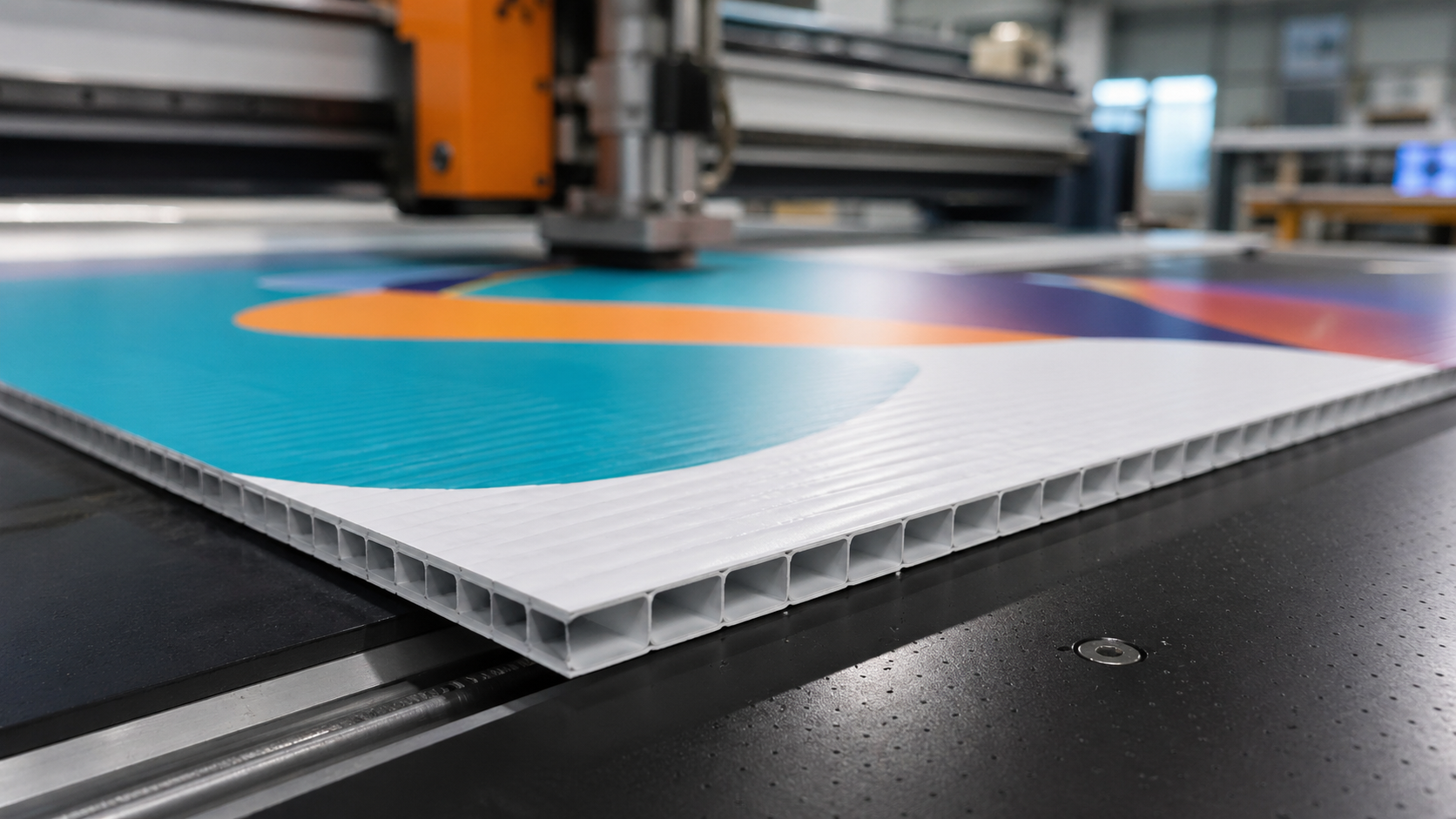
Corflute is the everyday Australian name for a printed sign made from fluted polypropylene. It's a lightweight, rigid plastic sheet with a hollow internal structure. In cross-section it looks a bit like a slice of cardboard. Two flat outer skins are bonded to a series of vertical ribs, the 'flutes', that run through the middle. That structure is what gives corflute its strength-to-weight ratio. A 5mm sheet is stiff enough to stand up to wind in a real estate frame, but light enough that a single person can carry a stack of fifty without thinking about it.
Strictly speaking, Corflute® is a registered trademark of Corex Plastics Australia, the Dandenong-based manufacturer that has been producing the material locally for decades. In the same way that 'Esky' technically refers to one brand of insulated cooler and 'Textas' to one brand of marker pen, the trademark has been so thoroughly absorbed into Australian English that it now functions as the generic term. Sign makers, councils, real estate agents, builders and event organisers all use 'corflute' to mean any fluted polypropylene sign, regardless of who manufactured the substrate. This article follows that convention. We use 'corflute' generically throughout, while acknowledging that the trademark belongs to Corex.
The naming gets more confusing once you cross a border. In the United States the same material is most commonly called Coroplast, another brand name that became generic in its home market. In the United Kingdom and parts of Europe the technical term 'fluted polypropylene' (or simply 'fluted plastic') is more common, with Correx being a frequently used trade name. So an Australian designer searching for 'corflute file setup' and an American designer searching for 'Coroplast artwork specs' are looking for exactly the same thing. If you're sourcing artwork from an overseas designer or working with international suppliers, it's worth knowing the equivalents. They are identical materials with regional names.
It's also worth being clear about what corflute isn't. It isn't cardboard, even though the fluted internal structure is borrowed from corrugated paper. Corflute is 100% polypropylene plastic, which means it's waterproof, won't soften or warp in the rain, and won't go soggy when it's left out on a Saturday morning open-for-inspection. It's also not the same as foam board (a paper-faced foam core used for indoor display work), ACM or Dibond (an aluminium composite used for premium long-term signage), or solid PVC sheet (a heavier, more rigid plastic used for permanent installations). Each of those substrates has a place. Corflute's niche is the sweet spot of cheap, light, weatherproof and printable, which is why it dominates campaign signage, real estate, construction hoardings, A-frame inserts and short-to-medium term outdoor work right across Australia.
For the rest of this guide, when we say 'corflute' we mean a printed fluted polypropylene sign. The product, not the trademark.
Material specifications that matter
Most articles about corflute skip the technical detail. That's a shame, because the specifications are the part of the conversation that actually helps buyers make better decisions. If you're quoting on a council job, specifying for a tender, or just trying to work out whether a 3mm sheet will hold up on a windy site, the numbers matter. Here are the specs that come up most often, and what each one means in practice.
Standard gauges (3mm to 10mm)
Corflute is manufactured in a range of thicknesses from 3mm up to 10mm. The right choice depends on the application. A 3mm sheet is light and cheap, suitable for short-term indoor display work or hand-held event signage. 5mm is the workhorse gauge for outdoor signage in Australia. It has enough rigidity to sit flat in a real estate frame or A-frame insert, holds eyelets without tearing, and stands up to wind without flexing dramatically. Heavier gauges (8mm and 10mm) are used where the sign needs to be self-supporting, where it will be stake-mounted in soft ground, or where the visual presence of a thicker edge matters. For most printed signage jobs, 5mm is the default for a reason. At Mediapoing we carry 3mm and 5mm corflute. It's the gauge that balances cost, weight and durability for the way Australian signs actually get used.
Service temperature (−20°C to +95°C)
Corex tests the substrate to a service temperature range of −20°C to +95°C. The lower end is irrelevant for most of Australia, but the upper end is genuinely worth noting. A black corflute sign sitting in direct sun on a 40°C day in Mildura or Port Hedland can easily reach surface temperatures of 70 to 80°C. The substrate handles that without warping or softening. Cheaper imported alternatives often don't, which is one reason locally manufactured corflute outperforms unbranded equivalents on long-running outdoor jobs. If your sign will be in direct sun all summer, the substrate isn't your problem. The print is, and we cover that further down.
UV treatment as standard
All corflute we print is UV-treated as standard. It's not an upsell, and it's not an optional extra. The polypropylene itself contains UV stabilisers that slow down the breakdown of the substrate under sunlight, which is why a blank corflute sheet left outside will still be structurally sound years later. Worth being clear about what this does and doesn't mean. Substrate UV protection keeps the plastic from going brittle. It doesn't stop the printed image on top of it from fading. Those are two separate things, and the distinction matters for anyone setting realistic expectations on outdoor life.
3-year substrate warranty vs 2-year printed sign life
This is the spec that gets most often misrepresented in marketing copy. Corex tests the substrate to 3 years outdoor weathering. That's a substrate figure. It refers to the polypropylene itself holding its structural and visual properties under sustained UV exposure. The printed sign sitting on top of that substrate is a different story. The UV inks we use are rated to roughly 2 years outdoor life under typical Australian conditions. Beyond that point, the substrate is still fine, but the print starts to fade noticeably. Magenta and yellow tend to go first.
The honest framing is this: a printed corflute sign in Australia has a realistic outdoor life of around 2 years before fade becomes noticeable. That's plenty for the vast majority of corflute jobs (real estate listings, election cycles, event signage, construction hoarding) where the sign is doing its job for weeks or months, not years. If you need permanent outdoor signage that holds colour for 5 or 10 years, corflute is not the right product, and any printer telling you otherwise is overselling.
These four specs (gauge, service temperature, UV treatment, and the substrate-versus-print durability distinction) cover most of the technical questions buyers actually ask. The full Corex technical data sheet covers more ground, including specific gravity (0.91 to 0.925 g/cc), Shore D hardness of 68, and standard sheet size of 2440mm × 1220mm. Those numbers matter for niche applications and for designers tiling artwork to the master sheet, but the four covered above are the ones that drive real-world decisions about whether corflute is the right substrate for the job.
Common applications across Australian industries
Corflute shows up in almost every industry that needs short-to-medium term outdoor signage. The reasons are always the same: it's cheap, light, weatherproof, and it prints well. Here are the applications that drive most of the volume in Australia, with the production tips that come up most often for each.
Real estate
Real estate is the single biggest use case for corflute in Australia. The standard 600 × 900mm sign is the workhorse of every weekend market, sitting in front yards and on auction frames from Friday afternoon to Sunday night. Most agents spec these double-sided so the listing is visible from both directions of the street, and 5mm gauge is the standard for wind resistance. If you're printing for an agency that cycles signs frequently, ask about bulk runs at standard sizes. Sheet yield works in your favour at the 600 × 900mm size.
Construction and trades
Construction sites use corflute for site identification, safety signage, hoarding panels, and developer branding. The substrate is rigid enough to survive being zip-tied to temporary fencing for months, and cheap enough to replace if a panel gets damaged on site. For long hoardings, larger custom sizes are common, but watch the sheet yield. A 1200 × 2400mm panel uses a full master sheet and is economical. Awkward intermediate sizes are not.
Election and political signage
Election cycles drive huge spikes in corflute demand. Federal, state, council and by-election campaigns all rely on corflute for booth signage, polling place A-frames, fence panels, and the corflute pickets that go up on stakes in front yards. The 2-year ink life is irrelevant here. Most election signs are up for weeks, not years. The thing to plan for is volume and turnaround. Campaign teams often need thousands of signs in days, not weeks, and trade printers who can confirm sheet stock and turnaround windows early are worth their weight in gold.
Events and festivals
Wayfinding signs, sponsor boards, stage signage, parking direction, and entry points all use corflute because it's easy to handle, cheap to replace, and recyclable at end of run. Eyelets are standard for rope-tying to bollards and fencing. If you're running an outdoor event in summer, plan for the print to look its best on day one and slightly faded by the end of a long touring season.
Retail point of sale
Retail uses corflute for window signage, in-store promotional displays, A-frame inserts on the footpath, and shelf-edge promo panels. Indoor retail jobs don't need to worry about UV fade, which means colour stays vibrant for the life of the campaign. For window-facing signage, double-sided is worth specifying so the message reads correctly from both inside and outside the store.
Government and council
Councils use corflute for park signage, public consultation notices, road closure signs, community event promotion, and temporary regulatory signage. Tender specifications often call for specific gauges and substrate certification, which is where citing the Corex specs (3-year substrate weathering, UV-treated, manufactured in Australia) becomes useful. For council jobs especially, knowing your printer can document the substrate makes the procurement conversation easier.
Standard sizes (and why custom sizes cost more)
Three sizes account for the majority of corflute jobs printed in Australia. They are not arbitrary numbers. They are the sizes that fit cleanly into the master sheet that corflute is manufactured at, which makes them the cheapest sizes to produce per piece. Knowing what they are, and why they are priced the way they are, helps designers and buyers make better decisions before the file ever hits the printer.
The three standard sizes
The table below covers the sizes we print most often. Each one corresponds roughly to a familiar A-size, which makes specification easier when you're working from a brief that uses paper sizing conventions.
| Size | Common use | Sheet yield |
|---|---|---|
| 600 × 900mm (≈ A1) | Real estate signs, lawn signs, auction frames | 5 per sheet |
| 600 × 450mm (≈ A2) | A-frame inserts, smaller property listings | 10 per sheet |
| 900 × 1200mm (≈ A0) | Large format display, retail point of sale | 2 per sheet |
Why sheet yield drives pricing
Corflute is manufactured in a master sheet of 2440 × 1220mm. Every printed sign comes from that sheet, no matter what size you order. The economics of trade printing are driven by how efficiently your sign tiles into the master. A 600 × 900mm sign fits 6 times into the sheet with almost no waste. That's the cheapest way to print a corflute sign in Australia, on a per-piece basis. A 600 × 450mm sign tiles 12 times into the same sheet. Same material cost, twice as many signs, half the per-piece price.
Custom sizes break this economy. A 700 × 500mm sign sounds smaller than a 600 × 900mm sign, and intuitively buyers expect it to be cheaper. It usually isn't. The 700 × 500mm size tiles awkwardly into the 2440 × 1220mm sheet, which means more offcut waste per piece, and a higher per-piece cost than the larger but more efficient standard size. This catches buyers out regularly. The lesson is simple: if your job can be designed to a standard size, design it to a standard size. If it has to be custom, ask your printer how the size tiles into the master sheet before signing off on the spec. Small changes (50mm here, 50mm there) can dramatically change the per-piece price.
Custom sizes are absolutely available. We print them every day. Just go in with the awareness that the price is driven by sheet yield, not by the surface area of the sign itself.
Designing artwork for corflute
Most corflute reprints are caused by file setup problems, not printing problems. The substrate is forgiving. The press is forgiving. The bit that goes wrong is usually upstream, in the artwork that arrives. Here are the file setup essentials that catch designers out most often. Get these right and your job moves through prepress without intervention.
File format and size
PDF only. We do not accept native Illustrator, InDesign, Photoshop, JPEG, PNG, or any other format. PDF is the only file type that reliably preserves vector data, embedded fonts (or outlines), and colour profiles through the prepress workflow. Maximum file size is 2GB, which is more than enough for any corflute job. If your file is approaching that limit, the issue is almost always an unflattened raster image at unnecessary resolution, not the design itself.
Bleed
Single-sided artwork needs 3mm bleed minimum. Double-sided artwork needs 5mm bleed minimum. The reason double-sided needs more is the small amount of registration drift that happens when the press prints both sides. Extra bleed gives the trim a safety margin so you don't get a thin white sliver on one edge.
Scale and resolution
Set up artwork at 100% size. Don't send a half-scale file with a note asking us to scale it up at our end. Raster images (photos, textures, anything that is not pure vector) need to be 300dpi at the finished print size. A 300dpi image at half scale is effectively a 150dpi image when we scale it back up, and it will look soft on the press.
Colour
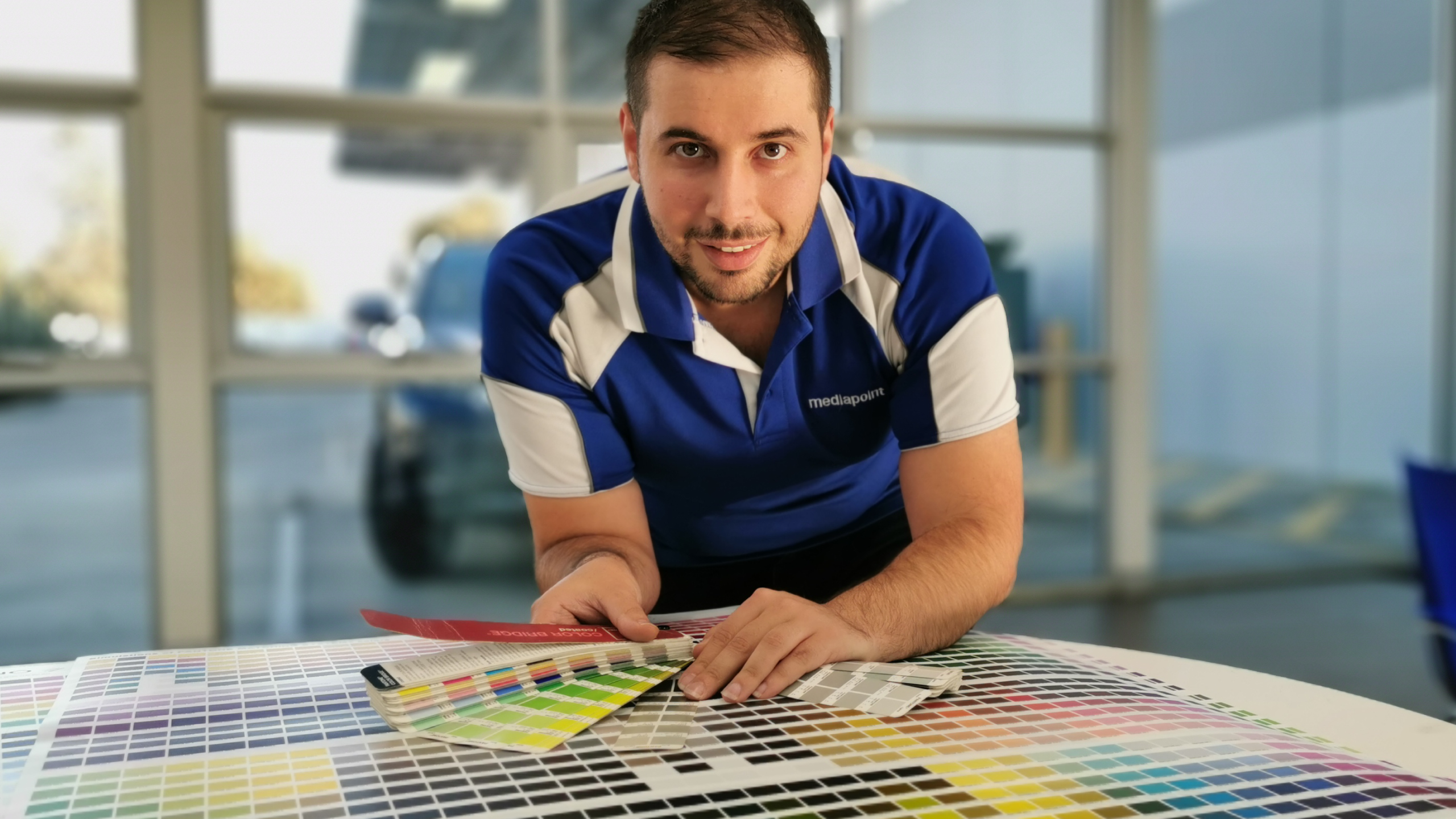
CMYK only. RGB files will be converted in prepress, and the conversion never matches what you saw on screen. If you have brand colours that need to match across jobs, specify them as Pantone C spot colours in the artwork. Our profile produces the closest possible CMYK match to the Pantone reference. It isn't a perfect match, because corflute is not a coated stock, but it is consistent from job to job.
Fonts
Convert all fonts to outlines before exporting the PDF. Embedded fonts can fail at the RIP and substitute incorrectly, which means your carefully chosen typeface arrives on the press as Arial. Outlined fonts become shapes, which eliminates the risk entirely. The trade-off is that you can't edit the text once it's outlined, so always keep an editable master file separately.
Filenames
Include the finished size and quantity in the filename. The convention is straightforward: 600mm x 900mm qty 2.pdf tells us everything we need to know to schedule, sheet-up and quote the job. Generic filenames like final_v3.pdf or artwork.pdf add a step every time the job is touched, which slows the whole process down. This is a small habit that designers who work with trade printers regularly have already built. If you're new to trade work, building it now will save you and your printer hours over the course of a year.
Custom shapes, holes and Thru-cut
Most corflute jobs are rectangles. The standard sizes are rectangular, real estate signs are rectangular, A-frame inserts are rectangular. But corflute can be cut to almost any outline shape, and once you know it's possible, the creative options open up. Custom shapes turn a generic sign into something that stops people in the street. They are also the part of the corflute conversation that competitor articles barely cover, which means most designers don't know what is possible until they ask.
When custom shapes are worth it
Custom shapes work best when the silhouette itself communicates something. A house-shaped sign for a real estate campaign reads as 'property' from across the street before the viewer reads a single word. A speech-bubble cut-out for a retail promotion creates personality. A bottle silhouette for a beverage sponsor stands out at an event in a way no rectangle can. The added cost over a standard rectangle is usually small relative to the visual impact, especially for short runs where the sign is doing serious work as a brand piece.
For high-volume jobs (election pickets, bulk real estate runs, multi-site retail), rectangles still win on cost and turnaround. Custom shapes add a cutting step and reduce sheet yield, both of which scale up with volume. As a rough rule of thumb, custom shapes pay off when the sign is hero artwork, not workhorse signage.
How Thru-cut works in your file
The cutting path in your artwork is called Thru-cut. It is a vector stroke in your PDF that tells our cutter exactly where to cut the shape out of the sheet. The setup is specific, and getting it right at the artwork stage saves a back-and-forth with prepress.
- Stroke name. The stroke must be named exactly 'Thru-cut', with that exact capitalisation and the hyphen. 'Thru cut', 'thrucut' or 'Cut' will not be picked up by our workflow.
- Colour type. Spot colour, not process. The CMYK values can be anything except white (do not use 0,0,0,0 or it will not register as a cut path).
- Stroke alignment. Centre-aligned on the path, not inside or outside. This ensures the cutter follows the exact line you drew.
- Closed shape. The Thru-cut path must be a fully closed shape. Open paths cannot be cut.
- Bleed outside the cut. Add 3mm bleed outside the Thru-cut stroke, the same way you would extend artwork past the trim on a rectangular job. Without bleed, you risk a thin sliver of unprinted substrate on the cut edge.
- Outer cut required. If you have inner cuts (a window in the middle of the shape, for example), you still need the outer Thru-cut stroke that defines the overall sign outline.
- One Thru-cut per sheet. Multiple separate cut paths on a single file are not accepted. If you need different shapes, send them as separate files.
Why shapes need to be simple
Corflute is a fluted material, which means the inside is hollow ribs running in one direction. That structure is what gives the sheet its strength along the flute axis. It also means the material is more vulnerable to cracking at sharp internal corners, where the cutter has to change direction abruptly. A speech bubble with a smooth curved tail will cut cleanly. A starburst with sharp inward angles can crack along the flute or tear during cutting, especially in heavier gauges.
The practical guidance is to round any internal corners to at least a 5mm radius, and avoid sharp 'V' cuts that point back into the shape. Outer corners are more forgiving (a sharp star point on the outside cuts fine), but anywhere the cut turns inward is a stress point. If you're not sure whether a shape will work, send the file across before the rest of the design is finalised. We can flag risk areas before you commit.
Hole cutting
Holes are cut with a router, not drilled. Drilling tears the flute structure and leaves a ragged edge. Routing produces a clean, sealed hole that does not weaken the surrounding material. Minimum hole diameter is 6mm. Smaller than that and the router cannot make a clean pass. Holes also need to clear the edge of the sign by at least 10mm so the bridge of material between the hole and the edge does not break out under load (especially relevant for stake-mounted or rope-tied signs).
Single-sided vs double-sided
The choice between single-sided and double-sided printing comes down to one question. Will the sign be seen from both sides? If yes, you need double-sided. If no, you don't.
Real estate signs are the classic double-sided application. A sign sitting at the front of a property needs to read correctly to drivers approaching from both directions of the road. A-frame inserts that sit on the footpath are the same. So are hanging signs, rotating display signs, and any sign mounted on a fence or pole where the back of the sign is visible to passers-by. Single-sided is the right call for anything mounted flat against a wall, hoarding, or other backing where the second side will never be seen.
There are two production differences worth knowing. Double-sided artwork needs 5mm bleed instead of 3mm, to allow for the small registration drift between the two passes. And double-sided printing roughly doubles the press time per sign, which is reflected in the price. The substrate cost is the same, but you're buying twice as much print. For most jobs this is a sensible spend. A double-sided real estate sign that gets seen by traffic in both directions is doing twice the work of a single-sided one.
Outdoor durability: what to actually expect
Corex tests the corflute substrate to 3 years outdoor weathering. The print on top of it is the limiting factor. Mediapoint uses UV inks rated to roughly 2 years outdoor life under typical Australian conditions. That's the honest number. Most competitor articles either claim vague 'long-lasting' performance or quote the substrate spec as if it applies to the printed sign, which it does not. The 2-year figure is the one that matters for your planning.
Why ink fails before substrate
UV inks bond to the surface of the corflute and cure under ultraviolet light. The same UV exposure that cures the ink in the press also breaks it down slowly in the field. The substrate is protected by built-in UV stabilisers that slow this process down for the polypropylene itself, but the ink doesn't have the same protection layer. So the sign starts to fade from the top down. The substrate will still be structurally sound when the print has gone past its useful life.
Which colours fade first
Magenta and yellow are the first to go. A sign that is visually dominated by reds, oranges, pinks or yellows will look noticeably tired earlier than one that leans on cyan, blue or black. This doesn't mean you should avoid those colours. It just means a hot pink real estate sign in full sun in Brisbane will not look the same at 18 months as it did on day one. If colour fidelity matters for the full life of the campaign, design with that in mind.
Why Australian conditions are harder
Most ink fade-rating tests are done in European conditions, where UV intensity is significantly lower than Australia. The Australian sun is, by global standards, brutal on print. UV index regularly hits 11 to 14 in summer across most of the country. Combine that with the 40°C+ surface temperatures a dark sign can reach in direct sun, and you have an environment that ages ink faster than the lab tests assume. The 2-year figure already accounts for this. It's a realistic local number, not a transplanted European spec.
When 2 years is plenty (and when it isn't)
Two years is more than enough for the vast majority of corflute jobs. Real estate listings cycle in weeks. Election campaigns run for months. Construction signage tracks the build. Event signage gets used for a season. For all of these, a 2-year ink life is not a constraint. The sign has done its job and been retired well before fade becomes an issue.
Where 2 years is not plenty is permanent installations. Long-term wayfinding, permanent business identification, regulatory signage that is meant to be in place for 5 or 10 years. For these applications, corflute is not the right substrate. ACM, Dibond or solid PVC with appropriate ink systems will hold colour and structural integrity much longer, at correspondingly higher cost. Honest framing here matters. We'd rather direct a permanent-installation buyer to the right substrate than print them a corflute sign that will look tired in two years.
Mounting and finishing options
How a corflute sign is finished and mounted matters as much as the print itself. A great-looking sign that is not properly finished for its mounting application will fail in the field, no matter how good the artwork is.
Eyelets
Eyelets are the standard finishing option for any sign that will be rope-tied, zip-tied to fencing, or hung from a frame. We position eyelets in the corners as default, with additional positions along the edges for larger signs that need more attachment points. Specify the count and position when you order, or let us recommend based on the size and mounting method.
Taping
Taping reinforces the edge of a sign where it is going to take repeated stress, or where it slots into a frame channel and needs a smoother edge to slide cleanly. Real estate signs that go in and out of frames every weekend benefit from taped top and bottom edges. So do A-frame inserts that get swapped out frequently.
Shape cutting and hole cutting
Custom shape cutting (Thru-cut) and hole cutting are covered above. Worth repeating that holes are router-cut with a 6mm minimum diameter, and that simple shapes cut more reliably than complex ones with sharp internal corners. Stakes for ground-mounted signs go through holes positioned in the lower portion of the sign, with the same edge clearance considerations as any other hole-cut application.
Corflute is compatible with the standard mounting hardware used across Australian sign trades. Real estate frames, A-frames, fence-mounting brackets, ground stakes, hanging chain and rope all work with appropriately finished corflute. If you have a specific mounting system in mind and you're not sure how to spec the sign for it, ask before you order. The right finishing decision at the production stage costs nothing. Getting it wrong means a reprint.
How to order corflute signs from a trade printer
Trade printing runs differently to retail printing. The expectations on file quality are higher, the turnaround is faster, and the pricing is structured for volume. Here's what to know before placing your first order.
File requirements
PDF only, set up at 100% size, with appropriate bleed (3mm single-sided, 5mm double-sided). CMYK colour, fonts outlined, raster images at 300dpi at finished print size. Trim marks are not required for rectangular jobs and are actually preferred to be left off. Filename should include the finished size and quantity, formatted like 600mm x 900mm qty 50.pdf.
Turnaround
Turnaround starts from the next business day for files received and approved by cut-off. For high-volume jobs (election cycles, multi-site retail rollouts) call ahead to confirm sheet stock and press time. Trade printers usually have a rigid schedule but have capacity other printers cannot match.
Pricing
Pricing is driven by sheet yield. Standard sizes are the cheapest per piece because they tile efficiently into the 2440 × 1220mm master sheet. Custom sizes are absolutely available, but the price reflects how the size tiles, not just the surface area of the sign. For repeat work, building your designs around standard sizes will save real money over a year of jobs.
Trade pricing for resellers and sign shops
If you're a sign shop, designer or reseller buying corflute regularly to on-supply to your own clients, trade pricing is structured for that workflow. Account setup, consistent specifications, predictable turnaround, and pricing that allows margin for the reseller. The trade relationship rewards repeat work, and the more your designs work with the sheet model, the better the pricing gets.
Frequently asked questions
How long do corflute signs last outdoors in Australia?
Realistically, around 2 years before fade becomes noticeable. The substrate itself lasts longer (Corex tests to 3 years), but the print is the limiting factor. Magenta and yellow tend to fade first under sustained Australian UV.
Is corflute UV-treated?
Yes. The substrate has UV stabilisers built in as standard. This protects the polypropylene from going brittle in sunlight. It is separate from the print durability, which is governed by the ink, not the substrate.
Can I get corflute signs in custom shapes?
Yes, using Thru-cut. Shapes need to be simple and avoid sharp internal corners, which can crack the corflute or tear during cutting. The cutting path in your file needs to follow the Thru-cut spec covered earlier in this guide.
What is the minimum hole size you can cut?
6mm diameter, cut with a router. Smaller holes cannot be cleanly routed. Holes are not drilled, because drilling tears the flute structure and leaves a ragged edge.
Can corflute be recycled?
Polypropylene (recycling code 5) is only accepted at certain recycling centres, though most kerbside collections do not accept signage-grade corflute. Best practice is to drop off at a designated PP recycling point, particularly for large quantities at end of campaign.
Why do you need fonts outlined?
Embedded fonts can fail at the RIP (the prepress system that processes your file for the press) and substitute incorrectly. Outlined fonts become shapes, which removes the substitution risk entirely. The trade-off is that outlined text cannot be edited in the PDF, so always keep an editable master file separately.
Can I get corflute in any colour?
The substrate is available in a range of colours, but for printed signs the print determines the colour. Our UV inks cover the full CMYK range plus Pantone matching, which means almost any brand colour can be reproduced. Pantone matches are as close as the corflute substrate allows (it isn't a coated stock, so the match is consistent rather than perfect).
Why does my custom-sized sign cost more than a slightly bigger standard size?
Sheet yield. A 700 × 500mm sign tiles inefficiently into the 2440 × 1220mm master sheet, costing more per piece than a 600 × 900mm standard size that tiles 6-up. Pricing is driven by how many signs come out of the master sheet, not by the surface area of the sign itself.
Key takeaways
If you only take a handful of points from this guide, these are the ones that will save you the most time and money on corflute jobs.
- 'Corflute' is the generic Australian term for fluted polypropylene signage. The trademark belongs to Corex Plastics, a Dandenong-based manufacturer.
- 5mm is the workhorse gauge for outdoor signage. 3mm for short-term indoor work. 8mm and 10mm for self-supporting or stake-mounted applications.
- Substrate is tested to 3 years outdoor weathering. Realistic printed sign life is around 2 years before noticeable fade. The ink is the limit, not the substrate.
- Standard sizes are cheaper per piece because they tile efficiently into the 2440 × 1220mm master sheet. Custom sizes are pricing-driven by sheet yield, not surface area.
- PDF only, 100% size, CMYK, fonts outlined, 3mm bleed single-sided or 5mm double-sided. Filename should include finished size and quantity.
- Custom shapes (Thru-cut) need a closed spot-colour path named exactly 'Thru-cut', with 3mm bleed outside and one cut path per file.
- Holes are router-cut, not drilled, with a 6mm minimum diameter and edge clearance to prevent tear-out.
- Double-sided printing roughly doubles press time, but is essential for any sign visible from both directions.
- Magenta and yellow fade first under sustained Australian UV. Design with this in mind for long-running outdoor jobs.
- If your job is permanent (5+ years outdoor life), corflute is not the right substrate. ACM, Dibond or solid PVC will serve you better.
Working with Mediapoint on your next corflute job
Mediapoint is an Australian trade printer specialising in corflute signage and the full range of large-format print products. The sheet-model pricing covered throughout this guide is the same model we use to quote every job. Standard sizes get the best per-piece economics, custom sizes are priced honestly against sheet yield, and turnaround starts from the next business day for files received and approved by cut-off.
If you're a designer, sign shop or reseller looking for a trade partner who treats your specifications and turnaround commitments seriously, get in touch. View our corflute product page for current pricing and order options, or browse our full product range for everything from corflute to ACM, banners, foam board and beyond.