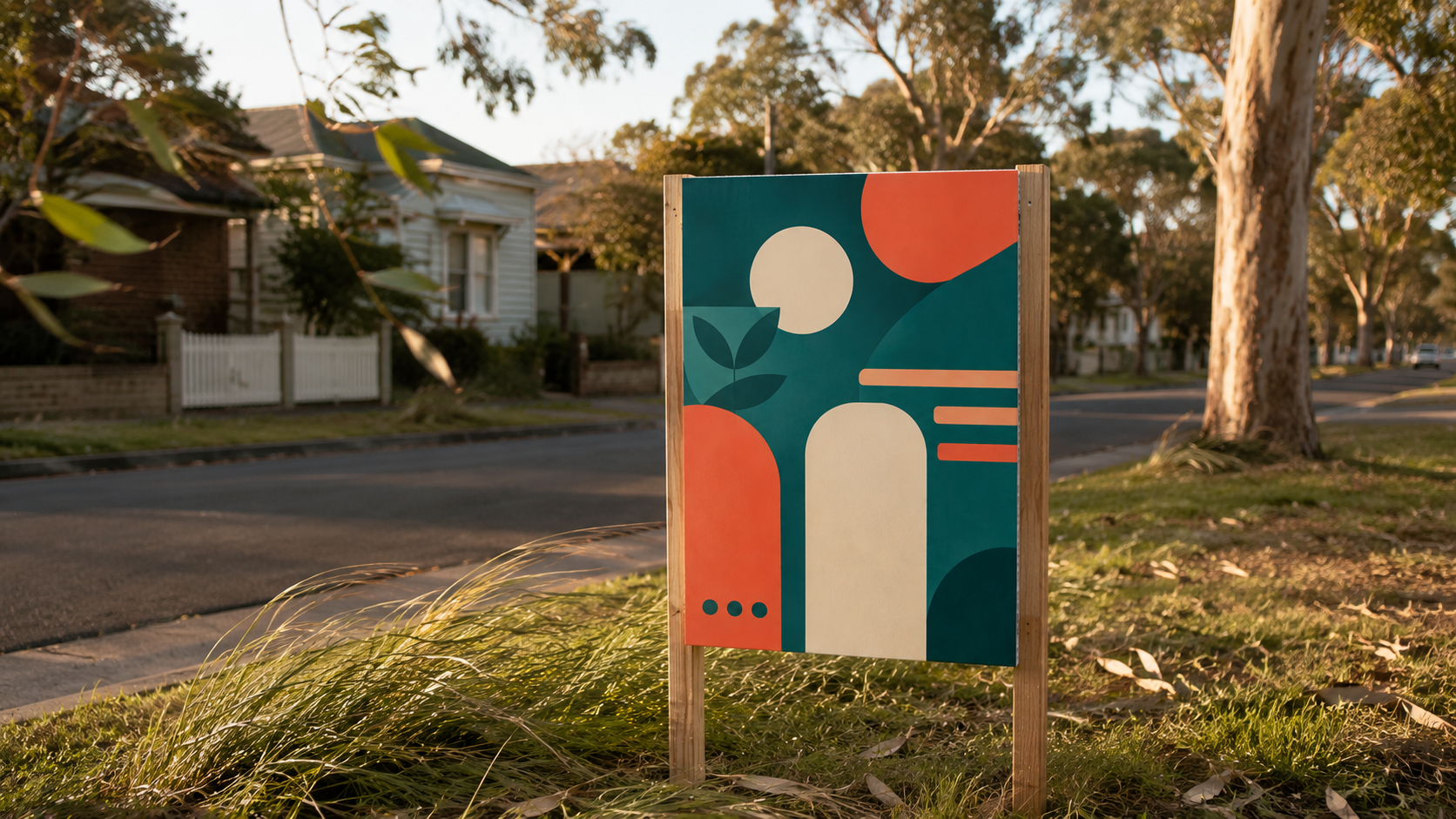
Wind Damage and Corflute Signs: How to Stop Your Signs Blowing Away in Australian Conditions
The phone call no campaign manager or real estate agent wants: 'your signs are in next door's yard'. Wind is the most common cause of premature corflute sign failure in Australia, ahead of UV fade, ahead of vandalism, ahead of theft. A storm front through Melbourne or a southerly buster up the NSW coast can take out hundreds of signs overnight, and most of those failures were avoidable with better mounting or better site selection.
This guide explains why corflute and wind have an awkward relationship, how to specify and install signs that survive realistic Australian wind conditions, and — honestly — when corflute isn't the right substrate for the location at all. It's written for installers, campaign coordinators, sign shop resellers and end customers planning deployment. Skim it for the section you need or read it through; both work.
For the comprehensive overview of corflute signage in Australia, see our corflute signs guide. This article is the focused companion piece on wind.
Important: this article is general guidance based on Mediapoint's product knowledge and general installer experience, not engineering advice or warranty against wind damage. Wind tolerance depends on installation quality, site conditions, weather events and substrate handling — factors outside Mediapoint's control as the printer. Specific wind-speed-to-failure thresholds in this article are general guidance, not guarantees. For high-stakes installations, consult a qualified sign installer or structural engineer about site-specific requirements. Mediapoint prints what is supplied; the customer or installer is responsible for installation decisions and outcomes.
Why corflute and wind don't mix
Three things about corflute make it more wind-vulnerable than other rigid signage substrates. Worth understanding the physics before getting into installation, because the same physics drives the mounting decisions. Wind is one of two major outdoor failure modes for corflute (the other being UV fade and substrate breakdown over time); for the broader picture of what determines a corflute sign's realistic outdoor service life beyond wind specifically, see our corflute outdoor durability guide.
The fluted structure acts like a sail
The same hollow-tube internal structure that gives corflute its strength-to-weight ratio also makes it flex more in wind than a solid sheet substrate would. Solid panels (ACM, Foamed PVC) bend less under wind load. Corflute flexes, which catches more wind, which makes it flex more. The flex itself is not the failure point, but it loads the mounting harder than a rigid panel of the same surface area.
Lightweight is a feature and a problem
The same low weight that makes corflute easy to deploy also means it has less mass to resist wind force. A 5mm 600 × 900mm corflute sign weighs about 1kg. A 3mm ACM sign of the same size weighs about 4 to 5kg. That mass difference matters. Heavier signs need much higher wind speeds to lift, and they don't flutter or vibrate the way a light sign does in steady wind.
Surface area dominates wind catch
Wind force scales with surface area. A 600 × 900mm sign catches roughly twice the wind load of a 600 × 450mm sign at the same wind speed. A 900 × 1200mm sign catches roughly four times the load. Bigger signs are not just more visible, they are more vulnerable. This trade-off matters when you're choosing standard sizes for high-wind locations.
Single-sided vs double-sided
Single-sided Corflute Print Only catches wind on one face. Double-sided Corrugated Plastic catches wind on both faces, but the wind tends to be similar pressure on both sides, which partially cancels out. The exception is exposed corner installations where wind speed differs between the two faces; cross-wind situations can twist double-sided signs. Rare, but worth knowing about.
Realistic framing: corflute will survive most everyday wind conditions when properly mounted. It will not survive every storm front Australia produces. The question for any specific installation is whether your mounting and site selection are designed for the wind range you'll actually encounter, not the average wind range.
Wind load basics
A small amount of wind physics goes a long way for sign installation decisions. The key principle is that wind force scales with the square of wind speed. Doubling the wind speed quadruples the force on the sign. A 60 km/h gust does not produce twice the force of a 30 km/h breeze. It produces four times the force. This is why signs that survive months of normal weather can fail catastrophically in a single severe gust.
This also means 'average wind speed' is the wrong metric for sign survival planning. Maximum gust at the site is what kills signs. The Beaufort scale reference below shows roughly which wind speeds break which mounting types in Australian sign installation work.
Beaufort scale practical reference for sign installers
| Force | Wind speed | Observable conditions | Sign installation impact |
|---|---|---|---|
| Force 4 | 20-29 km/h | Loose dust raised, small branches move | Standard installations should survive easily |
| Force 5 | 30-39 km/h | Small trees sway | Single-stake corflute starts to flex visibly |
| Force 6 | 40-50 km/h | Large branches in motion, umbrellas difficult | Single-stake mountings start failing; two-stake mountings still hold |
| Force 7 | 51-61 km/h | Whole trees in motion | Most single-stake corflute fails; two-stake mountings beginning to fail |
| Force 8+ | 62+ km/h | Gale conditions | Most corflute installations of any kind fail |
The practical takeaway: plan for the worst hour of your installation period, not the average. A campaign that runs four weeks will see at least one severe weather event most of the time. A real estate listing that sits six weeks will see one too. Sign deployment that survives the average will fail the gust.
Mounting type comparison
This is the section installers reference most. Five mounting types, each with strengths, weaknesses, and the wind speed at which they typically start failing. The mounting types covered here are the broad categories — for the deeper reference covering eyelet specifications, hole positioning, stake selection criteria and the full mounting hardware ecosystem for corflute signs, see our eyelets, holes and mounting hardware guide.
Note on wind speed thresholds: the speeds below are general guidance based on industry experience, not engineering ratings. Actual failure points depend on stake quality, soil conditions, sign size, eyelet placement, cable tie quality and other variables. Use these as planning ranges, not warranties.
Stake mounting (single stake)
Most common for election picket signs and small property signs. Strengths: cheap, fast deployment, easy to retrieve at end of campaign. Weaknesses: most vulnerable mounting type by a long way. The sign pivots around the stake, wind catches one face, sign lifts and twists. Failure mode is usually the stake bending or pulling out of the soil. Single-stake corflute starts failing reliably at Force 6 wind (40+ km/h). Recommendation: only use for sheltered or inland locations with low wind exposure, or as the standard mounting where periodic replacement is acceptable and budgeted.
Stake mounting (two stakes, edge-mounted)
Significantly more wind-resistant than single-stake. Two stakes prevent the sign pivoting and distribute wind load across both anchor points. Failure typically requires both stakes to pull simultaneously, which needs much higher wind speeds. Recommendation: standard practice for any roadside or exposed picket sign installation. Marginal extra cost (one extra stake, a few cable ties) for substantial wind-resistance improvement. If you make one upgrade to your installation practice for high-wind work, this is it.
Eyelet and rope mounting (fence-line)
Used for chain-link fences, temporary fencing on construction sites, and fence-mounted property signs. Performance varies dramatically with technique. Strengths: rope distributes load across multiple eyelets when done properly. Weaknesses: tight rope can shred eyelet holes under wind load; loose rope flaps and accelerates failure of both rope and eyelets. Recommendation: four eyelets minimum for a 600 × 900mm sign, rope tight but not over-tensioned, additional eyelets for larger sizes or higher wind exposure.
Frame mounting (real estate, A-frame)
Most stable mounting for the same surface area. Real estate frames are built to the standard 600 × 900mm corflute size and transfer wind load into ground or wall structure rather than into the sign itself. Strengths: stable, professional appearance, sign edges protected from damage. Weaknesses: cost, weight, and the frame doesn't suit all installation contexts (you can't put a heavy frame on a fence). Failure modes: entire frame tipping (typically requires very strong gusts), or the sign being lifted out of the frame slots if not properly secured.
Adhesive mounting
Limited use, typically for temporary indoor or sheltered outdoor application. Strengths: no hardware required, easy to apply. Weaknesses: wind exposure rapidly defeats adhesive. Signs lift at corners and progressively detach. Not recommended for primary outdoor installation. Acceptable for sheltered shop windows, temporary indoor signage, and very short-term promotional displays where the sign comes down within days.
Stake mounting deep dive
Most failures happen at stake mounting, so this section gets dedicated treatment. Five things to get right.
Stake length and depth
Longer stakes hold better. Minimum 30cm into the ground for soft soil. 45cm or more for sandy or loose soil. Lawn installations are particularly weak because the soil is loose at the surface and dense underneath. Drive deep. The first 10cm of lawn does almost nothing for holding strength.
Soil type
Clay holds best. Sand holds worst. Lawn sits in between. Coastal sand is the worst combination available: loose substrate plus high wind exposure. If you're installing into coastal sand, plan for failure regardless of mounting practice, or move to a different substrate entirely.
Stake type
Metal U-stakes (the C-shaped ones used by election volunteers) are the workhorse for a reason. They're stronger than wedge stakes, more resilient than wooden stakes (which split when hammered into hard ground), and dramatically stronger than plastic stakes (which flex and fail easily). For any installation you actually want to survive, metal U-stakes are the default.
The two-stake technique
For any 600 × 900mm sign in a roadside or exposed location, use two stakes — one on each side of the sign — with the sign sandwiched between them or attached via cable ties through the eyelets. This roughly doubles wind resistance for less than 50% extra installation cost. There is no other single change to standard installation practice that gives a comparable resistance gain.
Reinforcement options
For very exposed locations, additional reinforcement helps. Cable ties through the eyelet holes back to the stake to prevent the sign sliding up. Cross-bracing between two stakes for extra rigidity. Taping the sign edges to reinforce against tearing where the eyelet meets the substrate. None of these are standard practice, but for high-stakes installations (literally), they earn their place.
Designing for wind tolerance
Less commonly considered, but worth covering because some design choices materially affect wind survival.
Hole patterns and ventilation cuts
Perforated signs catch dramatically less wind. Trade-off: visibility and aesthetic. Some Thru-cut designs incorporate decorative ventilation that doubles as wind relief, particularly for exposed installations where survival matters more than visual purity. Not standard practice for most corflute work, but worth considering for sites that have killed previous sign deployments.
Reinforced edges and eyelet placement
Eyelet placement matters more than buyers expect. Eyelets too close to the edge can tear out under wind load — the sign rips along the flute axis from the eyelet outward. Position eyelets at least 30mm from any edge. For larger signs in exposed positions, taped edges around the eyelet area add reinforcement that genuinely extends life.
Thru-cut shape selection
Simple shapes survive wind better than complex ones with sharp internal corners. The same Thru-cut guideline that prevents cutting issues (avoid sharp internal corners) also prevents wind tear failures, because sharp internal corners are stress concentrators when the sign flexes.
Single vs double-sided choice
For two-direction-visibility installations, Corrugated Plastic (double-sided) doesn't catch more wind than Corflute Print Only (single-sided). The wind hits one face regardless of whether the other face is printed. Use double-sided when you need visibility from both sides; don't avoid it for wind reasons.
Site selection: where NOT to install corflute
Some installation sites are wrong for corflute regardless of how good the mounting is. Worth being honest about this list because pretending corflute survives every Australian site is how customers lose trust.
Coastal exposure (within 1km of coast)
Constant wind plus salt accelerates everything. Corflute will fail faster in coastal positions than inland installations of the same age and mounting. ACM tolerates this better; aluminium signs better still. For genuine coastal installations, plan for shorter campaign windows or move to a more tolerant substrate.
Highway proximity
Passing trucks create wind blasts that exceed ambient wind speed. A site that seems calm from the verge gets hit by 80+ km/h truck blasts every few minutes. Highway-adjacent corflute fails earlier and more dramatically than ambient wind speeds would predict.
Wind tunnel effects between buildings
Urban installations between tall buildings can experience wind speeds significantly higher than the surrounding area, because the buildings funnel and accelerate the wind. A Bondi-style southerly buster funnelled through an urban valley can sustain much higher speeds than the open coast.
Hill crests and ridges
Elevation amplifies wind exposure. Adelaide Hills, Perth Hills, and similar elevated installations face significantly higher average wind than the surrounding lowland areas. Local councils with hill-crest sites are often surprised at how much faster their sign deployments fail compared to flatter parts of their region.
Cyclone-prone north (November to April)
Northern Australia in cyclone season is hostile to all temporary signage. Plan around the season or budget for replacement at a multiple of normal expectations. Cape York and tropical coastal regions in particular are not corflute country during cyclone season.
When corflute isn't the right substrate
Direct continuation of the previous section. For genuinely high-wind locations, the right answer might not be 'better corflute mounting'. It might be a different substrate entirely, or a different sign approach.
ACM (Mediapoint's Aluminium Composite Panel product) is heavier, more rigid, and tolerates wind significantly better than corflute. The cost premium is roughly 3 to 5 times corflute pricing, but the cost of repeated corflute failures often exceeds this for long-running installations. If you're already on your second or third sign at the same location, the ACM cost premium has probably already been spent on replacement corflute.
Larger structural signage may need professional installation with engineered mounting — engineering certificates, structural steel, ground-anchor systems. This is beyond Mediapoint's scope as a print supplier; it's a referral to qualified sign installers and structural engineers.
Some applications shouldn't use printed signage at all in high-wind locations. Digital displays, painted permanent signage, or installations behind glass may be better answers depending on the site and the message. The honest framing: corflute is a brilliant substrate for the conditions it's designed for, and the wrong substrate for conditions it isn't.
For a substrate-by-substrate comparison of wind tolerance, cost and other factors, see our rigid signage materials comparison.
Common wind failure scenarios installers see in the field
These patterns are common enough across the Australian sign industry that experienced installers will recognise them. Frame them as observations about what works and what doesn't, not as promises about your specific job. If your scenario looks like one of the failure patterns, plan for failure.
The 'Friday afternoon storm' pattern
Election signs deployed Saturday morning for a weekend campaign event survive the day, get hit by a Friday afternoon storm front the following week, and fail just before the next weekend's opens or events. The lesson: campaigns and agents that don't budget for replacement get caught by the weather event that hits between the deployment day and the high-visibility day. The signs were fine on Saturday. They were gone by the following Saturday.
The 'forgotten construction sign' pattern
Construction site signs survive months of normal weather, then fail in a storm right at end-of-job cleanup. The site manager has already removed the strong perimeter fencing that was sheltering the sign from full wind exposure, and the sign — which had survived everything thrown at it during the project — fails in the first decent gust afterwards. The sign's actual wind tolerance hadn't changed; the wind exposure had.
The 'substrate switch' pattern
Upmarket residential developments install corflute project signage, see one or two failures in early storms, and reorder the same artwork in ACM (or comparable rigid substrate). The cost premium is justified by the brand presence importance for the high-value development. This is the pattern where the substrate decision gets revisited mid-project, often with the original printer.
The 'successful coastal install' pattern
Counter-example, useful for what it teaches. Coastal real estate agents who use frame-mounted Corrugated Plastic in protected garden positions (not roadside, not on the front fence) often see signs last full campaigns even in salt-wind exposure. Frame mounting plus sheltered position plus double-sided substrate combines for survival where any of those three changes individually wouldn't. The lesson: site selection within a difficult region matters as much as substrate choice.
Wind insurance: practical campaign and project planning
Practical operational advice for buyers running campaigns or longer projects. Build these habits into your deployment workflow and you'll lose fewer signs.
Budget 10 to 15% extra signs for replacement during long campaigns or extended deployments. Most campaigns that run more than four weeks will see at least one severe weather event. Budgeting for it is much cheaper than emergency reprinting on a Friday before a Saturday event.
Have replacement signs printed and stored before deployment, not after a storm event when production capacity industry-wide is constrained. Storms create concentrated demand across the local print industry; the post-storm Monday is the worst day to be ordering rush replacements.
Build storm-day inspection runs into volunteer or staff schedules. The team that put the signs up should do quick checks after major weather events. Catching a partially-detached sign before it goes is much cheaper than retrieving it from a neighbour's yard.
Track failures by location to inform future campaigns or seasons. Locations that failed once will fail again under similar weather. If you're running back-to-back deployments at the same sites, the failure data from the first one is genuinely useful for the second.
For fixed-deadline jobs (Saturday opens, election day, event launch), have a backup deployment plan if storms hit the day before. The plan doesn't need to be elaborate — stored replacement signs and a known volunteer list is enough. The point is to have decided what you'll do, before the moment you have to do it.
The Friday afternoon storm planning principle: assume one major weather event during your deployment window. If your sign budget can't absorb that event, you don't have a deployment plan, you have a hope.
After the wind event
What to do when signs come down.
Inspect before reinstalling. Visible damage (bent corners, eyelet tears, cracks across the surface) means the sign is compromised. Reinstalling damaged signs typically results in faster re-failure, often during the next moderate weather rather than waiting for another major event.
Replace rather than repair when in doubt. Tape and zip ties can hold a damaged sign together visually, but they rarely restore actual wind resistance. The sign that came down once will come down again, sooner.
Store undamaged retrieved signs flat and dry for re-deployment. Most retrieved signs are still usable; the issue was the mounting or location, not the sign itself. Keep them out of UV exposure during storage and they'll go up again on the next campaign or listing.
Recycle damaged signs through appropriate channels. Corflute is polypropylene (recycling code 5). Drop at a designated PP recycling facility, not council kerbside, which usually doesn't accept signage-grade corflute.
Document the failure mode if you're planning to discuss with your printer or change approach for the next deployment. 'Sign came down' isn't useful information. 'Single-stake 600 × 900mm in coastal sand, failed in 50 km/h gust, eyelet tear at top corner' is. The detail is what makes the next deployment better.
Frequently asked questions
Is double-sided corflute (Corrugated Plastic) more wind-resistant than single-sided?
Marginally, but not dramatically. The wind primarily hits one face regardless of whether the other face is printed. Choose double-sided for visibility from both directions, not for wind resistance.
What's the maximum wind speed corflute can survive?
Depends entirely on the mounting and the site. Single-stake mountings start failing around 40 km/h. Two-stake mountings hold to 60 km/h or more. Frame-mounted signs in protected positions can survive 80 km/h+. There is no single 'corflute wind rating' because the substrate is only part of the system.
Should I use larger or smaller signs in high-wind areas?
Smaller is generally better. A 600 × 450mm sign catches roughly half the wind load of a 600 × 900mm sign. If size flexibility allows, choose the smaller standard size for exposed locations. The trade-off is reduced visibility, which may or may not be acceptable depending on the campaign or listing.
Will adding ventilation holes help?
Yes in principle, perforated signs catch less wind. In practice this isn't standard for most corflute work and conflicts with visibility and design goals. Worth considering for very exposed installations where survival matters more than aesthetic, particularly if previous deployments at the same site have failed.
Can Mediapoint guarantee my signs against wind damage?
No. We can guarantee print quality, substrate quality and dimensional accuracy. Wind survival depends on installation, location and weather, all factors outside our control as the printer. We can advise on substrate selection and design choices that improve wind tolerance, but the install itself is the customer or installer's responsibility.
What's the right substrate for permanent high-wind installations?
ACM (Aluminium Composite Panel) is significantly more wind-tolerant than corflute. For genuinely permanent installations in high-wind locations, ACM with appropriate mounting hardware is usually the answer. For installations beyond ACM's capability, professional structural signage installation with engineered mounting is required.
Key takeaways
The points worth remembering when planning your next high-wind installation.
Wind force scales with the square of wind speed. Small wind speed increases produce dramatic force increases. A 60 km/h gust does four times the work of a 30 km/h breeze, not double.
Two-stake mounting is significantly more wind-resistant than single-stake. Small extra cost, big resistance improvement. The single most useful upgrade to standard installation practice.
Larger signs catch disproportionately more wind. Choose smaller standard sizes for exposed locations when possible.
Coastal, highway-adjacent, hill-crest and wind-tunnel locations need extra wind planning, alternative substrates, or both.
For genuinely high-wind locations, ACM is more wind-tolerant than corflute. Cost premium is 3 to 5 times, but often justified by avoided replacement costs.
Budget 10 to 15% replacement signs for long campaigns or extended deployments. Pre-print and store before you need them.
Storm-day inspection runs save signs and budget. Catching a partially-detached sign is much cheaper than retrieving it from a neighbour's yard.
If your installation needs to survive every wind event without exception, corflute may not be the right substrate. The honest answer is sometimes a different product.
Working with Mediapoint on wind-resistant signage
Mediapoint prints corflute in 3mm and 5mm gauges, single-sided (Corflute Print Only) and double-sided (Corrugated Plastic). For high-wind installations where corflute may not be the right answer, we also print ACM (Aluminium Composite Panel) which is significantly more wind-tolerant. Standard turnaround starts from the next business day after file approval. Trade pricing is available for resellers and sign shops with regular volume.
For substrate selection guidance for your specific installation, see our rigid signage materials comparison (linked above). For corflute-specific information across applications, sizing and file setup, the rest of the corflute cluster is the place to start.
A final note on installation responsibility: wind tolerance information in this article is general guidance for planning purposes. Specific installation outcomes depend on site conditions, mounting quality, weather events, and other variables outside Mediapoint's control. For high-stakes installations where failure has significant consequences (public safety, expensive damage to nearby property, installations in heavily trafficked areas), consult a qualified sign installer or structural engineer about site-specific requirements before specifying. The customer or installer is responsible for installation decisions and outcomes.