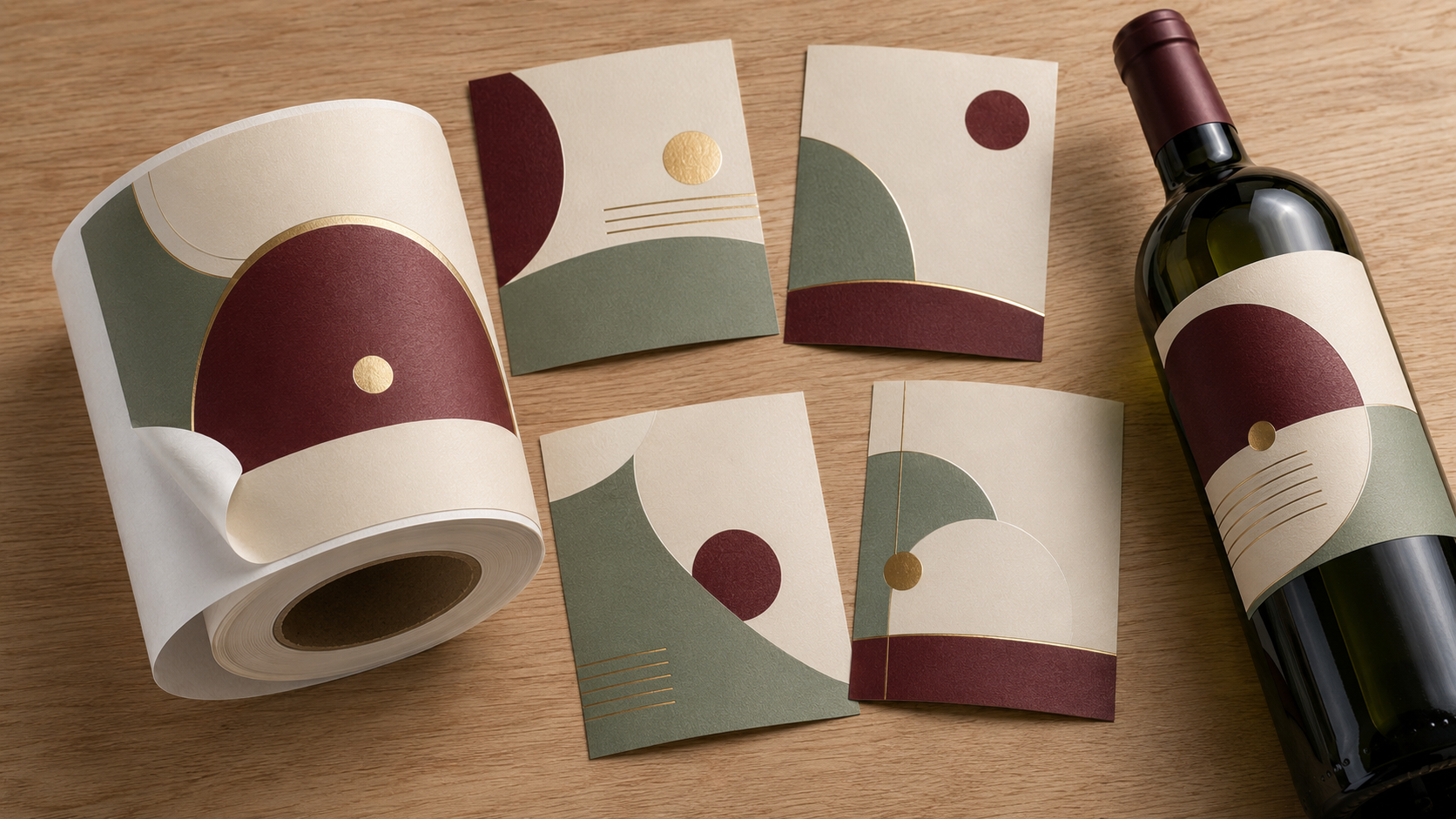
The Complete Guide to Wine Label Printing in Australia
Wine label printing is one of the steadiest categories of trade label work in Australia. Wineries cycle through new releases, vintage changes, single-vineyard editions, varietal launches, and seasonal label refreshes — and for the sign shops, designers and trade resellers fulfilling those orders, wine label work is high-frequency, design-driven, and well-suited to digital roll printing economics. The trade customers who handle wine label work well build healthy long-term relationships with their winery clients across many bottling cycles.
This guide is written for trade customers: sign shops, design studios, and resellers who fulfil wine label orders for winery clients. The aim is to give you the technical, material, and operational knowledge to advise winery clients well, head off common artwork problems before they reach our prepress queue, and quote wine label work with confidence. Where useful, the article flags what to push back on with your clients, so the file that lands with us is print-ready first time.
For Mediapoint's broader best-practice content across signage and print categories, see the rest of the Best Practice content — this article is the focused companion piece on wine labels.
Important: this article is general guidance for trade customers based on Mediapoint's product specifications and general industry experience. Wine label compliance in Australia is regulated under Food Standards Australia New Zealand (FSANZ) standards which change periodically. The compliance information in this article reflects current general guidance as of publishing date; specific compliance decisions for any wine label should be confirmed with FSANZ, Wine Australia, or qualified regulatory advisors. Mediapoint prints what is supplied. The customer is responsible for ensuring artwork meets compliance requirements for the intended market.
Why roll-fed digital is the standard for Australian wine labels
Roll-fed digital print became the default for Australian wine label work for four reasons that still hold today. Trade customers quoting wine work should know all four, because each comes up in client conversations.
Cost per run at small-to-mid scale
Most Australian wineries are small. A boutique winery producing 2,000 to 15,000 bottles per release needs label runs in the low thousands, not millions. Digital roll printing matches that economic envelope cleanly. Flexo or offset printing requires larger runs to amortise plate costs, which prices out the small craft producer that makes up the bulk of the Australian wine industry by number of releases.
Fast turnaround for short-cycle product changes
Vintages change, single-vineyard releases need unique labels, special editions get launched on short notice. Digital print handles this without the setup penalty of plate-based methods. For trade customers fulfilling wine label work for clients on tight bottling schedules, the turnaround flexibility matters.
Material flexibility within the trade-printer workflow
A winery's range often spans paper for table wines, BOPP for premium positioning, and metallic substrates for special releases. Digital roll printing handles material switching cleanly between jobs, which means a trade customer running multiple wine labels for a single client doesn't have to coordinate across different production methods.
Single-design workflow keeps trade pricing competitive
Mediapoint runs single-design digital roll printing — each unique label is its own production job. This is the trade-off that keeps per-label costs competitive: by scoping the workflow to single-design runs, the production process stays efficient and pricing stays affordable for the high-volume single-design jobs that make up most wine label work. For winery clients needing variable data, mixed-vintage runs on a single roll, or alternating front/back designs on the same job, specialist label printers with that specific capability are the right route — typically at meaningfully higher per-label cost. Worth knowing this constraint upfront so you can scope client conversations correctly.
What Mediapoint does and doesn't offer for wine labels
Quick reality check on Mediapoint's scope for wine label work. Trade customers handling wine clients should know this clearly to scope client conversations correctly.
What Mediapoint offers:
- Digital roll printing on paper, white BOPP, clear BOPP, and silver BOPP substrates
- White ink layer on clear and silver BOPP for opaque colour rendering
- Single-design production runs with fast trade turnaround
- Roll formats compatible with standard wine bottle applicators (76mm core standard, 312mm wide-core variant available)
- Trade pricing for resellers and design studios running regular wine label volume
- Order minimum of $120 + GST per job (dollar-based, not quantity-based)
What Mediapoint doesn't offer:
- Foil stamping (gold, silver, or coloured foil)
- Embossing or debossing
- Spot UV or selective varnish finishes
- Textured or specialty premium paper stocks (e.g. felt-marked, ribbed, laid paper)
- Variable data printing
- Mixed-design runs (alternating fronts and backs, or multiple varietals on a single production roll)
For wine label work requiring foil, embossing, spot UV, textured premium paper, or any other embellishments — common at the reserve and high-end specialty positioning — your winery client will need a specialist wine label printer with embellishment capability. Mediapoint isn't the right route for that work. For digital print on the four substrates above with clean trade pricing, Mediapoint is the trade partner. Worth flagging this with winery clients early in the brief so the right scope is set from the start.
Standard sizes for Australian wine labels
Wine label sizing isn't standardised in the same way some other label categories are. Bottle shape drives label dimensions, and Australian wine uses a range of bottle styles. Trade customers should always confirm bottle dimensions with the winery client (or the contract bottler) before locking artwork — designing the label first and discovering it doesn't fit the bottle is the single most common preventable error in wine label trade work.
Bordeaux bottles (most common for Australian red and white wine)
The dominant bottle shape across Australian wine. Front label dimensions typically range 90-100mm wide × 80-110mm tall. Back label dimensions typically 90-100mm wide × 50-90mm tall. The label area on the bottle is usually recessed, so the bottle supplier's specification sheet defines the actual usable area.
Burgundy bottles (common for Chardonnay, Pinot Noir)
Slightly taller and narrower than Bordeaux. Front label dimensions typically 80-95mm wide × 80-100mm tall. Back label proportions similar to Bordeaux. Pinot Noir releases in particular often use Burgundy bottles, and the slightly different label proportions catch trade customers off guard if they assume Bordeaux-style sizing.
Hock/Riesling bottles
Taller and narrower than both Bordeaux and Burgundy. Front label dimensions typically 65-85mm wide × 100-130mm tall. Riesling and Gewürztraminer releases use this shape. The narrower width affects design — text-heavy labels can feel cramped if not designed specifically for this bottle.
Sparkling and Champagne bottles
Wider and often used with curved-edge labels following the bottle's shoulder. Front label dimensions typically 90-120mm wide × 80-110mm tall. Frequently paired with neck labels at 30-50mm wide × 60-90mm tall. Curved edges on the front label require a custom dieline, which adds artwork setup complexity.
Practical advice for trade customers: confirm bottle supplier specifications with the client before locking dimensions. Major bottle suppliers (Saverglass, Vetropack, O-I, Vidrala, and others servicing the Australian wine industry) publish label area specifications that designers should work to. The 30-second pre-flight check that prevents most sizing problems: get the bottle supplier's spec sheet, confirm the recessed label area dimensions, design within those constraints with appropriate clearance for the bottle's shoulder and base curves.
Mediapoint's roll labels run on standard 76mm cores. For winery clients using small-bottler applicators that specify the 312mm-wide-core format, that variant is available. Confirm with the contract bottler what core size and roll diameter their applicator handles before ordering.
For broader sizing reference across roll label production, see our custom roll label sizing guide (coming next in the cluster).
Wine label materials at Mediapoint
The four substrates Mediapoint offers for wine label work. Trade customers should match material to brand positioning, application, and how the wine will be stored or served.
Paper labels (standard, non-textured)
Suitable for table wines, mid-market positioning, and brands with a more informal or rustic tone. Smooth print surface with good colour reproduction. Lower cost than synthetic substrates, which matters for high-volume table wine jobs.
Trade-off: paper is less moisture-resistant than synthetic stocks. Wine bottles condensate in fridges and ice buckets, and paper labels can curl, lift, or stain when exposed to sustained moisture. Best for: bottles not typically chilled (red wines, room-temperature storage, cellared wines).
Worth flagging: Mediapoint doesn't carry dedicated textured or premium wine paper stocks (felt-marked, ribbed, laid paper). For winery clients wanting a specifically textured or premium paper for reserve releases, that's specialist label printer territory.
BOPP white (the mid-market workhorse)
The dominant substrate for Australian table and mid-market wine label work. Excellent moisture and abrasion resistance — survives ice buckets, fridge condensation, and humid cellar storage without degrading. Bright white print surface produces vibrant colour reproduction and clean brand colours.
Trade-off: BOPP is a synthetic substrate, which doesn't communicate the same craft positioning as paper for some brand identities. Best for: white wines, sparkling, rosé, anything chilled, and brands where reliable print quality across the bottle's life matters more than substrate "feel."
This is the substrate trade customers will quote most often for wine label work. The combination of cost, durability, and print quality makes it the workhorse for the small-to-mid winery segment.
BOPP clear ("no label look")
For brand identities where the bottle glass colour is part of the design — green Bordeaux bottles showing through to read the wine within, or clear sparkling bottles showing the wine's colour against backlit display. Mediapoint prints white ink as a base layer underneath colour artwork on clear BOPP, which keeps opaque elements (text, logos, illustrations) readable against the bottle background.
Trade-off: clear BOPP is limited to designs that work with see-through backgrounds. Designs needing solid coloured backgrounds (where the bottle glass colour would interfere) aren't suitable for clear substrate. The designer needs to plan for the bottle showing through during the artwork stage, not after print.
Best for: clear-bottle sparkling, white wines in clear or pale green glass, premium designs where the "floating" print aesthetic supports the brand identity.
BOPP silver (metallic)
For premium positioning, special editions, limited releases, anniversary releases, and brand identities that benefit from a reflective metallic substrate. Mediapoint prints white ink under colour artwork so colours don't get washed out by the metallic surface — without the white ink layer, printed colour on silver BOPP renders muted and grey-shifted.
Trade-off: cost premium over white BOPP. The reflective surface affects how colours render slightly compared to a white substrate, which matters for brand-colour-critical work. A sample order is genuinely worth the cost for premium silver BOPP runs.
Best for: limited editions, sparkling premium releases, special anniversary wines, brand identities specifically built around metallic positioning.
Honest framing on materials: Mediapoint covers the four substrates above competitively. For winery clients wanting foil stamping, embossing, spot UV, or specialty textured paper stocks — common in the reserve and ultra-premium tier — those go to specialist wine label printers. Trade customers servicing winery clients should set this scope expectation early. The "Mediapoint plus specialist for the hero release" model works well for trade customers managing winery clients with mixed-tier product ranges: digital roll work for the regular range, specialist printer for the reserve and special editions.
For deeper material analysis including adhesive options and substrate-by-application matching, see our wine label materials and finishes guide (coming next in the cluster).
Wine label compliance basics
This is the section most likely to save a winery client from a compliance failure that requires a full reprint. Trade customers don't write the compliance content, but you're often the last set of eyes on a wine label artwork file before it goes to press. Knowing what should be on the label, and what an obviously wrong version looks like, can save your client an expensive mistake.
Important compliance disclaimer: wine label compliance in Australia is regulated by FSANZ standards which change periodically. The information in this section reflects current general guidance and is not a substitute for specific regulatory advice. For specific compliance decisions on any wine label, winery clients should consult FSANZ (foodstandards.gov.au), Wine Australia, or qualified regulatory advisors. Mediapoint prints what is supplied; the customer is responsible for ensuring artwork meets compliance requirements for the intended market.
What must appear on an Australian wine label
The mandatory elements for wine labels sold in Australia under current FSANZ standards include:
- Country of origin
- Producer or bottler name and street address
- Volume statement (in mL, e.g. 750mL)
- Alcohol content as percentage by volume (% v/v)
- Standard drinks declaration (calculated from alcohol percentage and volume)
- Best before or vintage date for sparkling wine
- Allergen declarations where applicable (sulphites are nearly always present in wine; milk products or egg products if used in fining)
- Pregnancy warning label per mandatory standard
- For export markets: additional Geographic Indication (GI) compliance requirements
Pregnancy warning specifics
Since 1 August 2023, Australian wine labels must carry the mandatory pregnancy warning label. The standard specifies a pictogram and text format, including specific colour and size requirements. Red text on white background or a red pictogram with prescribed sizing. This is the single most common compliance issue Mediapoint's prepress team sees on incoming wine label artwork: missing pregnancy warning, incorrectly coloured pregnancy warning, or pregnancy warning at insufficient size.
For trade customers receiving artwork from clients (or their freelance designers), this is the first compliance check. If the pregnancy warning isn't there, isn't red, or is buried in tiny text, raise it before the file enters prepress. The two-minute conversation up front is much cheaper than the alternative.
Allergen declarations
Sulphites are present in almost all wine and must be declared. Standard format is "Contains sulphites" or equivalent FSANZ-compliant wording, typically placed near the ingredients or volume statement. Milk and egg products are used as fining agents in some winemaking processes; if so, they must be declared as allergens. Winery clients should know whether their winemaking process uses milk or egg fining — if you're unsure when receiving the artwork, ask.
Standard drinks declaration
Mandatory on all Australian wine labels. Calculated from alcohol percentage and bottle volume. Wineries typically have software or templates that handle this calculation — trade customers don't need to calculate it, but should verify the standard drinks number appears on the artwork.
Geographic Indications (GI) for export
If the wine is being labelled for export to markets that recognise Australian GIs (most of the EU, UK, USA, and others), additional GI compliance applies — particularly around naming wines after specific Australian regions. Wineries exporting should consult Wine Australia for GI compliance specific to their target markets.
Mediapoint's role and yours: Mediapoint prints what is supplied. The winery client is legally responsible for ensuring the artwork is compliant with FSANZ standards and any export-market-specific requirements. As the trade customer in the middle, you're not the compliance authority either — but you're well-placed to flag obvious issues before the file enters prepress. Missing pregnancy warning, illegible volume statement, or absent allergen declarations should all get raised with the client before submission.
For a deeper walkthrough of Australian wine label compliance specifically for trade customers fulfilling winery work, see our wine label compliance and regulations guide (coming next in the cluster).
File setup essentials for wine labels
The artwork file setup essentials for wine label work. This section gives trade customers what they need to brief their designer or check incoming client artwork. For the full file setup walkthrough, see our custom roll label file setup guide (coming next in the cluster).
PDF only, sized at 100%, 3mm bleed on all four sides. For back labels and any artwork where critical compliance text sits near the trim edge, 5mm bleed is safer because trim drift is more visible on smaller back labels.
CMYK colour space throughout. RGB files will be converted at prepress, and the conversion never matches what you saw on screen. For brand-colour-critical work, soft-proof the CMYK build before sending — wine label brand colours often involve specific reds, golds, and creams that shift noticeably in conversion.
Pantone spot colours for brand-critical work. Specify Pantone C references for winery brand colours and Mediapoint's profile produces the closest CMYK match available on each substrate. The match is consistent from job to job, but it's not perfect — different substrates render colours slightly differently. For winery clients with strict brand colour requirements, a sample order is genuinely worth the cost.
Fonts converted to outlines before export. Standard Mediapoint requirement, prevents font substitution at the RIP. Keep an editable master file with live text for future revisions.
Dieline specification for non-rectangular labels. Wine labels often use rounded corners, curved tops, custom outlines following the bottle's shoulder, or distinctive shapes. The dieline must be supplied as a separate vector spot colour layer named exactly "Thru-cut" (matching Mediapoint's convention for all rigid signage and labels cut work). One Thru-cut per file, closed shape, centre-aligned stroke.
White ink specification for clear and silver BOPP. This is the most-missed file setup requirement for premium wine label work. On clear and silver BOPP substrates, white ink prints as a base layer underneath colour artwork to keep colours opaque and readable. Files supplied without white ink instruction default to no white layer — which produces washed-out colour that disappoints winery clients. Specify white ink coverage areas explicitly in the artwork file using a spot colour layer named "White" (or similar — confirm with Mediapoint prepress what spot colour name to use for white ink jobs).
Resolution: 300dpi at 100% size for all raster content. Wine labels are read close-up by buyers picking bottles off shelves — resolution that's slightly soft on a billboard is unmistakably soft on a wine label. Photographers' high-resolution source files are essential for any label featuring property photography, food imagery, or other photographic content.
Filename convention. Include the finished size and quantity: "90mm x 100mm qty 500.pdf" or similar. For multi-SKU winery clients, include the wine name or SKU identifier in the filename to prevent the wrong version going to press.
Common artwork problems on wine label submissions
The file-level problems Mediapoint's prepress team sees most often on wine label work. For trade customers receiving artwork from winery clients or their designers, this is the catch-list.
Pregnancy warning missing, wrong colour, or undersized
Consequence: legally non-compliant label that requires reprint at the winery's expense. Watch for: pregnancy warning absent entirely, pregnancy warning in colours other than the prescribed red, pregnancy warning at illegibly small size. The fix is to flag with the client immediately and request a revised artwork file before submission.
RGB images sent without CMYK conversion
Consequence: shifted brand colours, particularly reds, golds, and cream tones common in wine label work. Watch for: photography or graphics files exported direct from Lightroom or RGB-based design workflow without colour-space conversion. The fix is a CMYK conversion with appropriate ICC profile and soft proof before approving the file.
White ink layer missing on clear or silver BOPP files
Consequence: washed-out colour on the printed substrate, dramatic disappointment from the winery client when the labels arrive. Watch for: clear or silver BOPP artwork supplied without a white ink spot colour layer. The fix is to request a revised file with white ink coverage specified for all opaque colour areas.
Critical compliance text positioned too close to trim edge
Consequence: trim drift cuts off pregnancy warning, allergen declaration, or volume statement. Watch for: compliance text running within 3mm of the cut line. The fix is to confirm the safe zone is 5mm inside trim on small labels, and reposition critical text inwards if it's encroaching on the trim.
Brand colours specified as Pantone Uncoated when label runs on coated substrate (BOPP)
Consequence: brand colours render differently than the winery client expects. Watch for: Pantone references specifying Uncoated builds when the label substrate is BOPP (which is coated). The fix is to specify Pantone Coated references for BOPP work, or confirm with prepress which Pantone library to use.
Dieline absent or drawn as a regular line instead of spot colour layer
Consequence: order delay while artwork is returned for revision. Watch for: custom-shaped wine labels supplied with the cut line drawn as a regular black line in the artwork rather than as a spot colour layer named "Thru-cut". The fix is to redraw the cut line as a centre-aligned, closed-path spot colour stroke on its own layer.
Bleed missing on premium artwork
Consequence: white slivers on trim edges, especially noticeable on premium wine labels where the artwork extends to the edge. Watch for: artwork built to exact trim dimensions with no 3mm extension. The fix is to extend background colour and imagery 3mm beyond trim on all four sides, with critical content held at least 5mm inside the trim edge.
Production turnaround and ordering wine labels through Mediapoint
The trade workflow essentials for wine label work. If you're running a Mediapoint trade account already, this is familiar territory. If you're considering setting one up for wine label volume, here's how the process runs.
Files are submitted as PDF, sized at 100%, with 3mm bleed (5mm for back labels with close trim tolerances), in CMYK colour space, fonts outlined. Filename includes the finished size and quantity. For multi-SKU winery clients, include the wine name or SKU identifier in the filename. The dieline (for non-rectangular labels) must be supplied as a spot colour layer named exactly "Thru-cut".
Turnaround starts from the next business day after file approval, for files received before the daily cut-off. Trade pricing is available for design studios, sign shops, and resellers running regular wine label volume.
The Mediapoint order minimum: $120 + GST per job. This is a dollar-based minimum, not a quantity-based minimum. The practical implication is that small winery runs — a couple of hundred labels for a small craft release — fit comfortably within the minimum without forcing the client to over-order stock they don't need. For typical wine label sizes on white BOPP, $120 + GST translates to a few hundred labels (the exact quantity varies with size, substrate, and complexity). This is genuinely useful framing for winery clients used to quantity-based minimums from other printers — they can order what they actually need for the release without padding.
Each unique label is a separate job. Mediapoint's workflow doesn't support variable data or mixed-design runs on a single production roll. If a winery client has four varietals to label, that's four separate jobs. Multiple jobs can be combined within a single order for shipping and pricing efficiency, but each design runs separately at the press. Trade customers should scope client conversations to reflect this — winery clients used to flexo workflows may have been getting variable data and might not know to ask. Better to set the expectation early.
Sample orders for premium work. For winery clients running their first label with Mediapoint, or for premium silver BOPP and brand-colour-critical work, sample orders are genuinely worth the cost. A small sample run confirms colour fidelity, substrate feel, and print quality before committing to a full production run. The cost of a sample is much smaller than the cost of a 5,000-label reprint with off-brand colour.
Practical advice on lead time. Align label production with the winery client's bottling schedule, not the finish date. Most contract bottlers and winery in-house lines need labels on hand 5 to 7 business days before the bottling date to account for QC, set-up, and any reprint contingencies. Building this buffer into your client workflow protects both you and the client from rushed reprints.
Frequently asked questions
What's the minimum order for wine labels?
$120 + GST per job. The minimum is dollar-based, not quantity-based, which means small winery clients can order exactly what they need for a small release without padding to hit a quantity threshold. For typical wine label sizes on standard substrates, $120 + GST covers a few hundred labels.
Can I run multiple wine label designs in a single production run?
No. Mediapoint runs single-design jobs — each unique label is its own production run. Multiple designs can be combined within one order for shipping and pricing efficiency, but each design prints separately at the press. For winery clients with four varietals, that's four jobs, not one. Worth setting this expectation with clients early in the brief.
What if my client needs foil stamping, embossing, or other specialty finishes?
Mediapoint doesn't offer foil stamping, embossing, spot UV, or specialty embellishments. For wine label work requiring those finishes — common at the reserve and ultra-premium tier — your winery client will need a specialist wine label printer with embellishment capability. The "Mediapoint for the regular range, specialist for the hero release" model works well for trade customers managing winery clients with mixed-tier product ranges.
What if the label needs to survive ice buckets and condensation?
Specify BOPP material (white, clear, or silver). BOPP is moisture-resistant and abrasion-resistant — labels survive fridge condensation, ice bucket exposure, and humid cellar storage without curling, lifting, or staining. Paper labels are not suitable for sustained moisture exposure and should be specified only for bottles stored at room temperature.
How do I match my winery client's brand colours across multiple SKUs?
Specify Pantone C spot colours in the artwork. Mediapoint's profile produces the closest CMYK match available on each substrate, consistent from job to job. The match isn't perfect — different substrates render slightly differently — and for brand-colour-critical work, request a sample order before the first production run. Confirm the CMYK build with the winery's marketing team or designer before committing to large runs.
Can my winery client get a printed sample before committing to a full production run?
Yes. Sample orders are available and genuinely worth the cost for premium silver BOPP work, brand-colour-critical jobs, or any winery client running their first label with Mediapoint. A sample confirms colour fidelity, substrate feel, and print quality before committing to a few thousand labels.
Key takeaways
The points worth remembering when advising winery clients or quoting your next wine label job.
Roll-fed digital print is the workhorse for Australian wine label work because of cost, turnaround, and material flexibility. Mediapoint's single-design workflow keeps trade pricing competitive at the small-to-mid winery scale.
Mediapoint offers paper, white BOPP, clear BOPP, and silver BOPP. For foil, embossing, spot UV, or textured premium paper stocks, winery clients need a specialist label printer.
Bottle shape drives label sizing — Bordeaux dominates Australian wine, but Burgundy, Hock/Riesling, and sparkling bottles each have different dimensions. Confirm bottle supplier specifications before locking artwork.
Australian wine label compliance is governed by FSANZ. Mandatory elements include the pregnancy warning, allergen declarations, alcohol content, volume, standard drinks, and country of origin. The pregnancy warning is the single most common compliance failure on incoming artwork.
White ink specification is required for clear and silver BOPP work. Files without explicit white ink coverage default to washed-out colour.
Each unique label is a separate production job. No variable data, no mixed-design runs on a single roll.
The Mediapoint order minimum is $120 + GST per job — dollar-based rather than quantity-based, suiting small craft winery releases.
Sample orders for premium silver BOPP work and brand-colour-critical runs are worth the cost. Reprint costs on full production runs dramatically exceed sample costs.
Working with Mediapoint on wine labels
Mediapoint prints wine labels in digital roll format for design studios, sign shops, and trade resellers servicing Australian winery clients. Standard turnaround starts from the next business day for files received and approved before the daily cut-off. Order minimum is $120 + GST per job. Trade pricing is available for design studios and resellers with regular wine label volume.
View our roll labels product page for current sizing options, material variants, and ordering. For winery clients with mixed-tier product ranges where the regular range fits Mediapoint's digital workflow but the reserve releases need specialist embellishment work, the routing conversation is worth having upfront.
A final note on compliance responsibility: Australian wine label compliance under FSANZ standards is the customer's responsibility, not the printer's. The information in this article is general reference based on Mediapoint's experience as a trade printer — it is not legal or regulatory advice. For specific compliance questions on any wine label, consult FSANZ, Wine Australia, or a qualified regulatory advisor before approving artwork for production.