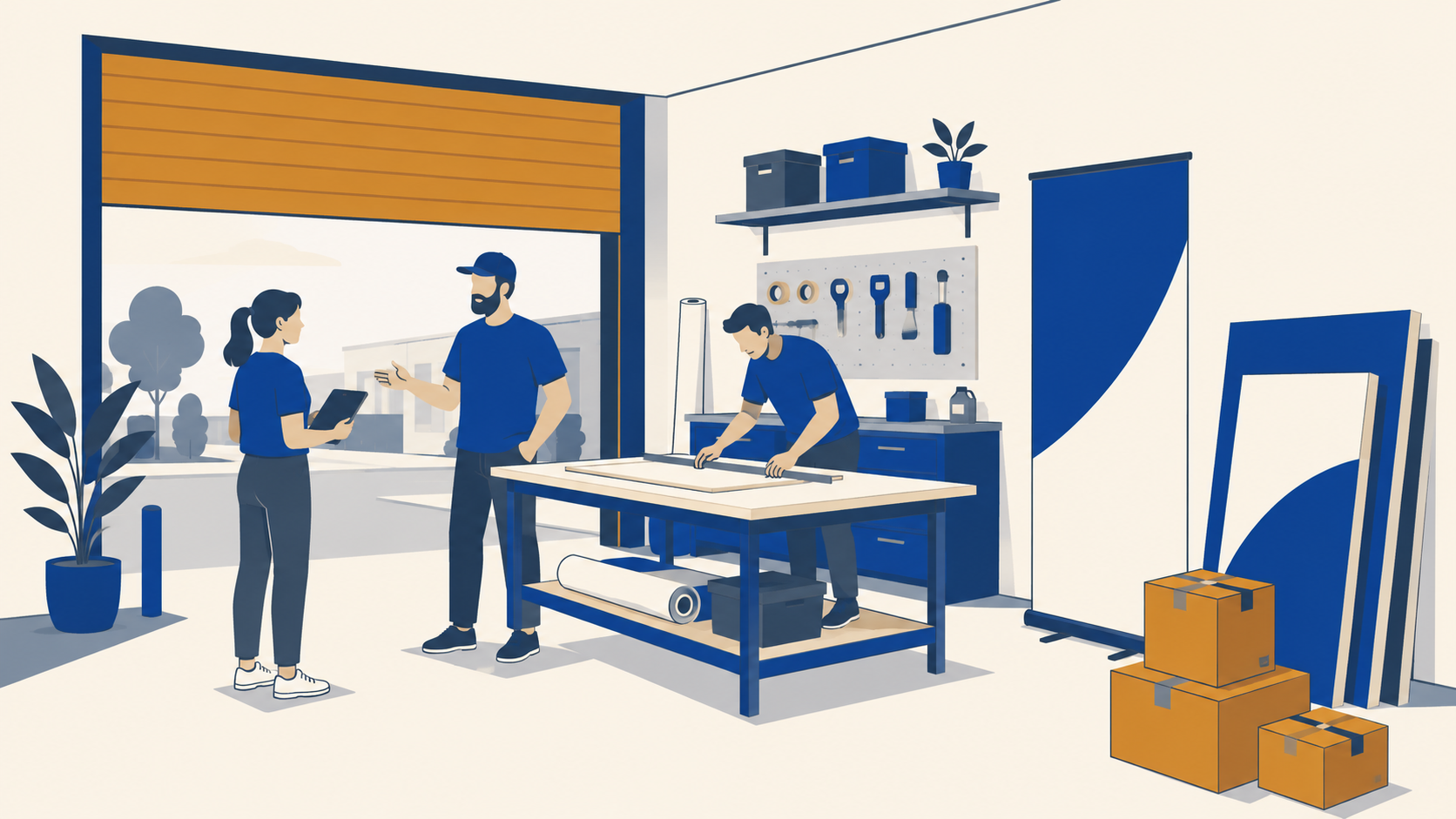
Hiring is hard in the sign trade. There's no degree in sign making, the pool of experienced people is small, and the good ones are usually already employed. One of the biggest decisions that shapes who you hire is what you keep in-house. If a trade printer runs the press, your team is built around sales, design, project management and install, and those roles are easier to hire and faster to train. This guide covers how to build that team: where to find people, how to train them, and the systems that make each hire pay off.
Decide what your team actually does
Before writing a job ad, decide which work stays in-house. A shop that prints its own corflute, banners and labels needs machine operators, maintenance know-how and enough volume to keep them busy. A shop that outsources standard print needs people who can:
- Sell and scope: understand the brief and choose the right product.
- Design and prepare artwork that prints right first time.
- Manage the job: order from the trade printer, track production dates and handle the client.
- Install safely and well.
- Quality-check deliveries before they reach the client.
Those skills are more transferable than running a specific machine, and nobody sits idle when the press would have been quiet.
Hire from outside the industry
Many shops prefer people with no sign experience: no bad habits, and no assumption that your shop runs like their last one. Designers, project coordinators, tradespeople and customer-service people from adjacent industries pick it up fast, provided you have documented processes to train them against. Product knowledge can be taught; reliability and attitude can't.
Build your own pipeline
Don't wait for trained sign people to apply. Create them:
- TAFE placements: design, fabrication and construction programs often need host employers. Get on their placement registers.
- School VET programs: Certificate II and III students in design or construction.
- University design courses: final-year students looking for industry placements.
Pay your interns, give them real work alongside a designer or project manager, and treat it as a recruiting funnel. One or two strong hires a year is a good result.
Shadow before solo
For the first couple of weeks, a new starter works alongside someone experienced: a new project manager next to the current one, a new installer riding with a senior installer. It costs some output, but far less than rework on a paying client's job in week three. If you're a one-person shop hiring your first employee, block the time and accept that your output dips for a fortnight.
Train on the skills that make money
When the print is outsourced, training shifts from running a machine to getting jobs right. Priorities for a new hire:
- Product knowledge: which board, banner stock or label material suits which job. Our rigid board guide, PVC banner guide and roll label materials guide are written for exactly this.
- Artwork setup: bleed, safe areas, cut lines and white ink, so files don't bounce back. Start with the common print file mistakes.
- Ordering and scheduling: placing jobs, reading production dates and planning installs around them.
- Delivery QC: checking quantity, size, finish and colour before anything goes to the client.
- Site safety: working at heights, EWP tickets and electrical work where relevant.
Use your suppliers. Material and equipment reps run demos and product sessions, and trade printers can explain specs and file requirements. Industry bodies like the Australian Sign and Graphics Association run safety courses and training that a small shop can't run itself.
Write the procedures before you hire
The biggest lever in training isn't the training itself; it's the documentation behind it. For every role you currently cover yourself, write down:
- What the role is responsible for.
- The tasks involved: daily, weekly and per job.
- How each task is done: the steps, templates, suppliers and files.
A new project manager with written procedures is productive in a couple of weeks. Without them, they're asking you questions for months. A good test: could someone keep the shop running for a week using only your procedures folder?
Frequently asked questions
Where do I find staff if nobody has sign experience?
Build a pipeline through TAFE placements, school VET programs and university design courses, and hire capable people from adjacent trades.
Should I pay interns?
Yes. Outside formal coursework placements, unpaid internships carry Fair Work risk and send the wrong message.
How long should a new hire shadow someone?
About two weeks is a sensible baseline before solo work on client jobs.
How does outsourcing print change who I hire?
You hire for sales, design, project management and install instead of machine operation. Those skills are easier to find, faster to train and more transferable.
Is industry association membership worth it?
Usually, if you use it. Safety tickets, courses and supplier rates often cover the fee.
Key takeaways
- Decide what stays in-house before you hire. Outsourcing print shapes a leaner, more flexible team.
- Hire for attitude from adjacent trades and train against written procedures.
- Build your own pipeline: paid interns from TAFE, schools and universities.
- Shadow for two weeks before solo work.
- Train on product knowledge, artwork, ordering, QC and safety.
Let us run the press
Mediapoint prints corflute, banners, pull-ups, labels and rigid boards for sign shops across Australia, trade only and blind shipped, with live trade pricing and real production dates in our portal. Your team focuses on the client and the install. Register for a trade account, and see sign shop sales for the other half of growing the business.